
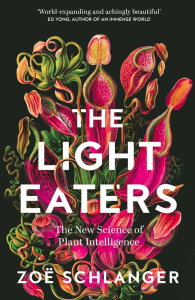
“DOES THIS LOOK INANIMATE TO YOU, PUNK?!”
Since at least the time of Aristotle, the western mind has regarded plants as passive background scenery; useful to eat, nice for decor, but not all that interesting. Think of how we use the word ‘vegetable’ to refer to someone who’s brain-dead: plants are rooted, boring, unexciting. Zoë Schlanger’s The Light Eaters blows that conceit entirely out of the water, taking as its subject plant intelligence and demonstrating how wonderfully and weirdly responsive plants are to their environment. This is one of those “Holy cow!” kind of the books, one that makes the apparently mundane wondrous.
Schlanger’s previous science journalism dwelt on climate change and natural disasters, and after becoming dispirited she turned to plants, discovering in botany journeys that a new and exciting world was unfolding before her eyes, rather like the petals of a rose. Plants are far from ‘passive’; with patient study, they prove to be extremely responsive to their environment. The fact that plants are rooted in places makes responding to the world around them all the more important, and that response is not an individual effort but a collaborative one. We already knew that trees and mushrooms are entangled together in ‘mycelilal network’ that allows for the transfer of nutrients from one tree to another, but plant communication is more common than that: here we encounter a tree being preyed upon not only pushing tannins to its leaves to make them increasingly bitter to the caterpillars, but other trees in the area had gotten the message and begun weaponizing their leaves as well. Even more interestingly, there are indications that plants can ‘hear’, or at least parse vibrations: one plant studied here would produce toxins when sounds were played that mimicked the vibrations caused by a bug chewing on its leaves, but not otherwise. (Flowers, in addition to being advertisements for pollinators, may also help with catching and amplifying vibrations.) There are also hints that sight or optics have some place in the life of plants, though the means are not quite understood. One climbing vine will ape the plant it’s climbing on — including mimicking areas where the plant is beginning to wilt!
A steady refrain in The Light Eaters is the interconnectedness of plants and their environment — their relationships with not only the soil around them, but with other plants — especially those they’re kin to. Schlanger suggests that some species border on the edge of being eusocial, not only sharing resources but orienting their parts to allow other plants better access water and light. There are relationships between species, too, like flowering plants which do better when near one another, their color combinations attracting far more pollinators than they would in a more homogenous stand. (I suppose a human equivalent would be a coffee shop next to a bookstore!) This interconnectedness is then applied to life in general: termites are incapable of digesting wood without gut bacteria, and in another example one species of flower depended on the same moths for pollination that were responsible for preying on it during their caterpillar phase. Schlanger suggests that humans rethink our own relationship with the world around and within us.
This was a fascinating read: I can’t imagine it being stopped in science this year, though I know it’s early days yet. I will admit to being a bit “plant blind“, but this book’s survey of plant responsiveness has me looking at botany books on goodreads. Definitely recommended if you want to open your eyes to the richness of the green world around us!
Highlights:
Nature is not a puzzle waiting to be put together, or a codex waiting to be deciphered. Nature is chaos in motion.
Nature, never a flat plane, has always more folds and faces still hidden from human view. The world is a prism, not a window. Wherever we look, we find new refractions.
As we have seen, some plants will pump out bitter tannins in a bid to taste disgusting. Others will manufacture their own insect repellant, which in many cases is the bit of the plant humans most enjoy—it’s the rich oregano oil in oregano, the sharp spice in a horseradish root. Sometimes the approach is more sinister. One devilish case has been found in the humble tomato: the tomato plant will inject something into its leaves that makes the caterpillars look up from their chewing and turn to eye their fellow caterpillars. Soon, the leaf becomes irrelevant. The caterpillars begin to eat each other.
After all, in Appel’s work, a sound cue caused the plant to make its own pesticide. If plants could be made to produce pesticides through simply playing sounds to them, it could reduce or eliminate the need for synthetic pesticides on farms, and in some cases increase the levels of compounds that the crop in question is grown for. In a crop like mustard, for example, the plants’ own pesticide is the very thing it is farmed for—mustard oil. Putting a lavender bush on high alert by playing the right sounds would cause it to make more of the defensive compounds we prize in lavender oil.
What the garlic needs, in order to sprout, is the memory of winter. That the spring eventually comes is not enough to make life emerge—a good long cold is crucial. This memory of winter is called “vernalization.” Apples and peach trees won’t flower or fruit without it. Tulips, crocuses, daffodils, and hyacinth, often the first blooms of spring, need a good strong vernalization too. If you live in a warm climate and buy tulip bulbs, the garden supply store clerk might wisely advise you to put your bulbs in the refrigerator for a few weeks before planting, or you’ll never see a flower.
As mentioned, Venus flytraps can count to five, and can store the memory of that counting at least as long as it takes to figure out if it has a fly in its maw or not. How it works is this: if two of the trigger hairs inside the flytrap’s trap are touched within twenty seconds of each other—a good indication that a living creature is moving around inside it—the trap snaps shut. But the flytrap keeps counting after it closes. If the trigger hairs are disturbed five times in quick succession—eliminating all doubt that it has caught a living, wriggling creature—the plant injects digestive juices into the trap, and the meat meal commences. Digestion takes many days, so it’s important to be sure. But if the trap is triggered twice, snaps shut, and the triggering stops, the trap will open again within one day. Clearly whatever is inside is too small to bother with, or not a living creature at all, but perhaps a bit of twig or stone—or, in the case of all the flytraps that have told us anything about their kind, the cold tip of a botanist’s probe. The flytrap corrects for its error.
In other words, parent plants can pass on skills for surviving in a tough world. In some cases this involves whole new body parts and coats of armor. For example, if yellow monkey flowers are exposed to predators, they will produce babies with a quiver of defensive spikes on their leaves.
In fact, genetic inheritance seems to explain only about 36 percent of the heritability of a person’s height, one of the physical traits that appears to be the most reliably related to the physical traits of your parents. Scientists call this perplexing phenomenon “missing heritability.” No one yet knows what fills the gap.
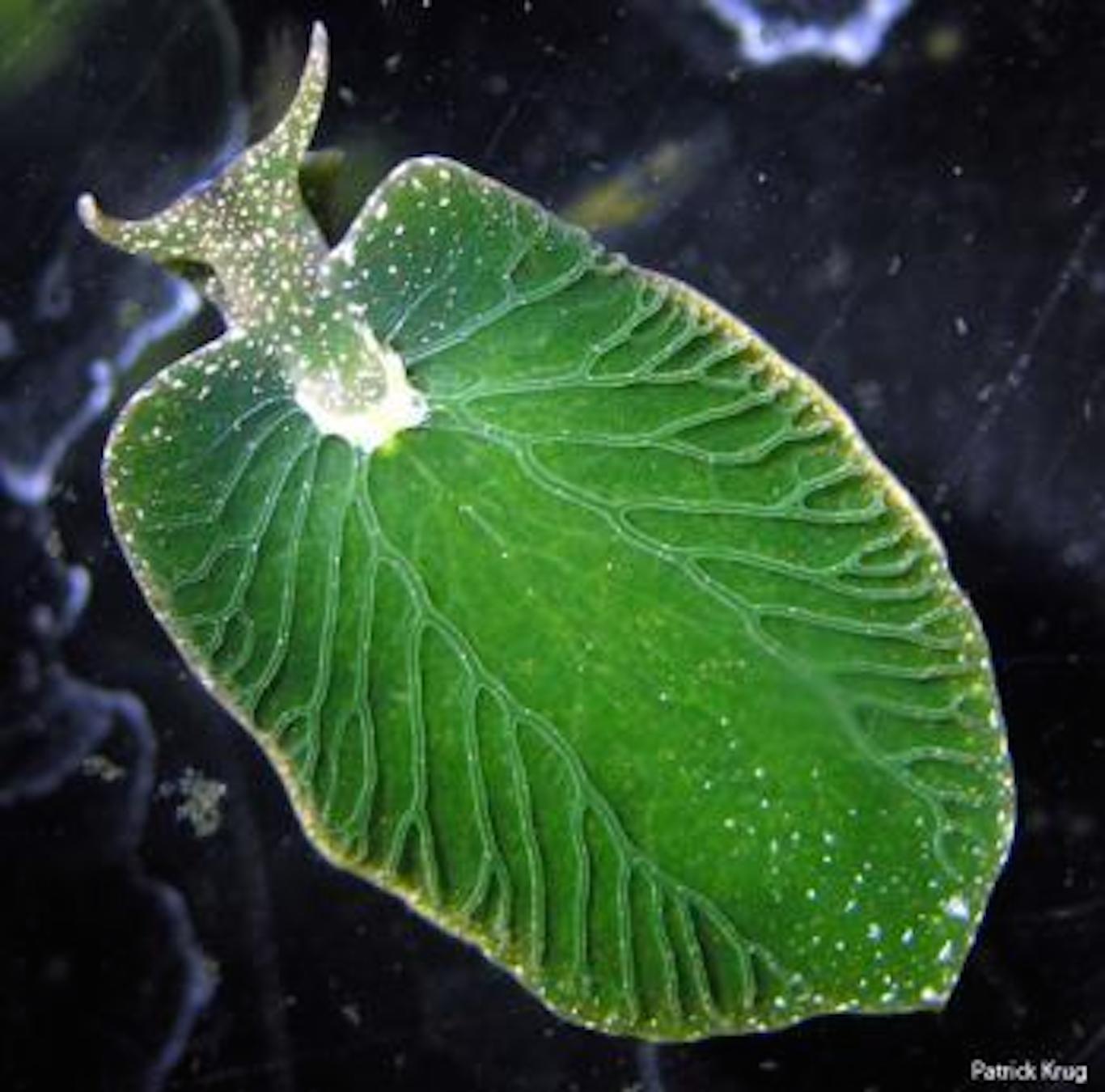
After a few algal bubble teas, the slug never needs to eat again. It begins to photosynthesize. It gets all the energy it needs from the sun, having somehow also acquired the genetic ability to run the chloroplasts, eating light, exactly like a plant. How this is possible is still unknown. Remarkably, the now-emerald-green slug is shaped exactly like a leaf, all but for its snail-like head. Its body is flat and broad and heart-shaped, and pointed at its tail end like a leaf tip. A web of leaflike veins branch across its surface. The slug orients its body in the same way a leaf does, angling its flat surface to maximize the sunlight that falls upon it.
The Italian philosopher Emanuele Coccia wrote that plants exist in a state of total “immersion.” Immersion is an action of “compenetration,” he wrote, a word that means pervasive, mutual interfusion.

 Reading Freely
Cool! Botany isn’t really my ‘thing’ but I do have a *passing* interest in plants (despite being a veggie for the last 25 years). This sounds like it might change my mind…
May read Pollan’s book on plant intelligence a little later. Next science read will be a collection of interviews with Carl Sagan — probably for the “Wildcard” category.
A have a few science related books coming up… But my next non-fiction read will be more Valentine’s related [grin]
I’ll take Ranch Dressing for $100 Alex….
A nice fruit vinaigrette can be even better!
Bzzzzt!
Wrong Answer contestant number 2. The correct question is “what goes great with chicken strips?”
Because obviously, I have to “Represent” for the non-veggie side of things here 😉
I prefer honey mustard, but to each his own!
Oh, THAT was the question to the $1000 double jeopardy question!