
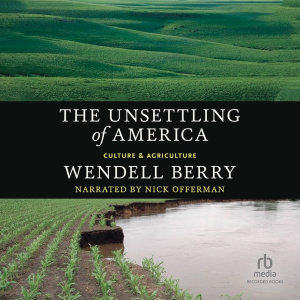
It was twelve years ago that I met a man named Jayber Crow, and met too, his author — Wendell Berry. Berry is one of my very favorite living authors, and would probably still make the list of favorite authors in general. For those who don’t know, Berry is first and foremost farmer and husband, hailing from Port Royal, Kentucky. Port Royal is loosely the basis of his Port William novels, which are both superb character dramas and all part of a longer story that is Port William’s decline as industrialism takes over agriculture, with both social and personal consequences. Those personal and social consequences are the subject of this treatise, which is a deeply thoughtful reflection on how industrialism has not only destroyed agriculture, but American culture in general. It’s a landmark work, and I was tickled to see that Audible offered it in their library, performed by Nick Offerman — whose steady, thoughtful tone was perfect for the subject.
Unsettling of America is a remarkable work, demonstrating in full Berry’s holistic or integrated worldview. It is a view in which all the aspects of human life are bound up together, inseparable, just as we are inseparable from the creation. We are engaged together in a ‘membership;, one of his favorite words. Change man’s relationship to the land, and the effects ripple into everything: personal meaning, relations between the sexes, etc. Berry opines industrialism is exploitative — a one-sided exchange in which humanity consumes that which it did not, and cannot create or nurture. (Compare this to agriculture, in which we have a relationship with the land and pay attention to and even nurture it so that it might in turn nurture us.) The essential rapaciousness, he continues, colors all that follows: the husbandman who becomes a common laborer is reduced to a cog in machine, performing the same rote action a thousand times a day. This is not only demeaning and unpleasant, but an absolute smothering of what we are capable of.The industrial system, when applied to farming, has a similarly desecrating and destructive role, both to the land and to those who are farming. Farmers who take loans out to buy new equipment often find themselves trapped in a circulating spiral of debt, and this is debt often imposed on them by food wholesalers like Tyson who demand they upgrade their machinery for their contracts to be renewed. Thus, even big operators can become, at the bottom of the balance-sheet, little better than tenant farmers. There is no stability, no harmony — only the desire for more growth, more consumption, bigger factories, vaster acreages — consumption by appetite.
Like a plowman drawing lines across rich earth, back and forth creating a pattern that will, in time and with care, produce food fit for eating, so too does Berry explore his general theme through multiple lines — history, economics, politics, etc. In addition to big picture reviews like the general theme of exploitation and abuse that industrialism engenders, he also looks at smaller topics like continuing experiments with horse-based agriculture, still practiced by the Amish and a few private practitioners who have recognized the toll that multi-ton machines take on the land, compacting the soil. But as much as Berry writes on the land — his love of land, of building and protecting it permeates this — the book is as mentioned holistic. Berry is critical of our obsession with convenience and ease, for instance, and argues that labor is part of what makes us whole: a more recent book, Shop Class as Soulcraft, has also argued for that, and its author has since written on the importance of staying grounded in the material world.
Unsettling was in turns insightful, inspiring, and disturbing — disturbing because of how far we have gone since this book was originally published, further and further away from an economy in which human needs could be squared with what the land can bear. No only have we become more rapacious in what we consume individually — see the ever growing number of self-storage enterprises popping up — but agriculture has continued being devoured by corporate-agribiz. The good news is that resistance has also grown, and today there are younger voices like Joel Salatin and Paul Kingsnorth continuing the line of argument Berry began.

 Reading Freely
The proliferation of self-storage typifies everything that is wrong with America today. I’ll leave it at that so I don’t get all ranty 😀
I understand!
*Completely* off topic, but….. You might find this rather interesting…
The Guns of the South : Checkmate, Alt-Hist Plausibility Sticklers
Guns of the South was my first Harry Turtledove! I saw a picture of Marsh Robert holding an AK47 in a used book store and couldn’t resist. (First alt-history was a YA Indiana Jones novel in which the Titanic is sunk by German saboteurs for….reasons.)
I remember it WELL and really enjoyed it. I think it must be Turtledoves best….. at least of the ones I’ve read.
As I recall the Confederates (in victory) found the SA’s too extreme and then the SAs began attacking them, as well?
Yes, indeed. The video mentions this and makes some interesting observations about it.
Pingback: January 2025 in Review | Reading Freely
It’s definitely the time to read this! Great review, thanks
Pingback: Against the Machine | Reading Freely