
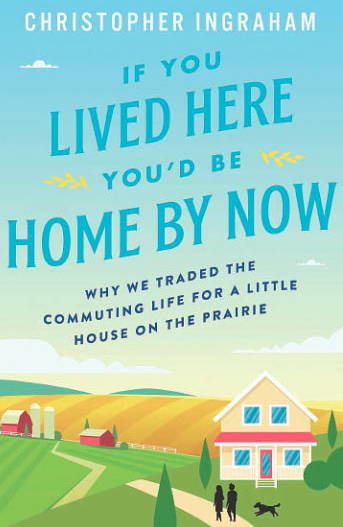
It was just another day at the office when Chris Ingraham wrote a piece about the prettiest and ugliest places to live in the United States and declared Red Lake Falls, Minnesota, as the worst. He received lots of angry tweets and the like afterwards, but it had been a one-off, so he expected nothing else. Then he received a letter cordially inviting him to visit Red Lake Falls. Figuring it would make for a fun follow-up story, Ingraham cleared it with his bosses at the Washington Post and sallied forth. He found the town of Red Lake Falls to be absolutely charming, and even friendly despite his casual abuse lobbied at them from the Post. Not long after, when Chris and his wife Briana were stressing over their ninety-minute commute and the cost of living on the East Coast, a wild suggestion floated up: why not move to Red Lake Falls? Chris’s work at the Post involved internet research and statistical analysis, not wandering the halls of power asking congresscritter’s aides for soundbytes: he could work from anywhere with an internet connection, after all. f You Lived Here is a memoir of the Ingrahams picking up and starting life over in a radically new spot, one that’s amusing on its own merits but also reflects on what people need and want out of life, and how sometimes flyover country can feed the soul more readily than high density metroplexes.
Ingraham readily admits from the start that the best parts of small town or rural living are those not capable of being witnessed through a tourist drive-by window. What he grew to appreciate most about living in Red Lake Falls was the stuff that took a while to observe: the way the landscape changed dramatically throughout the year, for instance, or intimacy he found in becoming part of of a tight-knit community — one in which there weren’t bureaucracies and institutions mediating everything. This was something he started becoming aware of almost immediately: alarmed by the lack of real estate listings, he talked to the man who invited him to visit the first time, and was immediately connected with all kinds of offers from people who were perfectly wiling to sell to an interested buyer, but didn’t see any point in having formal listings. The low cost of living was a key factor in moving, since the reporting job that wouldn’t have even paid rent on the East Coast was enough to cover a family of four — and then five — in the country. Ingraham reflects on the differences between the country and the commuter life, savoring the fact that he’s not losing three hours of his life every day staring at lights, time he can spend with his twin boys during their formative years. There’s something to be said, too, for the slower pace in general — even if he has to drive an hour to get to the nearest substantial hospital.
The most entertaining parts of this book are the fish-out-of-water scenes as Ingraham, long a beltway metroplex denizen, tries to accommodate himself to the local culture with varying degrees of success. He has nothing good to say about food in the Minnesota hinterlands, especially the Scandinavian specialties like lefse still popular with the area’s Swedish settlers, and the less said about local variants on pizza, the better. A few local men adopt him, though, taking him on excursions like hunting and ice-fishing. While he’s reluctant to actually shoot a deer, he regards it as both a rite-of-passage to be accepted, and something that he wants to prove he’s capable of doing. The book struggles a bit when it tries to be very serious, as when he decides to go to town after election day to answer WaPo’s question of “How did this happen” and can only find Clinton voters, resulting in him throwing up his hands and saying well, by golly, the more ya think ya know the less ya do. The one Trump voter he finds only did so because he really disliked Clinton. The Minnesota winter was interesting to learn about, though given that I’ve become an obsessive Charlie Berens and Myles “The You Betcha Guy” fan over the last few years, I’ve gotten some taste of it through their winter sketches. (Who knew windshield wiper fluid could freeze? Or that there was such a product as an engine block warmer?)
On the whole this was a fun memoir, sometimes unintentionally: Ingraham never quite loses his “You are sixteen, going on seventeen” -esque patronizing air, even as he’s repeatedly confronted with the limits of his knowledge: decorative corn stalks that freeze in place and remain there until late spring, leaves that don’t rot but instead just keep piling up because it’s too cold for microbes to microbe, and election results that defy the pollsters he’s so confident in – – but he does grow to accept the place on its own merits and not his expectations. While admitting that he’s something of an outlier in that he’s able to have his big-city job while living in a smaller town, in general the move appear to have agreed with him.
In the end, it seems that city life is slowly driving many of us mad. That was the case, at least, for me. Urban life is hazardous to your personal safety, your physical health, and your mental health. Why do we do it? In a word: jobs. We move to cities that wear us down because that’s where the jobs are. Happiness, health, safety—nice things to have, but you need to have a roof over your head before you can even start worrying about them. Historically, city residents have tended to be “well compensated for their joylessness,” as one team of economists put it. “The desires for happiness and life satisfaction do not uniquely drive human ambitions,” they rather dryly conclude. “Humans are quite understandably willing to sacrifice both happiness and life satisfaction if the price is right.”
We exchanged no words. If you’re a FedEx driver, you probably try to avoid conversations with the types of people who order boxes full of insects from the internet.
There were crickets in the kitchen closet. Crickets in a pile of shoes. Crickets making their way downstairs to the kids’ playroom. The cats were in a state of high alert, having what I can only imagine was the greatest day of their lives. I tried to collect all of them. It was like the world’s [worst] game of Pokémon.
“You sure this is legal?” I said. “I mean there’s houses right over there.”
“We’re just outside town limits; anything goes out here,” Jason said. “Pull that trigger, find out what freedom feels like.”

 Reading Freely
Sounds like this memoir would leave me with a warm feeling and a newfound appreciation for the simple, yet profound, joys of small-town life. I live in the city now but I do like my small-town childhood!
I live near a city because I have to work in one, but fortunately my area doesn’t really have the ‘suburbs’: we go straight from the city to rural life, more or less. I’d rather live further out and was looking for land at one point before some medical issues intervened!
find out what freedom feels like.”
Couldn’t have put it better myself!
Your review gives me Steinbeck’s-Travels-with-Charley feelings. He was on the move in search of small towns in America, to see how other people lived. This feels a bit like that, minus a truck and dog.
The author wrapped his memoir up on point: people live like “that” because of jobs and livelihood. Some benefits of being in a city compared to a small town or rural area include more access to cultural connections and institutions like schools, museums, concert venues, theater, gardens, events, etc. I sure miss having easier access to those things since moving to a more rural area. But I still wouldn’t trade the nature and peace and quiet around me for those other connections.
I have a friend who is very divided on that subject: she loves the peace and quiet of her family’s ranch house, which has an ideal situation — two miles of dirt road between her and the county road, meaning not a soul can be seen or see from the front porch. At the same time, she’s a liberal academic who is done with the small-country-town culture. Me, on the other hand…I was actively shopping for land in that area before the kidney stuff happened! Still the dream, and happily I’m with someone who shares the same homestead-in-the-woods dream. 🙂
This is just the sort of story I love to read about. I call these “Moving and Starting Over” books. Note: Almost no one ends up happy when they move, though. It’s nice that this family did.
Yay for small town living. Big Cities are for visiting only, imo.
Harvee https://harvee44.blogspot.com