
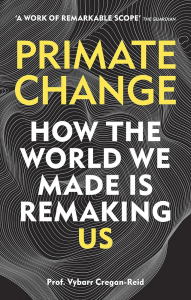
Longtime readers to this blog know that the mismatch between human biology and the world we have made for ourselves is a pet topic of mine, given its implications for human flourishing. Primate Made focuses on modernity’s effects on the human body, and begins with the key point that DNA, while being the ‘recipe’ for making us, is dynamic and its expression can change based on our lifestyles and experiences. The author opens by pointing out that human beings were ‘uncivilized’ hunter-gathers for the overwhelming majority of our natural history, and our bodies are still those of the ancient tribesmen who stalked prey on the plains.
Cregan-Reid begins his documentation of how our bodies’ recipe began fluctuating with the agricultural revolution, which offered generally steady but less nutritionally varied supplies of food, resulting in shorter, less hardier humans. This was not a hard-coded evolutionary change: we have seen the same shift happen in Korea, where authoritarian economic policies have resulted in North Koreans being smaller on average than their former kinsmen, living in more economically liberal South Korea. The fruits of industrialism and capitalism have allowed for much better diets, and average human height has recovered in suit. Every rose has its thorns, though, and most of the book focuses on how modernity affects our waistlines, feet, back, and mind – all to the bad, as you might imagine. While some of this was predictable (the waistline bit), his chapters on how our feet have been enfeebled by constant shoe use was interesting, especially given how some problems tend to begin with the feet and radiate up to our backs. What comes up again and again is the fact that we sit entirely too much: we need to move much more than we do, preferably in areas that will give our feet a proper workout and counter their flattening. The chapter on teeth and diet were fascinating, and intermittent fasting gets a shout-out — though, despite the section on fasting, he never goes into metabolic syndrome which is closely connected. Although some of this was old hat, I still learned quite a bit: for instance, our mandibles don’t get as much exercise as they’re designed for, and subsequently don’t develop as large as they might, leading some to some of our wisdom teeth problems. I also appreciated that Cregan-Reid touched on mental and emotional aspects of modernity, like the frustration that children (especially boys) experience with sedentary education. Not for nothing did Desmond Morris call his own book on this subject The Urban Zoo: we’re all pacing in our own tiny enclosures!
This was a fairly interesting read, and the author includes end-chapter summaries for the twitter-patted: he also proposes ways we can resist the worst distortions, like taking standing/walk breaks at work, and not grazing all day and giving ourselves breaks from constant stimulation. This strikes me as a servicable guide and a good read to understanding the ways our bodies are ill-suited for being cooped up in boxes all day, and a nice kickoff to the year’s science reading.
Highlights:
Your DNA, the code that instructs the assembly of the right amino acids into the right proteins at the right times in the right order and in the right places tens of trillions of times over, giving you a body, is not like a computer script. The code is not perfect, reliable or definitive. Instead, DNA sequences are more like the dialogue in a play. There may be a script, but the outcome depends on the environment in which those instructions are performed. Versions of Romeo and Juliet can vary in quality and tone, from the most ornate productions by the Royal Shakespeare Company to an elementary school performance.
[A]pproximately 10 percent of all the humans who have ever existed are alive today.
While early humans probably consumed about ten tablespoons of sugar per year, in the modern Western diet that is more likely to be the amount consumed daily.
To put it another way, if the timeline for human-like species were condensed into a nine-to-five working day you would need to wait until 4.58pm for the Agricultural Revolution. Even the smallest cities weren’t built until well into 4.59pm. The Industrial Revolution? You would have to have been keen-eyed to notice it. It began at 4:59 and 58 seconds. Nearly all the technology we know and interact with would have come and gone in about the time it takes to sneeze. As a result, our bodies are in shock from these changes. Modern living is as bracing to the human body as jumping through a hole in ice. Our bodies are defending and deforming themselves in response.
These children’s bodies are rejecting sedentariness and almost our first response is discipline, expulsion or a psychoactive pill.
We are unique among species because instead of waiting for evolution to provide us with the right tools for the job, our cognition reversed the process. Other apes’ hands have adapted to their environment, but humans used their primitive hands to make an environment in which those hands, fingers and thumbs became the ideal apparatus for interacting with it.

 Reading Freely
Cool. Glad you liked it. I’ll see what I can do about scheduling it in at some point this year.
Something I picked up recently might interest you… ‘Technofeudalism – What Killed Capitalism’ by Yanis Varoufakis. Essentially it looks to be about how Tech companies are taking over things….
Sounds promising! There’s a ebook I want to read called “Markets, not Capitalism”, which describes itself as “”left wing pro market”.
Meant to include link:
https://marketsnotcapitalism.com/
Become a land surveyor! That will solve all your problems 😉
Your mandibles will get a real work out from all the swearing you’ll do too. Amazing what thorns can do to you…
I have a friend who is a land surveyor, and he’s found some amazing buildings/structures abandoned in the woods, along with some creepy stuff. There’s an overgrown cemetery, for instance, with an unmarked vault that’s falling in, but someone knows it’s there and leaves lit candles. I’ve visited a couple of times and the candles are always different.
Probably just witches….. [grin] Nice people generally… a bit… strange… but nice….
Oh, the part about how modernity affects the feet is so interesting. I keep seeing shoes for kids with wider toe boxes that say they’re healthier for the development of children’s feet because they can walk without getting their toes all squished, which makes sense. This post is making me want to go to the gym now and I hate the gym lol but I’m gonna do it! I know that my sitting position (cross legged on my laptop with my dog on my lap) is actively playing havoc on my feet/back/legs it’s terrible 🙈
Pingback: January 2025 in Review | Reading Freely