
This week I’ve read three books about lonely old men finding connection. I already posted a review for The Borrowed Life of Frederick Fife, but here are two more. They were both absolutely lovely, and featured friendships and connection across generational gaps.
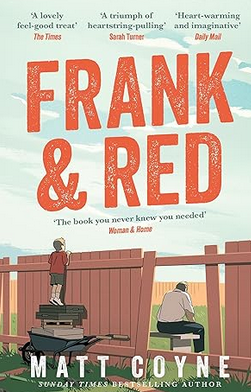
Frank is a lonely widower who, since his wife died, has become a stranger to virtually everyone. His son and he fought bitterly after the funeral, and since then Frank hasn’t left his house or yard. He relies on the nice chaps next door to pick up groceries and supplies and the like. His only company is his dead wife, who, contra “being dead” insists on appearing in the house and chatting with him. Although he’s certain he’s going mad, and confident that the wife he’s seeing is just a figment of his imagination, he’ll take being able to talk to her over being ‘sane’. And then, his elderly neighbor — the best neighbor ever, never seen or heard from — dies and a young mom and her son move in. And the son, Red? Red is friendly. And worse, persistent. Frank and Red is the story of a cross-generational friendship about two lonely people who, despite one of them being an obnoxious chatterbox and the other being a foul-tempered grump, find friendship and are able to move the other to face the challenges in their life. While Frank serves as a begrudging father figure to the boy (offering advice that that horrifies the mom and boy’s teachers, but works nontheless), Red’s curiosity about what happened between Frank and his own son pushes Frank outside of his comfort zone.

The Story of Arthur Truluv begins much less bitterly: here again we have a slightly lonely widower, but Arthur is not a bitter recluse. His life lacks the deep satisfaction that came from marriage with his sweet Nola, but he has a routine, and he does keep his neighbor company from time to time, rocking on her front porch and ocassionally going to dinner. Every day, Arthur goes to the cemetery and has his lunch with Nola, sitting near her grave and talking to her as he would if she were sitting there with him, picnicking in the necropolis. Arthur is a sensitive soul who also seems to hear what the other dead have to say, and he listens to to them. One day he happens to spot a young lady, a teenager, who is also a regular visitor to the cemetery, and they strike up an unlikely friendship. As it happens, the teenager Maddy could use a friend at the moment: she’s always been a bit of an outsider in class, and she was dating a lout who was using her for pleasure rather than being invested in a relationship with her, and now he’s tossed her aside like a used tissue. And….she’s pregnant. Arthur Trulov is a beautiful story about cross-generational friendships, as Maddy finds support in not only Arthur, a man with the affection of a grandfather but who was denied the opportunity, but in Lucille as well, who goes through a tragedy of her own. Together these three wounded souls find a way through the adversities of life.
Highlights from Frank and Red:
He looked at Marcie accusingly. ‘That’s your fault. You moved the curtain.’ ‘Franklin, I’m a figment of your imagination. How the hell did I move it?!’
‘As is a tale, so is a life. Not in how long it is, but how good it is.’
‘Okay,’ Red said after a minute. ‘I’ll go again. I spy with my little eye something beginning with L.’ ‘
‘Is it the last dying embers of my will to live?’ Frank replied.
‘Nope!’ said Red, delighted that Frank was apparently now fully involved. ‘Guess again.’ There was another long minute. ‘It’s lamp post! See? The lamp post over there.’ Red pointed towards the street. ‘Your turn.’Life is a big hole, unless you fill it with things, people and experiences and stuff. And that’s what you need to do.
Frank’s clothes were scattered in tiny mounds all over their bedroom and bathroom, as though a gang of old men dressed in Marks and Spencer’s trousers and shirts had been raptured where they stood.
Highlights from Arthur Truluv:
Arthur is eighty-five years old. He guesses he does want to live to be one hundred, even without Nola. It’s not the same without her, though. Not one thing is the same. Even something as simple as looking at a daffodil, as he is doing now—someone has planted double-flowered daffodils at the base of a nearby headstone. But seeing that daffodil with Nola gone is not the same, it’s like he’s seeing only part of it.
Everybody has thoughts that shame them. You can’t control them coming in. But you don’t have to let them all out. That’s the crux of it. That’s what made for civilization, what was left of it, anyway.
He changes his shirt and combs his hair, inspects his teeth. As he’s going out the door, he tells Gordon, “I’ll be back. Guard the house. Shoot if necessary.” The cat yawns. “You don’t exactly inspire confidence,” Arthur says.
Nola used to get perturbed with his quiet. “Oh!” she’d say, sometimes. “I just wish you’d make yourself a little livelier!” Once when she said that, it was at dinner and he rose up from the table, took in a deep breath, and yodeled good and loud for a full half minute. And Nola stared at him in amazement. “I didn’t know you knew how to yodel!” she said. And he said, “Now you do.” “Why didn’t I know you could yodel?” she asked, and he said it didn’t really come up that much, the need to yodel.
Life is such a funny thing. It’s so funny. So arbitrary-seeming, but sometimes he just can’t help but think that there really is a grand plan. In a way, it reminds him of square dancing, how you can see the pattern fully only by looking at it from above, by not being a part of it.
Frank had then made the case for the fact that mobile phones were the worst thing that had happened to humanity since it had crawled out of the mud, and told Red he would rather set fire to himself than own one of those godforsaken things. ‘You know there’s more computer stuff in them than NASA took to land on the moon. And what do we use them for? You see ’em out front there, walking down the street, the gormless buggers, their heads buried in the things. There could be a hole in the road the size of the Grand Canyon and they’d walk straight into it and still be tippy-tapping away on YouTubes and Instantgran and Arsebook. And not even bloody words: smiley faces and L.O.L. and D.F.S. and God knows what else. People don’t talk to each other anymore; it’s all texting.
And if it had come as a surprise to find out that adults did not know everything, it was even more of a shock to find out that, in fact, it was worse: adults were idiots. Yeah. They pretended to be super clever, walking about wearing suits and drinking coffee and eating salad, and driving and tying their own shoelaces, but when it came down to it, they were nowhere near as clever as they pretended to be.

 Reading Freely
Frank & Red sounds good. Thanks for the tip – adding it to my library holds list
Welcome! Hope you enjoy it.
You really are on a ‘grumpy old man finds a new lease on life’ kick! Frank & Red sounds super cute ! I still have to read A Man Called Ove!
They seemed appropriate for Christmas!
They really do, hearts growing three sizes and all that 😆!
I read Frank & Red at the beginning of the year and totally loved it. Those cross generational friendships are always so touching. At least, I like them. 😀 The Elizabeth Berg is another one I think I’d like. I’ll have to put it on my January reading list. Thanks for commenting on my blog earlier!
Sorry…this is Lark from Larkwrites.blogspot.com. Don’t know why I ended up anonymous.