
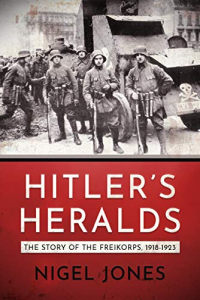
I’ve had this review written since September, but had intended to feature it as part of a series on inter-war Germany. That’s not going to happen this year, as I’m certainly not spending Advent reading about Weimar and Nazis!
After four years of war, Germany’s army was exhausted and on the brink of revolution, tired of fighting endlessly for a front that never seemed to move. Faced with fresh foes from the United States, courtesy of “He Kept Us Out of the War” Wilson, Germany’s leadership decided to sue for peace — and, seeing how vindictive the Entente’s demands were, German authorities decided to let the demands be someone else’s problem. Specifically, the Social Democrats’ problem, who were trying to form a government even as a leftist revolution began breaking out piecemeal throughout the country. Seeking stability first, the SPD began relying on “Freikorps”, paramilitary units formed of committed veterans and fresh young men who regarded the ‘spectre of communism’ with hostile loathing, to put down insurrections. For months, these mostly-independent Freikorps would range across the country, attacking cities like Munich which had been taken over by revolutionaries, but once the red menace had been put down, the Freikorps weren’t ready to stop fighting. This is an absolutely fascinating history of Germany during a time of near-civil war, frothing with violence and driven by a restless spirit.
Although I faintly remembered a socialist revolution breaking out at the very end of the Great War — one that began with sailors — plainly it’s been a long time since my German history courses at university, or since I visited this particular area in my reading — I had no idea how potent it was. Were it not for the assassinations of two of its prominent leaders, the left may have created its own version of the DDR. After the armistice but before the diktat of Versailles, Germany frothed with militant drama, with violent eruptions seemingly every few weeks, taking over cities like Bremen and Munich. With Russia still embroiled in its own civil war — the Bolsheviks had not yet triumphed over the White Russians, let alone executed their coup over the Mensheviks — militant leftists in Germany thought their time had come. Germany barely had a government and its people had been through the wringer of a four-year war. Because so much of the regular army was demoralized and refused to fight, the provisional government of the SPD began making use of paramilitary forces — some of which organized themselves, some of which were initiated by the government itself. These forces were not ‘regular’ troops, but had their own private cultures and were devoted to their independent Fuhrers. This led to some volatility: one Freikorps, dispatched to help the Baltic states fight for independence from Soviet factions, was successful, but then decided that it might as around stick around and rule a bit: one leader pledged his conquered city to the Tsar, but decided to rule in Nicholas’ stead since the Romanovs were no longer around. Interestingly, one inducement to get the Freikorps to attack leftists outside of Germany proper was the promise — from German authorities, not Baltic — of Baltic estates. Hitler’s lust for the east was not new — and nor was use of the swastika, as one of the Baltic-venturing freikorps wore them on their helmets.
The German government, too, would feel the sting of the Freikorps’ battle-lust and interest in power: in March 1920, one Freikorps seized the city of Berlin itself, intending to establish a new Reich that dismissed Versailles. (Hitler and a comrade were not involved in this, although they’d intended to be — on their arrival they realized the effort was a shambles not worth contributing to.) It was such a poorly planned and almost impulsive action, though, that there was almost no support from the other freikorps. Coordination between the groups had previously proven necessary (especially retaking Munich from the socialists who had begun killing prominent citizens), but the Kapp putsch did little to bring in other groups and the one it contacted happened to be stone drunk celebrating the arrival of their namesake, von Hindenberg. Of course, just as leftist coups created Freikorps reaction, so too did Freikorp actions generate reactions: in the case of the Kapp putsch, workers and revolutionaries took over much of the Ruhr, only to be brutally put down by the regular Army and arriving Freikorps. It’s worth noting that the Beer Hall Putsch occurred in 1923, only three years after this, and in a place (Munich) that had already been part of leftist-Freikorp back and forth fighting: the Nazi attempt to seize power was only one of a series from varying factions and ideologies. Jones closes the book with a chapter on Hitler’s putsch, which was more successful than I realized, taking over several government buildings in Munich. The putsch was the result of Hitler forcing two other paramilitary organizations to cooperate, but their leaders switched sides once the actual fighting began.
This is an all around fascinating book, because the subjects are not all of a kind. It’s good storytelling, though facts are sometimes repeated too quickly, and I found Jones’ probing of the Freikorps zeitgeist to be especially interesting, as he reflects on both the romantic German youth movement and the forge of trench warfare itself.
Note: this book was also published under another title, The Birth of the Nazis. I’m fairly certain, anyway: the table of contents matches this book’s progress to a T.
Related:
Life and Death in the Third Reich, Peter Fritszche. The “Volksgemeinshaft”, which Fritzschze studies in part, apparently originated as a concept with the Youth Movement that’s detailed in Heralds.

 Reading Freely
‘Interesting’ times…! Added to Wish List. I think the world might have been a very different place if the Spartacus faction had gained power early on…
I imagine we’d see an Allied invasion of Germany in coordination with the Reichswehr/Deutches Heer, with American forces playing a heavy role. This is based off the Allied attempt at intervention in Russia.
And yes, very interesting times what with France and Germany’s governments failing, South Korea’s president trying to make himself a dictator, and now jihadis who were probably backed by DC at one point now ousting Assad (just checked this morning — there goes another secular dictatorship replaced by crazy jihadis who will no doubt destroy anything non-Muslim left in Syria) . The GOOD news is that these particular crazies are Sunnis, so they’ll be antagonistic toward Iran and DT ‘s Iran fixation may not become an issue. I like that he’s generally non-interventionist in foreign affairs, but the Israel/Iran thing is a significant potential problem.
I picked up ‘A Nasty Little War – The West’s Fight to Reverse the Russian Revolution’ by Anna Reid recently. Looks like an interesting look at a (largely) forgotten conflict.
That’s one I’ve been eying as well!
I’m reading about the aftermath of the Korean War in South Korea, with books by Han Kang. Also books by Korean American immigrants who write historical novels.
Harvee https://bookdilettante.blogspot.com/2024/12/han-kang-witness-literature.html
Very timely! I need to learn more about the Koreas myself.
Pingback: The Best of 2024 – Year in Review! | Reading Freely