
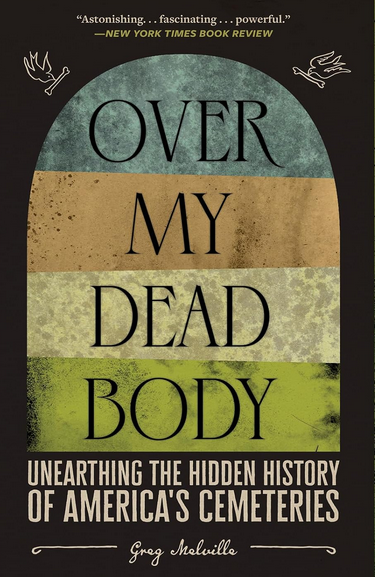
“There is glory in graves; there is grandeur in gloom”. So begins a poem inscribed on an elaborate tombstone in my favorite cemetery, Selma’s own Old Live Oak. Perhaps it was growing up in a city with such a picturesque cemetery that gave me my interest in them — at least, old ones. Modern cemeteries made for machines — and specifically, with no monuments and memorial stones designed so that lawnmowers can pass over them — hold zero interest for me. Given that it’s spooky season, I thought it might be interesting to look for a history of cemeteries. Over my Dead Body is a mix of cemetery history and cemetery tourism, though the history is sketchy and the tourism is mostly prominent places like Hollywood’s celebrity necropolis or — interestingly — Central Park. I enjoyed it in parts, but not consistently, and developed an acute dislike for the author’s frequent personal anecdotes about eating vegan at his friends’ house or boring his daughter wih dad-jokes. Other readers’ taste may vary.
Although there’s a chronological orientation to this book, it’s not a straightfoward history of American cemeteries. We do begin with Mississippi mound-builders and the graves at Jamestown and end with a modern push for ecologically-friendly burial practices, but in between it’s more focused on the ‘hidden history’ aspect, and not so much American cemeteries in general. There’s a chapter on the destruction of native American gravesites, for instance, a look at segregation’s expression in burial practices, the role of Chinese labor in the west, and so on. A few chapters do serve to illustrate American funerary practice in general, like the section on how the American Civil War changed perceptions about death and began leading to embalming becoming more popular, to the point that the grotesque practice is now the default option in the US (and no where else, thankfully), but it’s more focused on special subjects. I enjoyed the book when it was focused on the cemeteries, as the more I read the more suspicious I became about its merits as a history: he attributes Lincoln’s speech at Gettysburg National Cemetary to bolstering the president’s reelection bid, and not, say, Sherman’s successful drive into Georgia during the election season. His treatment of the Civil War is uniformly egregious, so that’s not surprising.
While I enjoyed this in parts, I found the author more annoying than not — in his frequent off-topic anecdotes, in his modern contempt for anyone in the past who didn’t have the right politics — and was disappointed by the book’s contents, which focus either on small topics or are only connected to metropolitan cemeteries. There’s little here on the ordinary history of cemeteries, or how they may reflect their region’s culture — like the use of shells as decor in coastal cemetaries, say. There are some interesting stories in here, like Central Park’s popularity as a place to disperse ashes, but it’s not one I’ll remember and reccommend.
Coming up:…I’m going back to a book I started last year for spooky season, a celebration of obituary writers. I’ve read the author previously, so I’m looking forward to it.
Related:
This Republic of Suffering: Death and the American Civil War
Smoke Gets in Your Eyes (and Other Lessons from the Crematorium). A much better history of funerary practices in America.
Quotes:
Cremation in the ancient world was difficult and dependent on an ample supply of trees. The human body is two-thirds water, after all, and it takes about 1,000 pounds of wood to produce enough heat to turn one person to ashes.
For me, romance involves seeing dead people. For my wife, Ann Marie, a physician who generally likes to keep people alive, not so much.
A body buried in America today doesn’t actually become food for worms or push up daisies. Typical graves are like mini Superfund sites. America deposits about 4.3 million gallons of toxic embalming fluids—including 800,000 gallons of formaldehyde—into the ground yearly, according to the Green Burial Council. We also inter 20 million board feet of wood, 1.6 million tons of concrete, and 81,000 tons of metal. In addition, human
remains contain mercury from fillings, metals from pacemakers and other devices, and potent pharmaceuticals like chemotherapy drugs, which leach into the soil. Then there are the chemical fertilizers, herbicides, and pesticides cemeteries use to keep the grass above the graves looking pristine, which requires regular mowing from exhaust-belching, fossil-fuel guzzling machines.

 Reading Freely
You might find ‘The Buried Soul – How Humans Invented Death’ by Timothy Taylor interesting, although its much more on the Anthropology of Death rather than cemeteries per se…
Still appropriate for the season! I’m planning on interlibrary-borrowing “The Speaking Stone”, another cemetary book.
What an amazing concept for a book – imagine waking up one day and deciding that’s the topic you’re going to research and write about! Great post, thank you, Linda