
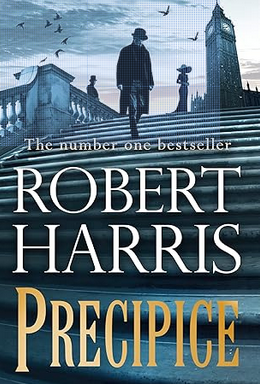
Summer 1914: there’s a man dead in Sarajevo, and ominous rumors of war are drifting from eastern Europe. Across the Continent, war machines are slowly cranking up. At 10 Downing Street, though, the long-serving Prime Minister has more pressing issues: why hasn’t his young quasi-girlfriend written back yet? Three letters a day he writes her, and she’s getting very bad about responding promptly. Such a wicked girl! But so loving, and sympathetic, and – oh, why won’t she write already?
Precipice is Richard Harris’ latest novel: though he’s known for thrillers, Precipice isn’t exactly exciting. It’s an interesting through-the-keyhole kind of novel as we witness the first two years of the Great War as experienced by Britain’s leadership: Winston Churchill and Admiral Fisher are prominent characters, and Lord Kitchener (you know his face even if you don’t know his name) also appears quite steadily. The novel takes us through the war through its two principal characters, Prime Minister H.H. Asquith and Venetia Stanley, a woman his daughter’s age. The PM and Venetia have an interesting relationship going on, reminiscent of courtly love: while they’re not physically intimate they frequently go on drives and write extraordinarily emotional letters to one another. We experience much of the war not through debates in Cabinet — though there are plenty of scenes there — but through the news that Asquith shares (quite inappropriately) to Venetia, including forwarding her classified letters and telegrams. Because Asquith has a horrible habit of chucking them out the window (littering as well as being negligent with state secrets!), some of these telegrams are found, the police are involved, and —
Here’s the thing. If all this hadn’t happened, there could have been an interesting story here in which a prime minister’s affections for a young woman half his age leads to public scandal, his resignation, and a change in the war: instead, Harris sticks to the facts and we get a mild soap opera with no serious drama. British intelligence knows about the passing-on of intelligence, but they appear more interested in learning about the war via the letters than they do reminding the PM of his duties toward the Realm. Oh, one could argue that the PM distracting himself with this courtship undermined his effectiveness as PM, and Harris certainly tries to tie the reckless treatment of telegrams to the logistics issues Britain was having, with some characters commenting to the prime minister that boy, wouldn’t it be nice to have Kitchen’s reports on munitions before addressing Parliament? Don’t you think you could find the letter, Prime? Perhaps write another letter to Venetia and ask her to retrieve it from the shoebox she’s keeping state secrets in! In the end, the story simply….ends. Frankly, I think Harris would’ve been better served with a fully fictional novel inspired by these events, where he would be at liberty to have exciting arrests and powerful speeches and wrenching sobs and all that. As it was, this novel was interesting enough to keep me reading, and it does offer the slightly voyeuristic pleasure of reading a prime minister’s love-letters.

 Reading Freely

Not his best then……?
Oh, no. It’s an interesting enough read if you’re really into the Great War, but (spoilers) — he’s never confronted by the cops, and both his career and his relationship just fizzle out. I was fully expecting scandal to bring him down!
I’ve read a little about this (mentioned in other stuff). I *think* his wife knew about the relationship but continued to ‘pretend’ as if nothing was amiss (although I might be thinking about another British politician doing exactly the same thing to be honest!).
Its definitely a *very* interesting historical period and I’ll be reading more about it going forward. I have a handful of other Harris books to read, but I guess I’ll get around to this one eventually!
I enjoyed this one, but I definitely think it worked better as a political history than as a thriller. I agree that he was too limited by sticking to the facts and it would have been a lot more exciting if Asquith’s actions had more serious consequences!