
‘My Fuhrer, I have never confused the Nazi Party with the German nation,’
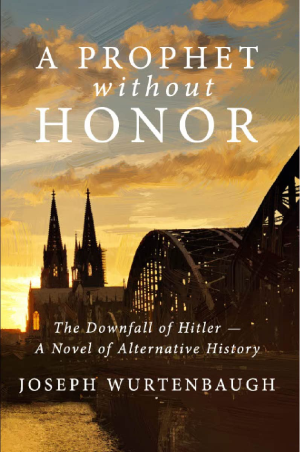
A Prophet Without Honor without a doubt one of the more interesting alt-history novels I have ever read, in part because it is told not through a straight narrative, but via a collection of excerpts from letters, journals, telegrams, and histories with varied viewpoints. The reader realizes quickly we are heading into a different timeline than our own — one in which the Wehrmacht rebelled against Hitler in 1936 — but the story is learning how that happened, and more pointedly in getting to know the man who was most chiefly responsible for that rebellion. This is the story of Karl von Haydenreich, the grandson of a vicious anti-Semite, the son of a principled aristocrat and the stepson of a Jewish woman who the Spanish flu bore away to eternity. Although interesting for its initial premise, this novel’s commanding character drama drove it into the ranks of superb storytelling.
A Prophet without Honor is first and foremost wonderful character drama. We are first introduced to the Haydenreichs via Karl’s father, Heinz, a man who has been forced to deal with tending to his family’s estate after creditors realized his father was absolutely hopeless on financial matters, and his elder brother was little better. Heinz is largely alienated from his family, who regard him as a spineless effete with far too much tolerance for Germany’s enemies, even permitting his wife Lottie to maintain a close friendship with a Jewish woman named Rosamund. When Lottie dies in childbirth giving the world young Karl, Rosamond becomes the children’s unofficial governness — and then, their stepmother, after Heinz and Rosamund fall in love over the course of time. Although Karl will have a youthful dalliance with the exciting Nazi party in his teens, thanks to a summer spent with his hateful grandfather, he is far more his father’s son than his grandfather’s, and joins the army (Reichwehr) out of concern that Germany is sailing into treacherous territory and will need a stabilizing force if it is to survive. The interesting thing about A Prophet is that, beyond the core “Nasties”, few people in this novel are absolutely rotten or virtuous: Heinz’s brother repents of being a bigot on his deathbed, and Karl’s best friend Albert remains wholly sympathetic to the causes of National Socialism even as he aids in some of Karl’s late-novel plans to save those who can be saved. Another character, who is steadily sympathetic, exposes himself at the end as fundamentally lacking in character. Karl’s own experiences as a teenager during the 1923 putsch — witnessing Hitler flee the scene rather than stand and fight with his men — privately galvanize him against the ‘little corporal’, even as he enjoys favor from the upper ranks thanks to his impetuously joining the party as a teenager, and his grandfather’s material support of the NSDAP. A key component of the story is the accidental friendship that emerges between an American officer stationed in Germany after the war — some fellow named Eisenhower who later becomes a military attache — and the Haydenreichs, so much so that “Ike” becomes a godfather and mentor to Karl. When Karl begins expressing doubts about the integrity of Hitler, Eisenhower is only happy to offer him support — and their bond becomes a means of intelligence passing into Allied hands that make the re-militarization of the Rhineland quite different.
In short, this is quite a compelling novel, though it’s unclear as to what happens in Europe after Hitler is removed from the scene: there are occasional hints that de Gaulle rises to power and gets up to mischief, and other hints that Bolshevism runs riot, but these are coming from contradictory sources who we have gotten to know over the course of the novel, and can’t completely trust. While I certainly don’t profess to be an expert in German history, the interwar history has been of morbid interest to me for decades, and lately I’ve been reading more into it: Wurtenbaugh appears to tack pretty close to the changing zeitgeists of the age, made especially obvious in characters whose spirit and morality are sometimes hard to box up. Definitely recommended to alt-history fans who want something more than “WW2 but Hitler wins” or “WW2 but there are space lizards“.
Highlights:
My darling Rosamunde, I don’t wish you to remain in suspense during the reading of this letter. This is a proposal of marriage.
My demented sister, This morning our mother presented me with news so horrifying my hair literally stood on end. She informed me that Heinrich Haydenreich had proposed marriage to you, and that you had accepted.
We are going to be coming home to a different world, a different Germany than the one we left, Willy. There are too many angry men, too many grieving women – too much blood, too many tears, for anything to be left unchanged. Does anybody even remember why this war began? Or what is the great reason why so much human misery had to be inflicted? I surely don’t. The people will demand answers, and there are none to give.
There is a French saying, si jeunesse savait, si vieillesse pouvait – if youth but knew, if age but could.
But it is my belief that it befalls to every man to meet one woman who haunts his life, who both comforts and afflicts him.
‘I feel I must justify this in my own life somehow,’ [Karl] said. ‘There must be a reason why I alone am left out of all of them.’
These [SA] men were not traitors to Adolf Hitler. The truth was that they were fanatically devoted to him, always had been, and remained devoted even now. They had exhibited that devotion throughout the morning, making grim, comic fools of themselves – pledging their loyalty to, or attempting to salute, a man shouting maniacal denunciations in their faces — even as they were being thrown into cellars. Murderers, sadists, pederasts, human vermin – all true. But traitors? Perhaps this was the only accusation of the lot that was not true. The truth was he was the traitor to them. Hitler continued to rage, refusing to be calmed. The word ‘rabid’ sprang to mind. At times, he had actually foamed at the mouth. He knew that the accusations he was shouting were absolute lies. I knew he knew and then, all at once, I fully understood the mechanism. He used the sheer magnitude of the lie to his benefit. He transformed the energy he had to exert to force himself to believe this preposterous hypocrisy into a manic, hysterical rage that swept aside all opposition, including his own awareness of the truth. The objects of his fury were too cowed and intimidated by its intensity to give him the lie. As I watched, he drove himself to even stormier heights.
I’d already seen and heard enough of the Third Reich to know where my real duty lay. The hell with practicality.
‘It is your honor that must compel you, Werner. The pistol is only there in the event you misjudge it.”
“I will use my little broom to brush away what muck I can. It is not possible to cleanse it all, but the house can be made cleaner. That will be my life’s work.”

 Reading Freely
Sounds EXCELLENT! Thanks for bringing it to our attention. I’ve added it to my Wish List. I do LOVE some alt-history – even (sometimes) with space lizards. This will make a nice change from the Germans win trope – BORING!
This one took me by surprise. I think it was suggested on goodreads and I was totally sucked in by it!