
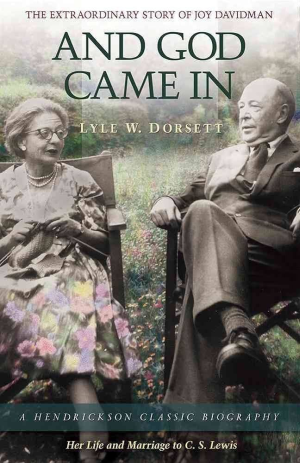
A friend lent this to me, knowing of my love of all things C.S. Lewis. It’s a biography of Joy Davidman, a Jewish-American convert to Christianity who befriended Lewis over letters, then later moved to England and became his great love, writing companion, and wife. Although I knew a fair bit of Joy from the various Lewis books I’ve read over the years, especially the letters and Lewis biographies, the closest I’ve come to a direct biography of her is Becoming Mrs. Lewis, a novelized version of her relationship with Lewis. And God Came In is a small but engaging work, one that emphasizes Joy’s intellectual gifts and love for argument — both qualities of which made the Lewis boys, Jack and Warren, instant fans once they’d met her. We meet Joy as the child of two secular Jews, who have no use for religion and pass that along to their daughter, who — as she ages — becomes interested in the social promises of Communism, and joins a local communist party. Despite this, Joy evinces an inexplicable interest in Jesus and the Crucifixion, and as her intellectual talents begin disassembling the arguments of Marx and Lenin, she simultaneously had an experience with the Divine which would put her on the path to converting to Christianity. Interestingly, she choose the closest church to her, a Presbyterian one, and appears to have taken on its animosity toward the Roman Catholic Church, as her writings frequently attack it and its doctrines and practices. If I’d known Joy had a connection to leftist politics, I’ve long since forgotten it, so reading this portion of her life was interesting. Although Joy loved to write, she found her talent was best applied as a collaborator, and this made her and Lewis into working partners as well as friends when she moved to England to get away from her abusive drunk of a husband who was also having an affair with her sister. I enjoyed encountering her here as a thinker and critic in her own right.
Related:
The Long Loneliness, Dorothy Day. Autobiography of another activist for whom the love of the poor manifested itself in both politics and religion.
Davita’s Harp, Chaim Potok. Secular child of Jewish socialists grows to find meaning through Judaism, not politics.
Quotes:
“Joy had a tendency to view people in one of two ways: either they were her pupils ad she lectured them, or they were her teachers and she pressed them hard for knowledge. As her brother remarked, Joy saw hardly anyone as equal.”
“Nothing had been done to [the Kilns] for about thirty years: the walls and floors are full of holes; the carpets are tattered rags — in fact,” she assumed, only half-facetiously, that the house is being held up by the books that line all the walls and if we ever move a bookcase All Fall Down!”

 Reading Freely