
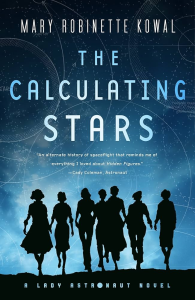
The night is young and you’re so beautiful, can’t we get into the swing of – what was THAT?! The Calculating Stars opens with a rocket scientist and a math genius/former WASP pilot having a romantic night in the mountains, only to witness from afar a fireball embroiling DC. These science-savvy scientists quickly realize it’s not an atomic bomb, though, but a meteorite. They soon learn that DC and the American government have just been snuffed out and the eastern seaboard is completely devastated. It gets worse, though: when Elma begins seeing photography of the strike zone, she realizes that humanity is possibly facing an extinction-level event. The amount of water vapor added to the atmosphere means that, after the dust all settles, Earth will experience runaway greenhouse effect, leading possibly to the oceans themselves boiling away. Looks like it’s time to boldly go where no man or woman has gone before. The Calculating Stars is an alternate history of the push toward the moon, beginning ten years earlier and under far different circumstances. Written with counsel from actual astronauts, it’s a compelling if sometimes irritating story that sticks the landing. At its best, we’re seeing a fun take on the space race, set when computers were people and not machines, where the star is an intelligent and driven woman who becomes an unwitting celebrity in her desire to push the United States into leading humanity’s first real steps into the final frontier. At its worst, we get characters with anachronistic expectations maneuvering in an altered world that doesn’t make sense in some ways, where the promise of the general premise is somewhat wasted in preaching. It’s a fun story, just flawed.
One limitation of the book, I think is that it’s trying to do a lot at once — creating an alt-history world and following it over a few years, engaging in a little science fiction speculation, a lot of critique of 1950s culture from a 21st-century lens, plus the usual plot & character drama that novels need. That is a lot to juggle, especially when the author is more interested in certain elements than others. The core of the story is Elma’s determination that women take part in the space struggle: after all, if Earth is going to create colonies, it’ll need women. and the more quickly they begin establishing their space legs, the better. She meets nothing but total resistance, inspired by everything from basic 1950s culture to personal grudges. She breaks through eventually, in part because she accidentally makes herself into a minor celebrity by appearing as “The Lady Astronaut” on Mr. Wizard, inspiring young girls and older women alike to dream of a future in rockets. Her progress is dogged by an anxiety disorder, though, and when she begins taking a pill to manage it she has to worry if it will invalidate her as an astronaut candidate — and given that one of the key men in the astronaut office despises her for reporting him for sexual molestation during WW2, it could almost certainly be used against her as blackmail. This is the strongest thread in the book, and brings with it the second-most prominent thread, dismissal of 1950s mores by a 21st-century author. This leads to Elma being obsessive about the diversity of the female astronauts chosen, and her becoming angry that none of the seven women who make the cut are black. In a strictly American context, this would be fairly easy to explain: the astronauts had to have so many hours of flight time, and the white WASP-experienced women would overwhelm the pool. Given that the astronaut organization is more international in this, that’s an explanation that falls short, but how much so is hazy because there’s no clear idea as to how much non-American participation there is in the program. There are a few non-Americans who pop up now and again, but it’s a bit like Star Trek peppering its crews with aliens in a token effort at showing the diversity of the Federation. This is connected to the hazy worldbuilding in general: every so often something is mentioned to remind us this is an altered world (“Why are the generals worried? The Soviet Union dissolved”), but the altered world doesn’t really show itself in the story, and some of the mentions are extremely improbable, like the Chinese in the 1950s creating a space program. The Chinese in the 1950s had just recovered from Japanese occupation and civil war and were still trying to create an industrial economy, so that seems unlikely.
Although the historical messiness detracted from my enjoyment of the book, the notes appended afterward make it clear that Kowal was serious about the technical aspects, and I did thoroughly enjoy the story — beginning it at lunch and then reading it nonstop after work. Interestingly, Kowal was aware of the likes of Jackie Cochrane and Jerri Cobb, even though they’re no-shows in the text aside from slightly inspiring the development of two minor characters. I like the premise, appreciated a few of her historical in-jokes, and am on board for the next one despite the over-abundance of space-talk combined with bedroom scenes and rocket puns. I hope she starts developing further and making better use of the premise, though.
Related:
Fighting for Space, Amy Shira Teitel. A history of Jackie Cochrane’s efforts to get NASA to recruit female astronauts in the 1960s. Also see her Breaking the Chains of Gravity, a history of 20th century rocketry and space interest before NASA.
The Lunar Missile Crisis, Bruno & Castle. Alt-history in which humanity is actively creating stations & settlements on the moon.
Fly Girls: How Five Daring Women Defied the Odds and Made Aviation History, Keith O’Brien
Lucifer’s Hammer, Larry Niven. Asteroid apocalypse novel.

 Reading Freely
I had seen this one floating about but didn’t know what it was about, I kind of assumed it was more like Hidden Figures didn’t realize it was an alternate history. I struggle with alternate histories sometimes because I feel like it’s difficult to balance the ‘things happened differently here’ with actual believability. And sometimes the fact that it’s ‘alternate’ can just be used as a magical hand-wavey solution to everything which can be annoying! Though I’m glad you overall liked this one 🙂
Well, there is a strong connection to Hidden Figures in that Elma and most of her friends are ‘computers’ — in fact, that’s one reason (in the book) they begin opening the astronaut ranks up to women — because computing machines are more primitive here than in the 1960s, they need the human computers that Elma was part of on aboard.
You’re absolutely right about alt-history abused — some authors use it as kind of a playground to throw in all KINDS of things: even “The Moscow Option”, which is an alt-history “history”, begins with one point of departure but then throws in other things which are unrelated!
Ah okay that makes sense and as awful as I am at math, I’m always so impressed by people who are like computers that way!
Yeah it’s almost like if you’re gonna go so wacky with the historical alternative might as well just set up a whole new world then! And oh I’ve never heard of The Moscow Option, just looked it up and I guess it’s named after the book by that title. Interesting not sure how I feel about that but then again I didn’t realize the device had a name in the first place! 🤔
Glad to know it’s worth trying.
In your related section, I would add Astronauts: Women on the Final Frontier, by Jim Ottaviani. I posted a few thoughts here: https://www.goodreads.com/review/show/6792465372
Ooh, fun! Have you read “The Six”, about America’s first astronauts? I did a review here:
I haven’t. Thanks, will look into it. What got me into it is actually the author. I like Jim Ottaviani’s style for graphic-“novel” biographies
I think, on balance, I’ll be saying ‘No’ to this one…. But it’s not like I’m short of a few books!
About 50 pages shy of finishing my first le Guin. Will post review in the AM on my side of the pond. Definitely thought-provoking, and I can see why it’s one you’ve returned to multiple times.
Excellent. I recently finished a book of classic SF shorts which I think you’ll like. It’ll be reviewed next Thursday.
Pingback: September 2024 in Review | Reading Freely
Pingback: Top Ten Winter TBRs | Reading Freely