
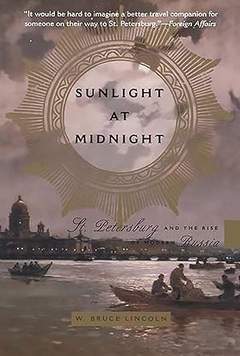
I must confess to not knowing much at all about Russian cities: say Moscow, and I think of the Kremlin and the subway art; say St. Petersburg, and I have some hazy idea that it was built in the model of a western-European city. (About Vladivostok, I can tell you it’s on Russia’s Asian coast, and that’s it.) I recently paid a bookish visit to St. Petersburg through American Phoenix, in which John Quincy Adams was stationed there as foreign minister, and was intrigued enough by his descriptions to try a history of the city available at my library. Sunlight at Midnight is a biography of a city, and one that rose on purpose, designed and intended to orient Russia toward the modern, industrial west. Its placement on the Baltic was chosen with deliberation, creating a seaport that could be used to ignite Russia’s commercial and industrial power, despite the tendency of the Nevas river to flood and the fact that the port was frozen shut for months on end. (The city had its delights, though: for one, the fact that sun never quite sets during the summer, leading to “White Nights”, a cultural celebration that continues today.)
St Petersburg became closely associated with the Tsarist empire, so much so that as Russia’s aggrieved proletariat began pushing toward revolution, the city itself developed a negative connotation, and when the Soviets took power they would center their far-more tyrannical empire in the traditional capital of Moscow. Because this is the biography of a city, there’s far more focus on architecture and culture than politics at large, despite St. Petersburg’s capital status. That said, politics does erupt in St. Petersburg on a regular basis, given that it was the site of the October Revolution (which led to the temporary establishment of a parliament) and then later the unrest that would lead to the tsar’s abdication and (some months later) the Bolshevik coup against the provisional government. This could lead to dramatic changes in the city: it lost nearly half of its population in the economic upheaval and political changes of the 1920s, for instance, though it would rebound later on. Lincoln provides a wonderful variety of photos from state archives, and they’re not all lumped together in the center but linked to specific sections. Although I knew St. Petersburg had been a target during World War 2 (the Siege of Leningrad), I’ve never done a deep dive into the Leningraders’ experience: it’s harrowing, to say the least. Death visited the city even more frequently than Nazi shells and bombs, as people fell prey to disease and starvation during the near-900 day siege. Art, always close to the subject in this book, is never more interesting than during the siege, as one composer began writing his seventh symphony on bed-sheets and later performed it for the first time during the siege itself to raise morale. Musicians were actively dying off from disease during practice and rehearsals.
Lincoln has done a great many books on Russia, and I will be looking at a few more. This one I just stumbled upon: it was in the library bookstore when I needed something to read during lunch.

 Reading Freely
Sounds excellent, thanks!
I’ve read some fiction set during the Siege of Leningrad (including The Conductor by Sarah Quigley, which is about the Shostakovich symphony) but I haven’t read any non-fiction. This sounds really interesting.
It’s led to me checking out a nonfiction history of the siege itself — “Leningrad: the People’s War” by Rachel Heil.
Great lunchtime reading!
Harvee https://bookdilettante.blogspot.com
This sounds very interesting- I’m definitely curious!