
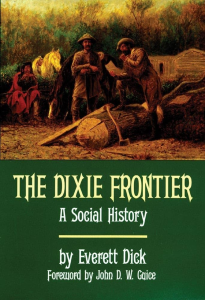
Everett Dick’s The Dixie Frontier offers a fascinating glimpse into the early days of the American Southwest, providing a colorful and informative account of life on the frontier. Following the end of the Revolutionary War, Americans poured westward, venturing all the way to the mighty Mississippi River. The Dixie Frontier is a highly enjoyable social history of that period (1780s – 1830s), as trappers were succeeded by aspiring settlers — some operating within the bounds of the law, sometimes out of it. Everett Dick focuses on the “old Southwest”, places later known as Alabama, Tennessee, and Kentucky, and explores different areas of life thereof, from the staking out of claims to the creation of law and order. The chapters are organized by subject, with different elements of frontier life considered in turn, as well as spotlights on certain kinds of settlers, including women and slaves. Although plantation money would find the Old Southwest eventually (after the Creek War made it safe), this is largely a book about smaller freeholders and other pioneers, and the life they were making for themselves.
Dick covers agriculture, food, home-building, and other material aspects as well as the growth of religion and frontier justice. A fundamental aspect of this book which underpins everything else is the sheer primitiveness. There was very little gold or silver in the frontier, so economic changes were barter-based, and were not limited to agricultural products: firearms and land were also used. Because of the general want of social infrastructure, events and buildings often serve multiple uses. Church, for instance, was not merely an opportunity for worship, or fellowship, but would become something of a market as farmers commenced to horse-trading or matchmaking. The chapter on justice was particularly fun given that lack of jails or basic legal infrastructure: one young couple was forced to travel for weeks looking for someone qualified to legally marry them, and one man who escaped a death verdict because of a badly written legal order was greeted outside the tavern where court had been held wih the announcement that while he had been “released by Judge Smith, he had not yet been tried by Judge Lynch!”. (The man was stuffed in a barrel and then thrown in the river, letting the currents and God decide his fate. Sending people down the river in a dugout or something similar was an amusingly frequent ‘corrections’ measure.) Dick also remarks that in a murder trial, jurists’ judgment of guilt owed more to whether the murdered man was a better citizen/neighbor than the accused. Similarly amusing is the chapter on social life, as people created game after game with the sole purpose of having an excuse to kiss each other. Kissing was also used as a reward for farm labor: at communal corn-shuckings, the man who could boast the largest pile could smooch the girl of his choosing. One wonders if the smoochee had any say in the matter! Although I think the book suffered a bit from the lack of a chapter to establish the political context, it was both enjoyable and informative. I’m glad Brutal Reckoning prompted me to finally take a look at it, as it’s been on my wanna-read list at the library for the longest. Dick has another book called The Sod House Frontier, on the western experience, which I’ll be looking for.
Related:
Daily Life in Early America. Similar treatment but for settlers on the East Coast.
Dixie’s Forgotten People, Wayne Flynt
Coming up:
Pompeii! Volcanos! Kid lit!

 Reading Freely
Make smootches, not war?
Pingback: August 2024 in Review | Reading Freely
Pingback: The Best of 2024 – Year in Review! | Reading Freely