
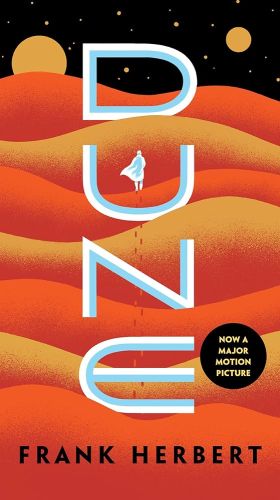
For as long as I’ve been online, I’ve heard of Dune, have heard expressions like “The spice must flow” and seen the “I must not fear / fear is the mind-killer / fear is the little death (etc)” recitation embedded in forum signatures. I’ve been aware of it, too, in PC gaming circles — mentions made of the games. And yet, despite being a fairly active reader of SF, not until recently did I attempt to read it. Part of the reason is its sheer scope: trying Dune is like starting the Star Wars Extended Universe, or the Star Trek Relaunch novels — thousands of pages all building on one another, with interwomen stories and evolving characters. It’s an epic space opera in the far future in which there’s a vast Imperium and warring houses within it. The story opens when the Emperor removes dominion of the Spice Planet Arakkis from House Harkonnes to House Atreides, for reasons known only to him. Duke Leto, leader of the House Atredies, knows this “gift” will bring only trouble, but is obliged to accept, bound by both lawful duty and — the hand of Fate? Although this is a science fiction novel, it is also a story rich in mysticism and prophecy — a book that tells its story not merely through the central narrative, but in sayings and poems interspersed throughout the text. It’s, in short, an epic, and lives up to its reputation.
Star Wars may start with a handy prelude telling you who the players are and what’s happening — rebellions, taxation on trade routes, that sort of thing — but Dune drops the reader into the middle of things. We open on a ducal capital in turmoil, as Duke Leto has just been ordered to take posession of his arch-enemy’s prize planet: Arakkis, a desert world that’s largely inhospital to human life but which is the only place that the substance known as Spice appears. Spice has all manner of uses which we learn about through the text. The main character of Dune, however, is not the Duke but his young son Paul who is in his mid-teens and being primed for adult responsibilities. He is a child of promise, of speculation: his mother was trained in secret arts, and she in turn has begun training him in these, wondering if he might be the one spoken of in her order’s prophecies. Paul will be thrown into adulthood after arrival on Arakkis, where the enemy Harkonnes have left traps and schemes that will soon see the Duke dead and Paul and his mother abandoned in the desert, where they find allies among the desert-folk Fremen and Paul’s destiny is put on speed. Biding his time in the desert, Paul will strike back — and claim a mantle of leadership far broader and heavier than his father the Duke’s, a mantle that will cover several more books.
Although it took a few tries to get into this, the incredible worldbuilding presenting something of an obstacle to an easily distracted reader who finds himself in the middle of things, once the ice broken and the skids greased by graphic novels and the movie, I was sucked wholly into the story like it was a sandworm’s open maw. There are a multiple levels of fascination: the core story of a young man suddenly being thrown into adulthood, forced to grapple with schemes from men and women more powerful and wealthy and he, but increasingly strengthened by the training he was given by his mother, as well as the invisible hand of Fate which lands him among people who view him as some kind of chosen one. There’s the political scheming, which features multiple factions using one another for their own private reason, and often through diobolical and subtle means: one man betrays another by delivering him into the hands of their mutual enemy, so that the betrayed man can serve as an instrument of reprisal by killing the mutual enemy! The world-building itself is compelling, with factions that are not “political” in the sense of being liked the House Atreides or the House Harkonnes, but utterly wrapped up in the politics: there are the Bene Gessirit, for instance, “weirding women” who are trained in mental and psi arts, and who are a bit like Jedi only they can’t do things like throw furniture or X-Wings around, but they also actively interfere in the life of society and the state in a kind of non-technical eugenics. They’re incredibly important to the plot given that Paul’s fate is tied up in their future reckonings, and his mother is one of their number. And then there’s the deep history, with plot-relevant consequences like the absence of computers — though I wonder if how that affects vehicles is ever really explored. Even B-29s in WW2 had some level of computerization! I especially enjoyed the way Herbert used literature and poetry from this world to illustrate it for the reader in the text, and his allusions to Earth culture (especially the Arabic world). The amount of pithy quotes was exceptional.
This book ends with quite the change for our main characters, and I’m interested in how things develop — though the descriptions for the next book seem pretty grim, so I’m very tempted to dip into the prequel novels by Herbert’s son Brian. At any rate, I can definitely understand why this series is so popular, and am looking forward to watching Dune Pt 2.

 Reading Freely
I haven’t read any of Brian Herbert’s add-on books (I will eventually) but if I was starting from scratch I’d (personally) leave them until after I’d read the original books – although I can certainly understand the temptation to do so for the deeper background vibe. ‘Dune Messiah’ is an interesting read. I hope they make the movie as Part III.
Paul is a (very flawed) character and has a very interesting arc. Even as the Duke’s heir you can see that he’s very much thrust into a situation he’s not really prepared for and can only cope (barely) because of his mother’s training and his advantageous genes! One of the things I loved about the books is the amount left unsaid and unexplained which you have to pick up from often tiny clues. The books don’t really *explain* anything because the characters don’t need it explained as they lived through it all. Its us, the reader, that needs to figure things out – like being dropped into a completely different culture and having to pick up a foreign language AND a whole set of customs from a culture you’ve only heard about in books. Difficult, but definitely worth the effort.
I’m going to *try* to fit in ‘Children of Dune’ late in the year.
I’m glad that you finally got to finish it – and more importantly – enjoy it!
He’s very assertive even early on, which one could judge as good or bad. It’s amazing how fast he goes from “teenage heir” to “I AM MUAD’DIB, HEAR ME NOW”, though.
Looking back, I do find it interesting (my own psychology-wise) that I found Duncan Idaho a much more intriguing character than the ‘hero’ of the piece. Maybe I thought that Paul was too much ‘on point’? Either way the Dune series is FULL of fascinating rabbit-holes that you can run down & mull over. Probably why people are still reading it, talking about it and making movies… [grin]
I had to look him up on Wikipedia to address my confusion….was tolerably sure he’d died. XD
Indeed he did…..
“Turned you into a newt?!”
“…I got better!”
I have not tried to tackle Dune, but see it’s still very popular. I’m not a sci fi fan in general. Glad you enjoyed it.
Harvee https://bookdilettante.blogspot.com
Yess you read Dune! I am so glad you enjoyed it as much as you did! I read it once so many years ago and I did NOT remember the fact that they have no computers, which in a space-travelling culture that’s incredibly surprising and almost unbelievable. Do you think you’ll be reading onwards at some point in the series? I am so torn on that front, like I liked how Dune ends and I almost treat it as a standalone in some ways in my head but also I am kind of curious as to the rest of the series (It’s funny because I keep hearing such contrasting opinions from book people whose opinions I trust). I was just talking about Brian Herbert’s books just the other day with a friend and I suppose I’ll wait and see what she thinks about them first and I’ll be on the lookout for your thoughts if you continue in that vein as well!
I’m re-reading the Dune series (slowly!) after first reading them around 40 years ago. My review of the 2nd book ‘Dune Messiah’ is linked below if you’re interested. I’m hoping to re-read the 3rd book this year – with the other 3 next year – possibly! Then I’m likely to hit the non-Frank Herbert ‘sequels’.
https://cyberkittenspot.blogspot.com/2022/04/just-finished-re-reading-dune-messiah.html
Oh thank you for sharing your review, I will definitely go check that out 🙂 That sounds like a very worth while re-read, I hope you’re enjoying it lots !
Pingback: Top Ten Books I’ve Experienced Inside the Covers and Out | Reading Freely
Pingback: Various & Sundry Tuesday Memes | Reading Freely
Pingback: The Best of 2024 – Year in Review! | Reading Freely