
’tis to glory we steer,
To add something more to this wonderful year;
To honour we call you, as free men, not slaves,
For who are so free as the sons of the waves?
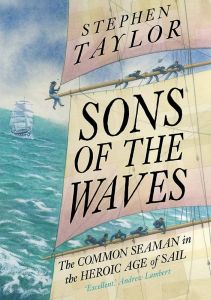
Heave your ship to, boys, deep soundings to take! Sons of the Waves is a celebration not of the gilded brass, not of a handsome oak-forest-falling ships, but of the ordinary — and able — British seaman in the Age of Sail. We visit here the 18th century, when Britain fully established itself as a naval, then world power — sending out ships to conduct science on the high seas, steadily knit the continents together with globalized trade, frustrate the designs of Napoleon, and turn Australia into the world’s largest penal colony. Taylor draws on memoirs, letters, and ship’s logs to deliver a sense of the challenges, deprivations, and pleasures these men experienced, and pays special attention to the conditions which prompted large mutinies like those at Spithead and Nore. Thoroughly readable, it offers a fulsome look at another area of the Age of Sail.
The range of Sons of the Waves is substantial enough to cover most of the 18th and early 19th century, so we encounter Jack Tars amid three wars — or two and a half, depending on closely a reader differentiates the War of 1812 from its mother conflict, the Napoleonic wars. This same range also covers the time when British ships and their mates were complicit in the slave trade to when they became the agents of its eradication. The book begins with the Royal Navy’s rapid expansion in the 18th century as England entered more onto the global stage, covering the conditions of life aboard ship. Some viewed the Navy as worse than prison, for it offered all the limits of prison but with the added risks of sinking and natural catastrophe. Many sailors were forcefully conscripted, or ‘impressed’, by roving gangs who collected men off the street and forced them into service, and they were subject to what one 24th century observer referred to as ‘bad food, brutal discipline, and no women’. Wartime meant the Navy’s needs were especially desperate, and as much as half of the sailing force was conscripted labor — on one boat, Taylor observed, the overwhelming majority of the crew had been impressed, which makes one wondered why they didn’t simply take over the boat. Marines, presumably, but there’s also the matter of men bonding with each other, their ships, and their missions: one ship that had been on the verge of mutiny nevertheless threw itself bodily into Trafalgar. Although Taylor isn’t offering a military history here, Trafalgar was so significant that it receives its own section.
Life at sea, despite its deprivations and the whip, also offered young men adventure and freedom from social mores, especially in far-flung locales like Tahiti. Pleasures to be found there were mixed with the gall of not being paid, the latter especially rough on men who had been taken by press gangs and left their wives and families in the lurch. Until reforms were made, these women were left to support themselves, which tended to get them in trouble given that the easiest options were theft and prostitution. One poor man had completed his voyage and was within a day or two of receiving payment when — thinking the press gangs had met their quota — ventured onto open streets and found himself aboard again. The appallingly low wages and the extreme delays in receiving them fueled discontent that made itsself visible in mutinies. I was inordinately pleased to encounter MY NAME IS CAPTAIN SIR EDWARD PELLEW here, and astonished to learn that he’d risen from the ranks and remained close to them long after he’d been made an officer, working in the masts along with his men. I also enjoyed the occasional American interludes, and was amused to learn that the number of British sailors who deserted to pursue opportunities in America was roughly about the same as the most conservative reckonings of how many Americans were seized on the high seas and inducted into the Royal Navy, a practice that led to war against the States and the mother country yet again.
Sons of the Waves was terrific reading: I’ll definitely take on the Pellew biography now, and I especially appreciate that one of Taylor’s chapters consisted of him analyzing his one of his key sources, extant soldiers memoirs that include some anachronisms given that they were being written decades after the wars at times.
Related:
C.S. Forester’s Horatio Hornblower series, set in the Napoleonic wars
To Rule the Waves, Arthur Herman. On how the Royal Navy shaped the modern world.

 Reading Freely
I *think* this is on my Wish List….. It’s certainly on my interest list!
Planning on buying the Pellew biography, but I need to find and read that “Building Britain” book I bought last year on your reccomendation! Reading a novel set during the rise of Cromwell now.
Pingback: What I Read in 2024 | Reading Freely