
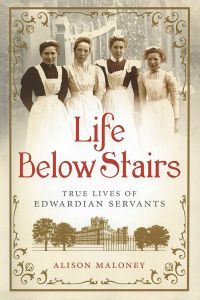
If, like me, you became interested in the goings-on of English servants via Downton Abbey, Alison Maloney opens with a word of caution. Many servants didn’t work in small armies at places like Highclere Castle. Instead, they were thoroughly leavened into society, most frequently found in middle-class homes, and were such a part of society at large that the only class that didn’t employ servants to some degree was the working class itself. That said, however, most of this text is about the staff of the great houses, drawing from oral histories of staff (Forgotten Voices of the Edwardians and Not in Front of the Children) as well as from household management guides and the like. It’s quite readable and has a good range, opening with a diagram of the Downstairs hierarchy (ranging from the Butler to the lower maids and dogsbodies) and then tackling various aspects of servant life in turn: the dynamics between the Household and the staff; the dynamics between the staff themselves; the nature of various duties, and so on. Maloney takes us through an average day in a great house like Highclere, as well as a normal years — punctuated by the summer visit to London for The Season, as well as the holidays. Reading this, I could only wonder how some people managed to stay in service for decades, because the work schedule appears absolutely brutal: up hours before dawn, working late into the evening and sometimes into the next day, depending on the lord’s schedule. Given that industrial England would have surely had opportunities for young people — young men, at least — life in service must have had some attractions or upsides. Surely pride in being connected to a great house wouldn’t suffice for the constant work (Oh, did someone track mud on the steps right after they were scrubbed? Back at it!) or the dehumanizing way servants could be treated, depending on their station: maids were especially ill-treated, and there was as much of a pecking order downstairs as there was upstairs. This was a fascinating social history, though I wish there’d had been more of a look at those in service throughout society, instead of just those attached to the big houses. That may simply reflect the availability of service accounts, though.
Related:
More Work for Mother and Never Done: A History of Housework

 Reading Freely
Its amazing looking back just how many people had servants – including live-in ones! I’ve come across numerous examples in my ancestry hunting, where you have a household listed in the census including 5, 6 or more people with the same surname and then one or two *completely* different…. Servants!
Actually my maternal grandmother was a housemaid before she got married. Don’t think she was live-in though. Not sure. Weird, isn’t it!
Do British censuses give residents’ relation to the head-of-household? DC’s do — usually “Sister”, “Boarder”, something like that.
Yes, they do. It is weird sometimes because the record is just for that particular day of the 10 year census – so it catches people who are just passing through and who never sleep there again!
One of the interesting… amusing… and infuriating things that comes up, especially as you go further back, is the number of people who don’t know when they were born…. It certainly makes tracking people a bit more difficult!!
Pingback: The Best of 2024 – Year in Review! | Reading Freely