
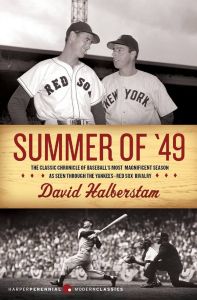
In the summer of 1949, young David Halberstam was fifteen years old, facing a father in declining health and thankful for the distraction that was baseball. The Boston Red Sox and the New York Yankees would provide it in spades, the arch-rivals competing for the American League pennant. 1949’s pennant race was especially dramatic because the Red Sox came from behind: after a very disappointing early season, they suddenly began winning, overcoming an eleven-game deficit — and it all came down to one game in Yankee Stadium. Summer of ’49 is a history of that ball season, following the victor of the game to the World Series, and then following up on the lives of all the players involved. Halberstam does not limit himself to a play by play of the games, as he uses the season to explore different trends in baseball: the way television was changing player and official behavior, for instance, or the slow integration of the Major Leagues. Jackie Robinson had donned the Dodgers’ jersey only two years prior, and the number of black ball players remained in the single digits. The Yankees and Red Sox would be among the last to add black players to their rosters, despite the Red Sox recruiting a Mexican player over ten years prior, and Halberstam notes that this would hurt both teams later on, passing up as they did major talent like Willie Mays. In addition to shining a spotlight on particular players, like Ted Williams’ obsessive study of the game and his computer-like ability to remember pitchers’ favorite sequences, etc, Halbestam also explores a little of the culture around baseball players in this golden age. Already being much familiar with Toots Shor’s establishment in New York from numerous Frank Sinatra biographies, I was surprised and delighted to find myself back there again: it was a favorite spot for baseball players and sports writers to congregate after games, at least until night games became the norm. Quite enjoyable on the whole.
This wraps up the scheduled ‘Opening Day’ posting week, but there will still be pop flies in the weeks to come.
Highlights:
It was said that while managing Chicago in the twenties, McCarthy had once lectured Hack Wilson about the seriousness of his drinking. He illustrated his lecture by pouring a shot of whiskey into a glass filled with worms. The worms quickly died. “What did you learn from that?” he asked Wilson. “That if I drink I won’t have worms,” the slugger answered.
Television, he soon decided, was a medium in which both the broadcaster and the fan became lazy—the broadcaster because he had to let the camera do so much of the work and the fan because he did not have to use his imagination. Allen felt he had a less-intimate relationship with his viewers.
To the other young reporters he was somewhat self-important and pompous, his use of language outdated. As Red Smith once noted, the people he quoted in his stories did not say things, they exuberated or vehemed. Once when he was discussing an earlier pennant race, his friend Frank Graham said, “Oh, Dan, stop veheming.”
It was as a Red Sox fan, he later realized, that he had first learned that man is fallen, and that life is filled with disappointment. The path to comprehending Calvinism in modern America, he decided, begins at Fenway Park.
With the Red Sox, it was a less-refined sort of racism. The top management of the Red Sox was mostly Irish, the most powerful group in Boston. They had established their own ethnic pecking order, which in essence regarded Wasps with respect and grudging admiration for being where they already were; Jews with both admiration and suspicion for being smart, perhaps a little too smart; and Italians by and large with disdain for being immigrants and Catholic and yet failing to be Irish.
I spent two wonderful days with Tommy Henrich at his retirement home in Arizona. I told him how much he had meant to me as a boy, and in our first phone conversation I recalled a moment in 1948 when he had almost broken the then-record for grand-slam home runs—I had been seated in a car listening to Mel Allen’s call as the ball hooked foul. Henrich, with what seemed like almost total recall, finished my description for me. He loves, more than anything, to talk baseball. As we sat and talked, me in my fifties and he in his seventies, I was struck by how boyish we both must have seemed.

 Reading Freely
Off topic AGAIN! If you’re interested in global military history, plus other interesting stuff I can definitely recommended a YouTube channel I’m watching ATM. Learning LOTS!
Kings and Generals – YouTube
Ooh! Thanks. Google Podcasts is about to be closed down so I’m going to have time on my hands given that YT music isn’t nearly as easy to find guests/podcasts/etc.
A great book for baseball fans.
Harvee https://bookdilettante.blogspot.com/