
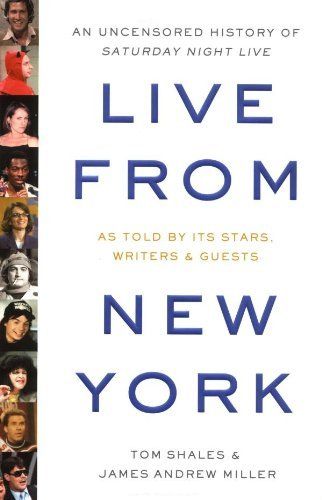
At the end of 2022, a friend of mine discovered that his former roommate had left a boxed set of SNL’s first five seasons — or at least, season two of the same. He was a teenager when SNL first aired and grew up it, and offered to introduce me to it, since I’d never seen anything of SNL. I was immediately smitten by Jane Curtin and Gilda Radner, and became fond of the Weekend Update routine. After plowing through season 2, I found a full boxed set on eBay, and we subsequently finished seasons one through four, my friend explaining the various seventies references and jokes that would have gone over my head entirely. I bought this volume to learn more about the early years of the show, though it covers everything up to the early 2000s. The subtitle is important, because lines from interviews constitute nearly the whole of the book, so there’s no narrative beyond what the interviewees contribute themselves. That largely works, though it does create some frustrating gaps: for instance, they mention Gerald Ford’s cameo in passing, but not how that happened. Still, the interviewees are largely good at delivering the general story of how things happened. I was surprised to learn that the show was created just to fill up space after Carson pulled permission to air his reruns on late Saturday nights: interesting that something so creative and culturally significant originated as an airwave band-aid. I imagine this book is of great interest to serious fans of the show, but once we’d left the era of the Not Ready for Prime Time Players, mostly what kept me powering through was recognizing names that gained more fame later on, sometimes in part because of the exposure the show gave them. Although Lorne Michaels created the show with the intention of using unknowns, later showrunners purposely hired comics who already had an audience, though this could trap the show into depending on one or two particular people instead of a strong ensemble, with severe consequences if they left. Learning how the show worked — or didn’t, sometimes — was interesting, as were the lives of the cast and writers, and the office politics. I was not surprised to learn that drug and alcohol abuse were rampant, though not everyone partook: Jane Curtin was as straight-edge as her character in “Weekend Update”. More than once, hosts took the stage and conducted the show under heavy influence. My favorite factoid was learning that Dan Akroyd and John Belushi bought a building with a ground-story bar, and after the show they’d just go there and hang out with friends: this was an incredibly cool incidence given that I watched the show in a ground-story bar space that served as a private spot for socializing. This was a fun-enough volume, though I imagine I would have enjoyed it more consistently if I’d seen the show beyond the original cast. (And technically, I still haven’t finished it….once I have, no more new Gilda.) My exposure to the show outside of these DVDs has just been ocassional clips, which don’t communicate the full experience of the show — the sometimes strange, sometimes awesome music, gags like having a monster ‘attack’ the studio audience, that sort of thing. Jim Breuer’s “Joe Pesci Show” is a favorite from later years, especially the clip where John Goodman is somehow pulling off a Robert de Niro impersonation despite weighing twice again as much.

 Reading Freely