
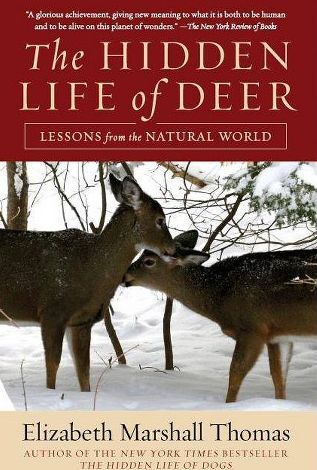
There’s a buck mounted in my living room, but it’s not a head: it’s a large photograph of one standing at a stream in the woods, dawn light softly illuminating the morning mist. I find deer, second to horses, utterly beautiful creatures – -at least, provided they aren’t standing alongside the road on dark winter nights, threatening to bolt at a moment’s notice and destroy whatever vehicle is passing along. Elizabeth Marshall Thomas shares that admiration for deer, and makes a habit of feeding the population that lives in the New Hampshire woods near her house. Her interest in them, though, goes beyond merely giving them something to eat in exchange for the joy of watching them as she might a group of hummingbirds: instead, she’s intently curious about them, a genuine student who pokes through their winter stools to gauge their health, and yearns to know the land as intimately as they do. She identifies four distinct groups in the population around her, which she labels Alpha, Beta, Epsilon, and Tau, and most of her study is on social dynamics: the four groups all have interior hierarchies, with clearly dominant females who guide the feeding. Curiously, lower-class females in a group will stop eating and move with the group as soon as the dominant female decides it’s time to move on, even if they haven’t had their fill. Amusingly, though, some lower-status deer will use alarm signals to spook the group into hiding so they can scarf some food down before joining their mates: I’ve read of similar behavior among primates who use predator alarms to frighten their troopmates away from choice fruit. Thomas’ observations aren’t strictly organized the way Leonard Rue’s Whitetail Savvy was (the only book on deer behavior I can find that’s not hunting-oriented) , but she covers the basics: how deer change through the seasons, their methods of communicating, etc. The back half of the book is less about deer and more general nature observations. Thomas identifies as a tree-hugger, and her approach is a quirky mix of serious scientific approaches (poring through scat) and references to Gaia ‘setting forth a path’ and ‘telling deer’ what to do. I enjoyed the volume as a reflection on nature, but for more serious content Rue is still the go-to source — and he’s referred to consistently.
Related:
Giant Whitetails and Whitetail Savvy. The first is bowhunting stories; the second is a more comprehensive study of deer intelligence, behavior, etc.

 Reading Freely
“…..at least, provided they aren’t standing alongside the road on dark winter nights.” TOTALLY agree there! In my last year @ Uni we lived out in the middle of nowhere (for fun…) and I lost count of the number of times we had to brake suddenly as deer – some of them HUGE – bounded across the road in front of us. Not as dangerous as sheep though… those buggers CHALLENGED you to hit them!
They’re a major hazard here, especially during hunting season when they’re more on the move. “Watch for deer” is a go-to goodbye during the fall/winter months!