
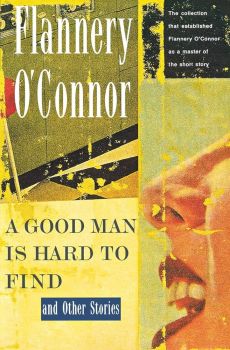
I was introduced to Flannery O’Connor perhaps twenty years ago when taking English 101 & English 102 at the community college, and I have never quite forgotten the two stories we discussed — “A Good Man is Hard to Find” and “Good Country People”. Or rather, there are startling elements within those stories that seared themselves into my head, even I’ve forgotten the plots in detail. As it turns out, Flannery O’Connor is good at that — provoking, shocking, horrifying. A Good Man is Hard to Find and Other Stories collects ten of O’Connor’s stories, a third of her work in that area of literature. The collection is saturated with race and religion: at least two characters masquerade as figures connected to religion (a Bible salesman, say), and if you made a drinking game out of racial epithets then I hope your will is current, because if you survive the alcohol poisoning your liver won’t be long for this world. O’Connor’s stories are filled with characters rendered in strange and frequently ugly detail – sometimes both at the same time. Horror of varying degrees is present throughout, but especially in “A Good Man is Hard to Find”, as the reader realizes what is happening far more quickly than the grandmother who features so prominently: as one progresses further into the collection and sees the sorts of things that happen, then tension starts mounting the moment a stranger shows up. There’s no obviousness to what will happen in any story, though. The most interesting new-to-me story was “The Displaced Person” in which an aging widow takes on a Polish refugee and his family as a farmhand: his work ethic, either natural or need-driven, immediately leads to tension with the widow’s other help (poor whites and blacks), and the widow is torn between benefiting from his work and her desire to keep her ‘people’ content. Violence makes its face known in this story and in many others. This is a collection to return to, in part because there’s more substance to them than mere plot-happenings, and in part because I’m still recovering from an illness and not thinking all too clearly.

 Reading Freely
I was reading the complete collection of her works several years ago, but never made it past 1/3. I thought she was brilliant; I especially loved the absurdism in some of the stories. But it was really hard to keep reading through all the racist language. She seems like an author to be taken in small doses…
I don’t know how much of that is O’Connor trying to show the ugliness, and how much was just her using the vernacular of the times. I’m sure in some cases she was throwing a light on ugliness, especially with the grandmother in the title story and in the story “The Artificial N–” in which a grandfather is angered and disappointed that his grandson fails to recognize black people as Other the first time he meets them.
That was my impression, too… Its realness/believability makes for heavy reading.