
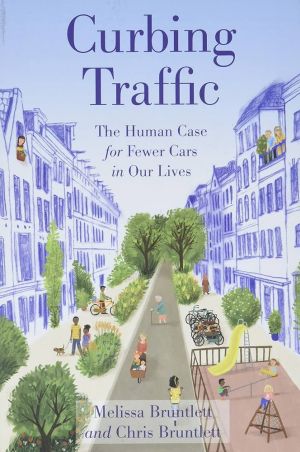
A few years ago, Chris and Melissa Bruntlett moved from Vancouver to Delft, and wrote a book (Building the Cycling City) on how Dutch city design not only facilitates, but encourages, cycling as a primary of transportation. Having explained how, Curbing Traffic delves into the why, combining critiques of what car-oriented design costs people and cities with personal experiences from living in Delft. Although flecked with some oddities, the book does a good job of collecting and distilling insights from different quarters into a overarching argument for restoring people and not machines to the masters of our city streets.
The book opens with a recollection of the Bruntletts’ move to the Netherlands, which they’d undertaken because while Vancouver had been fine for a young couple having fun, once children entered the picture they knew they wanted to raise them somewhere else, a place where kids could really flourish — a place they already admired. The Netherlands’ emphasis on people over cars is more than dedicated, sheltered bike lanes: there exists an entire organized approach to humane design, beginning with a hierarchy of different road/street types with different design principles, ranging from an auto-oriented outer ring road to interior ‘living streets’ that are effectively auto-free, save for those belonging to residents, and the street itself regarded primarily as an area for play and socialization. The Dutch incorporate different paving materials like cobblestones to communicate to drivers that they’re in a special zone, and even beyond these Delft’s streets make clear that people are king: instead of sidewalks abruptly ending at traffic sewers and forcing pedestrians to scamper across with beg buttons, street crossings are at the same level as the sidewalks and cars must slow to gently roll over them.
Why all this is done is the main subject of the book, and the Bruntletts explore the question via both studies and their personal experiences. A city in which the residents move about primarily via walking, cycling, or public transit is a healthier city — not only because physical activity is salutatory to brain and body alike, but because noise pollution and emissions have a grinding, noxious effect. Even longterm residents of cities who think they are ‘used’ to the city’s background noise experience deleterious effects, as their bodes respond with chronic high levels of stress hormones and elevated blood pressure. When cars are marginalized, everyone benefits — but especially the young and old. The Bruntletts moved to Delft so their children could be more free, but even they were surprised by how quickly their kids embraced their newfound independence: they were soon making their own schedules, meeting with friends, taking care of errands, and living life on two wheels without having to dominate mom and dad’s life as chauffeur. This is liberating not only for the kids, but for the parents, especially mothers who are invariably primary caregivers. The Bruntletts also spotlight how Dutch cities allow the elderly to maintain their independence as well, even if they become physically disabled and need to rely on scooters & wheelchairs. Environmental aspects are also covered, of course: not only the obvious matters subjects like emissions, but the material costs of cars versus say, bicycles, and the hazards created by cities covered in asphalt — particularly noxious rainwater runoff. They also dip into more obscure factors, like how auto orientation diminishes people’s connections to their fellow citizens and to the fabric of the city itself.Ultimately, this car-marginalized design allows people to be people — to be independent regardless of age or ability, to have easy access to a variety of goods and services regardless of where they are in the city, to mingle with their fellow man and enjoy the good life together.
There are some quirks, of course: the chapter on “The Feminist City” addresses the positive aspects of people-oriented design for women and refers to other cities as ‘patriarchal’, which…doesn’t make any sense: something can be hostile to women’s interest without favoring male interests. Frankly, irrelevant identity politics pops up here quite a bit, like the risible declaration that pedestrian accidents worldwide chiefly affect ‘people of color’. Well, if we’re using that stupidly contemptible expression to refer to people who aren’t ethnically European, and we consider the fact that most people are not, in fact, European, then the statement is meaningless. Despite this silliness, most of the book deals with facts rather than the talking points of the day, and does a nice job of corralling all the pertinent aspects. The big limitation of the book is its applicability to other cities, particularly those that have followed the postwar North American model. Transit and cycles don’t scale well to sprawl, meaning these lessons can only be integrated into existing cities with the right density, or (more easily but less preferably) into new developments.
Highlights:
The point of ‘resilience thinking’ is not to overhaul the entire system, but to introduce multiple stable regimes. Not to transform into something else, but to become more transformable, and find somewhere inbetween as a ‘new normal’.
Related:
The YouTube channel “Not Just Bikes“, which explores different aspects of Dutch urban design and infrastructure and how they work together to create the most humane cities on Earth. So good I subscribed to Nebula to watch its extra stuff.
In the City of Bikes, Peter Jordan. A celebration of Amsterdam that works just as well for Delft.
People Habitat: 25 Different Ways to Think About Greener, Happier Cities, F. Kaid Benfield
It’s a Sprawl World After All: The Human Costs of Unplanned Growth, Douglas E. Morris. Covers some kindred areas, like the negative effects of car-oriented design on children and elders.
Happy City, Charles Montgomery
Walkable City: How Downtown Can Save America One Step at a Time, Jeff Speck

 Reading Freely
Bikes are OK if the city/area is small enough… But things *should* be human scale any way! My ex-boss was a bit of a bike nut who cycled 7-10 miles in each day. He then moved a bit further away, so compromised by getting a small motorbike and let his wife use their only car.
That’s the interesting thing about Delft and other Amsterdam cities: they’re dense and mixed used , so people don’t have to travel far for their needs, and when a place is too far too cycle in a timely manner there’s transit. Was the motorbike like a moped or something more substantial?
I’ve been to Amsterdam, it’s brilliant. Plus everyone seems to speak English which helps! The motorbike was definitely a small one… I think it was the smallest he could get and still have it on his car licence (I *think* – not being a car or bike user). Of course you can get powered bikes – small electric motor I think – that help with distances when you get tired of peddling.
I don’t know that I’ll ever make it to Europe given that my “sit still on an airplane” tolerance is four hours, but I’d love to cycle through the Netherlands and England.
I have lived on the north side of Chicago, about four miles north of the center of “the Loop,” for most of my fifty years in the city. The last forty of which have been accomplished without owning a car. Fortunately, Chicago has a reasonably good public transit system, and I’ve been able to supplement that with cabs and, in the most recent years, with Lyft rides. That does not mean that this lifestyle works for all Americans; for example, my sister and her husband, who live in northern Nevada, would be stranded without their car and truck.
This is true, but given that most of us live in or adjacent to an urban area, I think it’s safe to say that the Nevada/Montana/Wyoming experience doesn’t fall within this book’s purview: there wouldn’t be enough concentration of vehicles to fall into the criticisms the Bruntletts are raising.
I do find flying pretty boring and I need a *good* book to get me through it! The longest flight I had was to Sydney, Australia via San Francisco (from London). Total time was 27hrs with a 5 hour stop-over in San Fran airport. Not my idea of fun! The flight over the Pacific was in an OLD 747 that had clearly seen better days! I remember it landing with a *hell* of a bang too. Scared the crap out of my friend who hated flying enough to begin with!!