
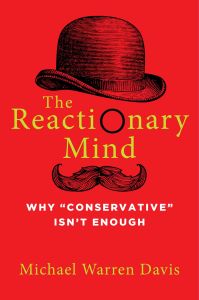
Arise, you consumers, from your slumber – arise, ye impoverished of purpose! Michael Penn Warren here picks up his pen in defense of medieval civilization, self-reliance, Luddism, and letter-writing. He bids the reader smash his cellphone and turn again to creating and producing, rather than consuming – to minding one’s own business and one’s garden. It is a fascinating, mirthful book that frequently provoked me to arguing with it, but always pulled me in further.
If Warren’s is a reactionary mind, what is it reacting against? Not much, just the last five hundred years or so of western history. He opens the book by inviting us to consider the medieval era, but without Victorian arrogance – to see its virtues as well as its limitations. Consider, he says, that people spent their lives outside working in the open air, mastering an array of challenging but often satisfying skills. People were tightly bound to one another and their places: their lives centered around a village church that sees them born, wed, and returned to eternity. Above the sea of clean air was the grand gallery of the Milky Way, with nary a light to spoil the view. Is that view highly romanticized? Yes, admits Warren, but so is our notion of progress: human nature remains as it was, but modern work is a drudge that many despise, we spend the majority of our days away from those we love, our homes are nothing but boxes to store the stuff we’ve bought trading our lives away, our minds are constantly bombarded with ads and notifications and never allowed to rest or focus – and our doctors’ bills and suicide rates testify to the degree to which modernity has impoverished us. The serf had little and was grateful for it: we live amid such abundance that we undermine ourselves body and soul, living in ungratefulness and addling our minds and often destroying our bodies with easy pleasures. The essential difference between the medieval world and our own is that the medieval serf and all those above him on the feudal hierarchy lived a life in scale with human needs, and saturated with a faith that taught temperance to the powerful and grace to the suffering. Warren writes in defense of the medieval not to argue for the restoration of feudalism, but to point that that there was Something pre-industrial life had which we do not possess, Something we have let go of and misplaced in our grasping after Mammon.
The second part of Warren’s book, elaborating on Why Conservatism Isn’t Enough, bids the reader to realize our problems cannot be solved politically, because the core problems are not political. They have more to do with the way we see the world, and the way we act personally build society based on that view – and the universal view of industrial nations is that we exist to produce and consume, to get and spend. For the last few decades, for instance, Warren writes that parties alleging to be conservative have embraced and endorsed the forces corroding what’s left of our social fabric: materialism, consumerism, the idolization of the Individual past any limit of reason. The medieval Christian viewed himself as a creature made in the image of God, and his life was centered on his role as a worshiping co-creator, tending the garden and raising a family. If we are to find lasting satisfaction and meaning, if we are to avoid laying waste to all our powers, Warren bids us re-orient our lives. We must rebel against modernity – not by raising an army and leveling the factories and data centers, but by refusing to become creatures in modernity’s image. Secede from “shallow, rotten, bourgeois culture”, he urges – and help create a sane, humane counterculture. On the individual level, Warren urges readers to drop out of the frantic meaningless of life, adopting techno-minimalism and practicing patient arts like letter-writing, pipe-smoking, and especially gardening – the latter crucially important. Gardening is not only a way to become more self-reliant, Warren writes, but keeps us in connection with creation. Readers who are familiar with Wendell Berry, GK Chesterton, Wilhelm Ropke, or E.F. Schumacher will spot their influences in Warren’s arguments and in his vision for a more humane society. Frankly, this section could have used more expansion.
The Reactionary Mind is not a book for everyone, admittedly. There are many who are perfectly comfortable in the 21st century’s status quo, and Warren does not offer comfort. He tells the reader directly that they’re being called to a more demanding way of living. Cooking for oneself takes more time and attention than picking up a packaged salad in Walmart; a letter requires more attentiveness and physical discipline than a text. But, that demanding way of life brings its rewards, as does taking on responsibilities: there is meaning and joy to be found in being a ‘hero in the strife’.
Related:
“Common Man“, Michael Warren Davis’ substack. Davis also appeared on Pints with Aquinas, talking for two hours on his involvement with the occult and his narrow escape from it. Very emotional interview, and informative as he comments the varieties of Satanism.
Crunchy Cons, Rob Dreher. On conservatives who are more like Joel Salatin and Wendell Berry and less like the GOP.
Alan Harrelson is a character. He’s a professor of southern folk music who talks like a Pentecostal preacher, who recently converted to the Catholic church and has a channel where he smokes a pipe (he has a pipe room) and talks about things.

 Reading Freely
The problem I always have with so-called Conservatives is that they’re always looking *backwards* to a way of life that never really existed and had a *lot* more problems than are ever admitted to. The Middle Ages were *far* from an idyllic time! Even if you had that way of life with decent health care it still wouldn’t be idyllic! Maybe it’d be OK or at least tolerable for the 2% at the top of the tree. The rest of them – not so much!
Ehh, capitalizing C makes me think you’re referring to politics and party, and that’s not Michael’s take at all. And yes, the medieval era was not an ideal time, but as stated in the review, that’s not his point: our modern arrogance over the towers of babel we are building blinds us what we are abandoning. without thinking about it in our zeal to make more money, etc. This is not a political view that can be assigned to conservatives/tories/etc because as Warren points out, those parties have, by and large, embraced the very forces of destruction. This is more about creating a reactionary, humane counterculture — and it is a counterculture that can be embraced by anyone who has rejected Business as Usual. I was on the fringe left when I bumped into people on the fringe right (see my reviews of Crunchy Cons, The Plain Reader, etc) and realized I had more in common with them than say, the uniparty that had Obama-Clinton-Bush-McCain as its microbial spectrum of ideological diversity. Pete Seeger, Ted Kaczynski, Wendell Berry, Rod Dreher — these are all VERY different voices, and yet there are similar criticisms in each to anti-human modernity. Kim Kimball’s “The Dirty Life” has a very modern woman — careeriest, progressive, feminists, etc — realizing how much more SATISFYING working on a family farm is. Mary Harrington’s “Feminism Against Progress” attacks postmodernity on the grounds that it dehumanizes both men and women, but (as her Reactionary Feminist blog would indicate) she’s primarily focused on its effects against women. You don’t have to be Jacob Rees-Mogg to object to the brutalism of the present day.
Yes, I was thinking more of the political ideology of Conservatism, rather than the personal. It might not be obvious from my Blog posts but I HATE goodly chunks of the ‘modern’ world with a *real* passion. To me it is fundamentally based on appearance to the detriment of substance. There’s a GREAT line in Steppenwolf by Herman Hesse (published in 1927!) that stunned me so much I could barely function for a long while. It summed up my feelings *exactly*:
“Whoever wants to live and enjoy his life today must not be like you and me. Whoever wants music instead of noise, joy instead of pleasure, soul instead of gold, creative work instead of business, passion instead of foolery, finds no home in this trivial world of ours…..”
So, I certainly see the point about rejecting at least certain elements of so-called Modernity and agree with Davis on that. For a small personal example, I only recently ‘upgraded’ my phone. Not because I wanted to, but because it was SO old it couldn’t handle 3G and the phone company was switching off the *really* old system to bring in 5G. I was at least THREE generations of technology behind other people – and it didn’t bother me in the least. My friends laughed at me (when I even bothered to carry my phone) but I didn’t care. The thing worked when I needed it to. What else did I need? Bevelled edges? I have a reputation amongst my friends for being a Luddite. Knowing what they believed, I carry that label with pride.
Inevitably, I have some books on anti-modernism (for want of a better term) that I hope to get to this year… I think you’ll find them interesting too!
Pingback: The Best of 2023: Annual Year in Review | Reading Freely