
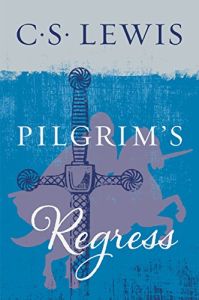
First up, C.S. Lewis’ The Pilgrim’s Regress. Lewis dashed this off immediately after converting to Christianity in 1933, and it’s a fictional and fantastical rendering of his own journey throughout the twenties as he fell away from his childhood faith, explored modern philosophies and the occult, and finally found himself back where he’d started. This isn’t a book I’d planned to read, because over the years I’ve encountered Lewis panning it himself in letters and such to his friends: he wrote it too quickly and it was much too abstract, he commented. I found it at an estate sale for free, though. From its title and premise it definitely reminds one of The Pilgrim’s Progress, but whereas Progress was ‘just’ theological, Lewis has his fellow John running across ‘secular’ philosophies as well — though, depending on one’s definition of religion, Fascism and Socialism can both function as a religion, something I realized when exploring the latter back in ’08/’09. As with Bunyan, different philosophies and ideas are represented through personalities — but the story around them isn’t as interesting as Bunyan’s, and the story is more rushed: most people come and go with the turn of a page. The plot is largely driven by Lewis dreaming about a man named John, who grows up in a little place with a severe absent landlord who has many rules and threatens horrible punishments for breaking said rules, even those that seem benign. John is driven from his home, Puritania, not just by his fear and hate of the Landlord, but in pursuit of something beautiful — an Island — out there. His hunt for the island, Lewis’ ‘stabs of joy’, takes him all over the realm, meeting rationalists and idiots, noble warriors and dwarven savages, over and round and attempting to find a way to cross a great chasm. There’s a little woman named Mother Kirk who says she can help.
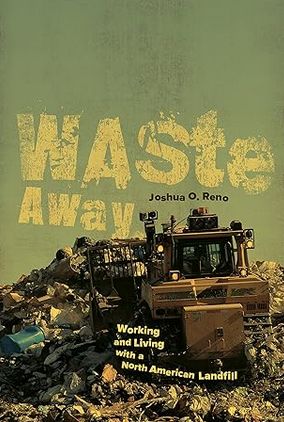
I’m something of a garbage book connoisseur, so on learning that I’d missed one in the last few years, naturally I had to hunt it down. It’s…an anthropological study of the men who work in landfills, and occasionally of the people who live around them. Imagine someone getting very pompous and academic about talking about people who work trash, and…well, there you are. That’s the book. There are several paragraphs given over to the importance of gloves, and the end-of-day ritual in which one’s gloves are disposed of, signifying both one’s freedom from the job of landfill worker, and the eternal cycle of trash: that which handled trash has now become trash — “the garbage keeps coming” is one mantra of the landfill managers. The book is less about trash and the handling thereof, and more about the men who work in the landfill, and those who live around it — who have, in the post industrial age, seen their cities dry up and had to trade keeping the roads paved by becoming the site of a mega landfill which they now attribute to rising health problems in the area. The most interesting chapter to me was “Smells Like Money”, in which we learn of how workers justify the indignity of handling other people’s trash (even Canadians‘) with the money they make, and how some who were pushed from the working to the ‘middle’ class in terms of income try to live up to expectations, creating a hedonic debt cycle that they can’t seem to escape from. Reno worked at the landfill as part of his graduate dissertation, but unlike Lawrence Oulett’s Pedal to the Metal, Reno is not only known to the landfill workers as a grad student but sticks out from them. (Oulett had driven trucks before he began studying drivers, so he blended right in.) Consequently, he catches a fair bit of hazing from the other san-men. Personally, though I have a great interest in the broader subject of waste and sanitation, I found Waste Away to be much too much impressed with itself.
More Trashy Books:
Rubbish! The Archaelogy of Garbage
Junkyard Planet: Travels in the Billion Dollar Trash Trade
Garbology: Our Dirty Love Affair with Trash
Picking Up: On the Streets and Behind the Trucks with the Sanitation Workers of New York City
Garbage Land: On the Secret Trail of Trash
Gone Tomorrow: The Hidden Life of Garbage
Waste and Want: A Social History of Trash

 Reading Freely
Pingback: November 2023 in Review | Reading Freely