
Between work and school projects my list of read-but-unreviewed titles is growing, so…alas, it’s short rounds time.
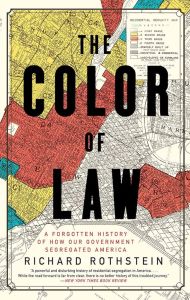
First up, The Color of Law, on how housing segregation was purposely pursued, not merely tolerated, by the federal government — primarily through zoning and redlining, but occasionally through more creative measures like “condemning” empty lots and declaring that the city was seizing them for use as parkland. I already knew the FHA is responsible for why the United States is eaten up with asphalty sprawl like a stage-5 cancer patient, but Color makes them even more hateable by demonstrating how explicit “no sales to blacks” rules were part of FHA and then VA policy. Rothstein also covers other ways federal policy has directly undermined black homeownership — by driving interstates through entire neighborhoods, for instance. Motives for creating and enforcing the segregated housing varied from the pretending-to-be-respectable claim that segregation avoided racial strife by avoiding racial mixing to the more honest self-interested fears about property values, to the good ol’ lizard brain fears of crime, especially rape. While Rothstein was presumably not writing to give an angry libertarian more fuel for the anti-FHA fire, I look forward to incorporating the racial aspects the next time I go Ron Swanson on someone.

Uhtred’s Feast by Bernard Cornwell and Suzanne Pollak, consists of three short stories about Uhtred of Bebbanberg bracketing a bunch of recipes for medieval Anglo-Saxon style cooking. I just read the short stories, being far removed from wild boars and mead. I enjoyed the stories, naturally, especially the one set during Uhtred’s youth, before he was captured by the Danes. Hard to recommend it generally, though, given the mixed content — people who are into stabbing, speech-making, and backhanding bureaucrats are not necessarily into cooking medieval style.
And wrapping up this short round is The Excluded Americans: Homelessness and Housing Policy, which is exactly as exciting as it sounds. It’s a 40-year old book brimming over with graphs, tables, and frightening words like “P-factor” and “regressive analysis”. William Tucker opens by reviewing factors that homelessness is commonly attributed to (poverty, joblessness, etc) and then looking for those that are most clearly and consistently tied to it. Although the book is extremely dated at this point as far as the data it employs, there are nonetheless some interesting lessons to be gleaned. Although it was common to attribute rising homelessness to the Reagan administration reducing housing assistance authorizations, Tucker points out that there is a difference between authorizations (which can take years to actually be used) and expenditures. While Reagan did dramatically reduce future authorizations, the actual outlays of funds for housing assistance increased during his administration. Tucker delves into the economics of the housing market, pointing out that historically, lower income citizens have always found housing in older buildings but the available stock of that has been greatly reduced by ‘urban renewal’, which destroyed wide swathes of housing stock which were insufficiently replaced — echoes of something that happened in the early Progressive movement, when residential hotels were attacked and closed on various grounds, ranging from the usual ‘Ew, poor people‘ to ‘Harrumph, harrumph, middle class people who live in hotels aren’t growing in responsibility the way real homeowners do’. The author is very critical of rent control, which — while sounding like a way to maintain affordable prices — privileges current owners and squelches new investment. Unfortunately, despite how dated the book’s data is, the core problems are still the same: despite issues with homelessness on the west coast, for instance, city leaders are still resisting permitting ADUs, microhomes, etc.

 Reading Freely
‘The Color of Law’ is on my Wish List. I’ve seen a few YouTube videos about the racial element of Town & City Planning in the US. It seemed to be *very* pervasive!
One thing to keep in mind is that it was pervasive, but also passive for SOME elements. Like, not every single expanding community in the United States was consciously going “no blacks”, but they were all relying on the same FHA rulebook, and — in the case of zoning — municipalities would just adopt the ‘default’ zoning codes, which is why everything built after 1960 has the same stupid rules — big setbacks, huge parking lot aprons, etc.
Sounds like a ready-made “Just following orders” excuse…! I suppose it helped with any potential or actual legal action too…
Nah, it’s just bureaucratic laziness No one looks at the regs to see what they’re adopting as their template. Bit like what everyone these days does with EULAs!