
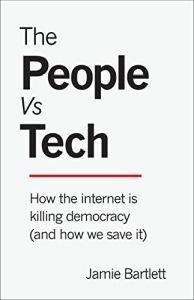
Democracy must bring big tech to heel, adapt itself to thrive despite big tech, or perish. Born of different times, with different expectations, they cannot coexist in their present date: the latter will surely destroy the other. In The People vs Tech, Jame Barlett examines six aspects of a healthy democracy that big tech is already challenging, or will in the future. These include independent-minded citizens, a shared culture based on a common reality, free elections, an economy allowing for participation and good-enough equality, and trustworthy authority. There is considerable food for thought here, and it’s presented in admirably nonpartisan fashion, so that even if a reader disagrees with Barlett, his view is approachable and understandable.
Much is discussed in his chapters on these six pillars. We begin with how tech nudges us into compulsive behavior, chilling or warping our thinking, and aiding and abetting in our self-infantalization by doing mental work for us. You don’t want to read a pdf? Bing has a helpful new AI companion which will reduce it to a few bullet points to memorize and forget. Were there sudden flashes of insight you might have gotten in reading the article and unexpectedly drawing connections to your own experiences or other reading? Oh, well, that’s life. We move on to how through our own choices and the recommendation engines, users of platforms like YouTube and Facebook sink into narrower and narrower worldviews, losing common frames of reference with citizens beyond their in-group. We see, too, how the hurricane of stimulation that sweeps over us online, the constant demands to Respond! Now! undermines our ability to think deliberately. How can we understand someone else’s worldview when our own has not been developed purposefully, but is instead a pile of reactions? Similarly, the data profiling of consumers which allows micro-targeted ads can be uses to sell politicians based on a single issue instead of people voting on a broad, cohesive platform. We then move into what big tech might do to society at large, if automation creates hyper-inequality and leaves most of the population with no meaningful way to contribute economically, and by moving every bit of civil society onto its platforms. Finally, Barlett examines the potential perils of cryptography: if the main reason people tolerate the state’s incursion to their rights (its taxes, its self-asserted monopoly on violence, its prisons) is security, and cryptography undermines the state’s ability to find and police bad actors, what then?
As someone whose young adult mind was formed by tech critics like Neil Postman and Nicholas Carr, I can’t offer any serious arguments against Barlett here, on the whole. Much of what he says has already been on my radar, although the last two chapters were new to consider, and the latter was particularly thought-provoking given my conflicted sympathies. There was much in here I appreciated being reminded of, of lessons updated for the current day — what we give away in agency and maturity when we rely on machines to do more of not merely our manual labor, but our mental work as well. I’m not convinced that automation will lead to the extreme inequality he predicts, though I can appreciate why he sees that coming. His example of Silicon Valley as a hyper-equal community was off, though: homelessness abounds in southern California not because Google and Facebook’s execs are distorting the labor market, but because the mild climate attracts those in need, and the local governments are generous — to a fault, both in what they give and what they tolerate, behavior wise. One limitation of the book is that Barlett doesn’t offer much in the way of solutions, though these are big problems and the nature of them precludes easy answers. How do you put the crypto-graphical cat back in the bag?
Related:
The Dark Net, Jame Bartlett. On the darker parts of humanity released by the internet, especially the parts hidden from public view.
Player Piano, Kurt Vonnegut. In an automated future, the only people with anything to do are those who manage the machine.
Them: Why We Hate Each Other, Ben Sasse. Chapter on “anti-tribes” is especially relevantt to one of Barlett’s points.

 Reading Freely
Pingback: Highlights from People vs Tech | Reading Freely
I think that particular genii is never going back in the bottle. We’ve already seen the Future – its a variant of Cyberpunk. Most people will cope, many will adapt, some will do well and a few will thrive. A few will fail too, they will crash & burn unfortunately…. We certainly can’t stop it – even if we wanted to and I’m guessing most people would be horrified at the thought of stopping or even heavily regulating such things. I think they only thing we can do is to teach people methods for coping – give them the tools and the skills to become good, productive, safe, and happy netizens.
Pingback: November 2023 in Review | Reading Freely