
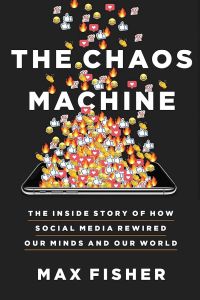
One of my core beliefs is that we live in a world which we made for ourselves, and yet which is not fit for ourselves. Our eyes expect to see what they do not see, our arms reach for which they cannot find to grasp, and our brains writhe under the stimulation of the unexpected and the starvation of the desperately needed. Just as industrial food products mesmerize our brains by adding the right chemicals to tickle our synapses and hit us with dopamine, so to does social media — but to the pleasure of connection, it adds the insidious pleasure in being vengefully and righteously indignant. The Chaos Machine is an interesting analysis of the different ways social media plays on our minds, and a sometimes sloppy history of that manipulation’s effects on societies across the globe — though largely focused on the United States. It ranges from chilling to insulting, and will nevertheless be one of this year’s more memorable reads.
Chaos Machine opens with a mother trying to find out more information on a vaccine discovering that facebook was rife with groups discussing nothing but the evils of the same, and it pushed her into ever more of them as she explored with morbid and astonished curiosity. Not a naif, she realized straightaway that she’d unwittingly stepped into some kind of engagement treadmill. From here, Fisher switches into how that engagement treadmill was built, beginning with a history of Silicon Valley but quickly shifting into the neurological factors at play, which we encounter as the history develops.The great strength of the book is that assessment — beginning with how a website or app is assigned to trigger dopamine from likes, addicting us like casino junkies. More critical, though is that this is social media: humans, as social animals, are highly tuned to pay attention to how we are regarded by the communities we are in, with an inner sociometer that tries to assay our standing. Mechanisms like the “like” button engage it directly, which is why we feel rewarded or crushed when a status update or a photo doesn’t receive the attention we believe it merits. Our attention to social feedback also makes it possible for us to work one another into outrages, in which our behavior becomes more antagonistic toward The Other — especially if we believe our group or its values are being attacked. Even more cruelly: while contact theory used to hold that people from different groups could moderate their opinions if they were exposed to others, it turns out there are specific contexts required for that to happen — like neutral territory and a shared task. If people from disparate groups are shoved together on the same platform, then what happens is not United Nations dialogue, but the rancor of soccer fans and the online hooliganism that follows. Basic psychological tools that our natural history has given us for self-domestication, like shaming and reprisal, are allowed to bloom cancerously large on social media platforms, their natural checks absent altogether. Still worse is that the platforms have a huge interest in maintaining this kind of engagement, because user engagement means ad revenue — and at this point, Google and Facebook’s engineers aren’t even doing the driving. Their algorithmic engines were trained to increase user engagement, and if that means sending people into Q-anon groups or offering them playlists of children in bathing suits, so be it.
The Chaos Machine is brilliant when analyzing how social media hijacks our brain, using our primordial instincts to maximize User Engagement at the price of weaponizing those platforms, polarizing users, allowing misinformation to profligate, and providing a silky-smoothy highway to mass violence. Although no book is truly free of bias, Chaos Machine‘s own grows steadily more pronounced as the book develops, however, with outright falsehoods written into the narrative — asserting that Candace Owens promote violence, for instance, and claiming that Jordan Peterson instructs young men into blaming their problems on others. Anyone who has watched Peterson will quickly realize what a lie that is, given that he attacks the blame-game attitude and encourages men to find meaning through responsibility to others. There are token efforts at being equal-opportunity earlier in the book. Take, for instance, when Fisher shares the case of a black college student who claimed a guard was racist for asking her to leave an empty lunchroom — not only did video evidence show that the security guard (called by the janitor, per policy) was perfectly polite and explained to her that this particular lunchroom was reserved for children, but she named the wrong man as the janitor in question. The man was harassed and suspended for her attention-seeking shenanigans, and yet the ACLU still hosts her vainglorious harrumph-harrumph article without mentioning the author’s willful misinterpretation of the events. By the midpoint, though, Fisher drifts into full partisanship with the aforementioned inaccuracies. It’s a pity he couldn’t stay more in the middle: realizing how poisonous social media is is vital for everyone, not just those who care about it because they think it and it alone led to the Dreaded Orange Man’s winning the elections. All this would matter regardless of one’s own politics, both the personal addiction and the effects on societies at large. Personally, I stopped using twitter at the beginning of this year and de-politicized my reddit feed because I realized how routinely angry and edgy it made me.

 Reading Freely
Pingback: Chaos Machine Highlights | Reading Freely
While I have not left X (the site formerly known as Twitter), I use it primarily for keeping in touch with a close friend and others with whom I share cultural interests. Likewise, I use Facebook for keeping in touch with family and long-time friends.
It is difficult to imagine the impact of social media on the generations that have grown up surrounded by it, as well as the insidious impact of “TikTok” on such sites as Instagram and even Facebook.
I pine for the era of great epistles and intelligent literary salons.
I’m very grateful to have been born in the last generation with any chance of remembering normality.
LOL- It *is* quite a contrast, isn’t it! Living in a time “Before Internet” hardly feels real… [grin] and when you tell youngsters about it they look at you funny, shake their heads and just don’t believe you…
Relevant article:
https://thespectator.com/topic/jonathan-haidt-smartphones-dooming-generation
Pingback: November 2023 in Review | Reading Freely
Pingback: The Best of 2023: Annual Year in Review | Reading Freely
Pingback: Social media: frenemy or foe? | Reading Freely