
288 pages
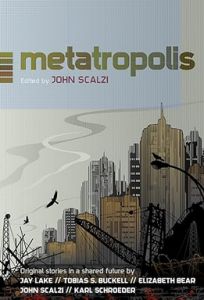
Metatropolis collects five short stories from a “shared future”, all in or about the future of the city. That vision is not one of growth, however, but of retraction and collapse. Expect nothing like the Sprawl here. I was drawn to this collection for both the urban connection (cities are technological revolution made visible, and casting a long shadow)and for the editor and contributor, John Scalzi. Initially, I shelved the book after realizing it wasn’t about smart cities (dystopian or otherwise), but decided to give the premise a shot. The shared future is not quite post-apocalyptic, but factors like climate change and peak oil have essentially turned America into a failed state: local forces like cities and gangs have far more presence and power than the essentially nonexistence threat of DC. The collaborative nature of the project is visible not only in its shared histroy, but in the common themes, like the central place of ecological management, and the potential that tech has to create more distributed rather than command/hierarchical activity. Strong collection on the whole, with some weak spots.
In “In the Forests of the Night”, we encounter an anarchist ecovillage/green city built in the lava tubes of Cascadia, which has drawn the attention of two very different personalities: a female special agent in the employ of we-don’t-know-who, and a mysterious but very charismatic man who simply calls himself Tyger. There are other eco-villages out there, but they’re falling under attack by (insert villain sting) Capital. This piece introduces us to the future these stories are all set in, one in which the United States proper has more or less fallen apart, both due to climate change and the fact that the corporations it charted have more power. I was very interested in the eco-village, but the author focuses more on the interplay between three characters (Tyger, the female agent targeting the town, and the town’s security chief). I liked the premise and the fascinating setting, but the mystery of Tyger is never explained, nor does the plot make sense.
“Schotastic City” shifts us inland, to a dying Detroit where a bouncer is introduced to an opportunity for odd jobs by his barkeeping friend, and unwittingly drawn into into a revolutionary movement. This story explores distributed political activity and green urbanism. Haunting are the scenes set in The Wilds, suburbs now being reclaimed by nature, having been abandoned by all but the most desperate given their distance from economy activity. “The Red in the Air is Our Blood” follows this, and is oddly similar, being set in Detroit and following a character who becomes part of an eco-oriented intentional community. It’s rather short. Both of these stories demonstrate that society is in a stage of decay and reclamation: a new world has not been created, the old world is not entirely dead, but those who have lived in both are actively trying to create the one by scavenging the other.
“Utere Nihil Non Extra Quiritationem Suis”, by editor John Scalzi,follows a young slacker whose lazy approach to school sees him assigned a job as a waste technician at a pig farm in New St. Louis. This is by far the easiest story to get into, in part because it’s a straightforward tale — though it helps that we’ve already gotten used to the idea of these cities as closed communities. The nature of the closure is not merely for security, but as we see here is also useful for ecological management: the pig farm is arranged so that no energy is waited, for instance. That creates tension and drives the story, because people living outside of New St. Louis want the resources and systems that created its prosperity — and while there are some in the city who would be willing to share, allowing tech (including genetically modified animals) to filter out without discipline would be disastrous.
“To Hie from Far Celenia” is the most unusual of the lot, as it features a virtual-reality overlay ‘game’ in which people navigating meatspace can “see” instead that world in the form of a techno-fantasy RPG, where people can assume different identies and real-world tasks appear in the form of quests and the like.In this story, the law is investigating the possibility that the game is being used for a criminal, terroristic reason as well. This was interesting to a degree but got increasingly more abstract.
Related:
Amazon’s “Warmer” collection, which I largely disliked (save for a couple of stories) but is also environmental-SF.
Daniel Suarez’s Daemon and Freedom(tm), especially relevant to the last story.
Jim Kunstler’s “World Made by Hand” series, in which peak oil has led to collapse of the industrial-technological order, but is set far enough from that collapse that some stable communities have already formed.

 Reading Freely
Sounds interesting. I recently picked up a copy of ‘Speculative Los Angeles’ edited by Denise Hamilton you might like. Apparently its the 1st book in a proposed series of future city short story collections. I was going to pair it with a non-fiction about 30’s/40’s LA.
Pingback: October 2023 in Review | Reading Freely
I have been wanting to try John Scalzi so this could be a nice place to try out his writing along with other sci-fi authors! I can’t say that I love stories when they get too abstract but some of these sound great. Cool premise and thanks for your review.
Depending on your tastes, you might like his “Agent to the Stars” — it’s a comic SF novel in which a Hollywood agent is asked by aliens with an unfortunate appearance and smell to introduce them to the public. He’s a varied author, though my favorite find in recent years is Cory Doctorow.
Pingback: Solarpunk stories: a novella and short stories | Reading Freely
Pingback: Top Ten Tuesday : It’s cold out, pull up the covers + SciFi month prompt | Reading Freely
Ooh, sounds great!
I read a fascinating nonfiction book on this topic and related ones: https://www.goodreads.com/book/show/55979381-the-future-of-buildings-transportation-and-power
Ooh, thanks for that! Definitely in my area of interest.
And I see it has become a series, with other short story collections: https://www.goodreads.com/series/73854-metatropolis
Yep! I haven’t continued in it yet, but am interested.