
This past week I’ve finished two books about ghost-hunting: one from “the only full-time professional paranormal investigator”, Joe Nickell, and the other from journalist Will Storr. I’ve read both men before: Nickell’s Real Life X-Files from 2008, and Storr only earlier this year. Nickell is essentially a debunker, though he would dispute that, and Storr is a journalist with an enormous tolerance for submerging himself in unusual circumstances amid unusual people.
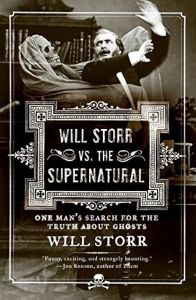
Storr’s Adventures with the Enemies of Science will be remembered as one of my favorite books of 2023, for its fascinating blend of science and weirdness. Will Storr vs the Supernatural is more Storr recounting his adventures with ghost hunters, exorcists, and shrinks, in which he has a few encounters of his own that rattle his own disbelief. Unlike Adventures, though, there’s not as much back and forth with Storr trying to inform his understanding of of those holding on to marginalized beliefs by talking to scientists who are more versed in the area. Instead, Storr encounters a series of people with wildly different interpretations of their experiences, or with ghosts in general, and by the end he’s so shell-shocked by one particular visit (involving a mentally unwell woman projecting her beliefs in ghosts on her autistic child, in a situation that screams child abuse) that he dismisses everything as either crazy people or quantum physics. It’s far from the thoughtful Storr of Adventures — the one who could hang out with people who talk to the voices in their heads, then explore schizophrenia as a kind of neurodivergence. This is especially interesting given that he himself records experiences within the book — a cold hand on his back, a feeling of dread and malice so deep that he feels compelled to leave a room — so that even though I don’t believe in ghosts myself, Storr gave off “trying to convince himself” vibes by declaring everything was quantum physics. There are some interesting chapters in here ,though, particularly his interview with a psychologist who has studied the psychology of paranormal belief, and explains that people can prime themselves and actually induce feelings in themselves — so that if something happens, the brain not only interprets it through a lens of belief, but actively experiences it through that lens. One interesting commonality among those interviewed is a denouncement of oujia boards: priests, witches, and ordinary ghost hunters alike viewed them as dangerously chaotic. Similarly, everyone agreed that paranormal activity usually needed to feed off of human activity to manifest itself — whether that be people fooling around with oujia boards ,or being in an emotionally aroused state to begin with.
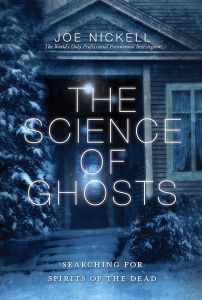
Joe Nickell’s The Science of Ghosts is more straightforward “This is the report, and this is why it’s nonsense” writing, with different kinds of hauntings grouped together (Civil War ghosts, theater haunting, etc). Nickell introduces each section with context, so we get a history of the spiritualism movement of the late 19th century before examining those specific claims. Nickell’s background and interests make him a keen investigator: he has performed as a magician, for instance, experiments with photographic effects, and has a background in folklore that he uses to analyze ghost stories from a different angle than most. When flipping through the book at the post office, I was surprised to encounter the familiar visage of Robert G. Ingersoll, a masterful orator of the late 19th century who was known for his skeptical lectures — evidently so much so that one person claimed his ghost was using her hand to rebut himself after his death and urge sinners to return to God. Nickell conducts a literary analysis of the “ghost” Ingersoll and the genuine article and points out how stylistically and grammatically dissimilar they are. Several of the cases were proven as frauds in their own lifetimes, but are nonetheless still believed in — like the Fox sisters, who admitted they were putting audiences on, but whose confession is regarded as forced or done for ulterior motives. The book is really just a series of cases and commentary, though, not a deep dive into the various environmental or psychological factors that lead to perfectly rational people believing in hauntings.
Coming up: Neuromancer, dead people, Star Trek, and more SF.

 Reading Freely
Recently downloaded the Neuromancer cover, so I’m all ready to go with my review tomorrow.
BTW – If you’re anything like me… you’ll like this YouTube channel (if you don’t visit it already!).
https://www.youtube.com/@Spacedock
Will redouble my efforts to finish tonight…got distracted by ghosts! The channel definitely sounds familiar, but I’ll know once I click after work.
Pingback: Science Survey ’23 | Reading Freely
Pingback: Haunted house BNB? + WWW Wednesday | Reading Freely
Pingback: Living in Wonder | Reading Freely