
288 pages
Nick Haflinger is a man of many names and identities, on the run from what passes for the government these days. With so much of the population constantly on the move, existing more in the plugged-in virtual realm than in reality — and with reality itself so flexible, people abandoning jobs and spouses and children in the blink of an eye when the whim strikes them — it’s hard to maintain order. Even so, Haflinger, a rebel, will find ways to attract trouble to him. No matter how many times he transforms his identity, his prodigious gifts at manipulating networks draw attention. Shockwave Rider is an exceptionally interesting novel, notable chiefly for its imagination: how, in 1975, did someone realize how radically disruptive networked computers would be to society? How did Brunner think up computer viruses, even coining the word ‘worm’ to refer to one?
The Shockwave Rider is a chaotic novel, frequently switching viewpoints and temporal frames even when its main character is not himself becoming different people. This is presumably deliberate, given that Brunner was writing inspired by the ideas of Future Shock and trying to convey a world even more in flux than our own: while we are on a runaway train called liquid modernity, the upset is worse in Brunner’s future dystopia, where a natural disaster has destroyed much of southern California, and entire populations are constantly on the move, chasing jobs or moving at whim. Society is severely unstable at every level: even families are not real units, since parents swap kids and spouses with as much thought as we do dishes at a restaurant — and readers are given the impression that most people deal with this through sedatives. The main character takes things even more seriously, frequently changing himself to escape the law or to gain access to networks that would otherwise be closed to him. Despite his technical talents, he encounters a young woman who sees through his psuedo-identities, into the man he really is. He’s disarmed by her, and their meeting will usher in a plot of tech-adventure and Nick’s finally taking a stand, instead of fleeing.
The Shockwave Rider is a difficult book to recommend — not because it’s bad, but because it’s somewhat esoteric. In its time, it was enormously far-seeing and experimental, and its artist’s vision makes it doubly interesting to those who take SF seriously, particularly the effects of the digital world on human civilization. Frankly. one reason I’m drawn to cyberpunk (and Shockwave Rider is the granddaddy of that genre) is because I believe whatever the perks, the disruptive energy of the digital revolution, coupled with human instincts that we have a marginal ability to control even under the best of circumstances, will ultimately lead us into nightmarish futures like that of Brave New World‘s — and BNW is arguably on the better end of human futures, since at least there most people are content. They are content because they have been severed from all that makes living real and worthwhile, but they’re not acutely miserable like the people we see in Shockwave Rider. This is definitely an ideas kind of book, and if you think seriously about the world we are creating for ourselves, about the effect the digital has on the real, you will enjoy it. If you’re going into it purely for a plot, though, you may be disappointed. There’s a plot there, but the delivery is rather disorienting — and that’s done pointedly, I think.
Coming up: I’m working on The Chaos Machine, and will be beginning The Neuromancer. Also reading Will Storr vs the Supernatural: One Man’s Search for the Truth about Ghosts. Storr’s Adventures with the Enemies of Science will be on my top ten list at the end of the year, I’m sure, and it’s an appropriate time of year to delve into a journalist’s hanging-around with ghost hunters.
Highlights:
“There’s a lot of brave new misery in our brave new world.”
“Take no thought for the morrow; that’s your privilege. But don’t complain
if when it gets here you’re off guard.”
“One might as well claim that the tide which rubs pebbles smooth on a
beach is doing the pebbles a service because being round is prettier than being
jagged. It’s of no concern to a pebble what shape it is. But it’s very important
to a person. And every surge of your tide is reducing the variety of shapes a
human being can adopt.”
“There was exactly one power base available to sustain the old style of government,”
Nick grunted. “Organized crime.”

 Reading Freely
I read this back in 2012 (surprisingly for the first time despite my love of SF and Cyberpunk). It’s certainly an *interesting* read both from a literary and cultural perspective. My review is here:
https://cyberkittenspot.blogspot.com/2012/02/just-finished-reading-shockwave-rider.html
I can recommend ‘Islands in the Net’ by Bruce Sterling if you’re interested in carrying on looking into this sort of thing.
Odd that I hadn’t run across your review before, but I don’t think it was on my radar until the last couple of years. Adding “Islands in the Net” to my list!
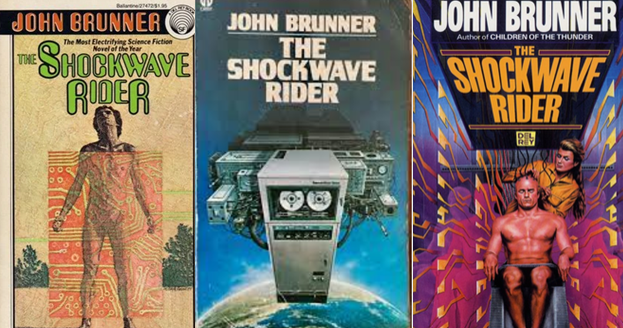
Again, I read this novel several decades ago – in the paperback edition that you pictured on the far left of your trilogy of editions depicted. I enjoyed Brunner’s work, especially The Squares of the City.
In reading about that novel, it looks like Brunner made a habit of structuring his tales in such a way as to support the story — sometimes at the cost of readability?
Pingback: October 2023 in Review | Reading Freely
Pingback: The Best of 2023: Annual Year in Review | Reading Freely