
264 pages
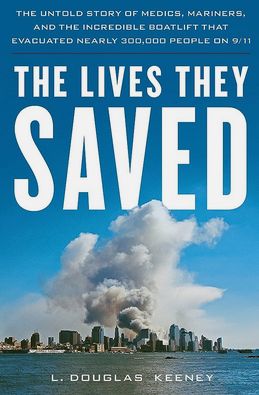
“Look for the helpers”, Mr Rogers advised children who were frightened by disaster. L. Douglas Keeney here offers a spyglass to readers. Instead of fixating on the flaming towers, the clouds of smoke filled with dust, jet engine fumes, and god-knows-what-else, he directs our attention to the waters around Manhattan, where the largest evacuation in human history was happening, largely ad-hoc. There was no FEMA plan for “Civilian-Led Evacuation of Manhattan”: emergency services plans for treating disasters at the WTC complex largely fell apart when the debris from the Towers covered roads. Keeney tells — or rather, allows the participants to tell — the story of how that boatlift happened, of how NYPD’s marine units, the Coast Guard, private ferries, tugboats, pleasure craft, etc all began casting their eyes toward the seawall and moving to help those they could. This is not a book exclusively about the boat evacuation, though: more broadly it’s about first responders, of people who were on the scene when the horror began to unfold, who responded immediately. We find firefighters and medics eating their breakfast abandoning their plates and moving toward the inferno to save who they could, the medics creating on-the-ground triage centers in lower Manhattan before 2 WTC’s collapse made the entire area a dangerous hellscape. The boat evacuation began unplanned — first responders realized the fastest way to get the gravely injured to hospitals was to get across the Hudson into New Jersey — and was later given the heft of government support when the towers had both fallen and all ships in the harbor asked to participate. A great multitude were already. Although there are many scenes of horror and tragedy here — do not read this with lunch — the great theme is ordinary human heroism, of people triumphing over their fear and their pain to do What Needs to Be Done. Disasters created by the worse demons of our nature often bring out the better angels — and The Lives they Saved is filled with such angels. One caveat: this book needed some sharper editing. There’s some serious misorganization toward the end, and a lot of repeated facts — some in paragraphs that follow one another. The spotlight on ordinary greatness, however, and the introduction of parts of the disaster I’ve not encountered before, still makes this an easy recommendation. Comparable titles are The Only Plane in the Sky, the best oral history of 9/11 imaginable, and Touching History, the story of the day as experienced by airmen and the airlines themselves.
Highlights:
She didn’t need to be told it was bad—the visible carnage said all that—but how bad was it? How close had the victims been to the impact zone? She wanted to understand the situation. “They brought us to a guy burned from head to toe. I said to him, ‘I know this is going to be a strange question, but I have to know what’s going on in those buildings. For everybody’s safety, can you please just tell me where you were.’ He looked at me and said, ‘I was in the basement of the North Tower.’ I said, ‘My God, these people are coming out from the basement. What is going on in that building?’
Unlike the jetliner that hit the North Tower, which hit it square in the middle, United 175 hit off center, near the edge of the South Tower, which allowed more energy to pass through the building and more debris and burning fuel to surge out into the sky on the opposite side. “(I) could feel the heat from the explosion through the glass in our windows,” said a witness. To give some perspective, he added that his offices were nowhere near the South Tower. “Our offices are about 10 blocks from the Trade Center site.
HROUGHOUT THE DAY, ACROSS THE CITY, THE WELL OF GOOD SAMARITANS ran deep, the unsung acts of kindness too frequent to count. The owners of a corner hot dog stand stood their ground even as frightened people swept past them. No doubt they were just as scared as anyone, and they were certainly covered with as much sweat and dust, but they had their carts and their carts were filled with bottled water and soda and, what with the attacks and the collapses and the injuries, maybe that was just what someone needed. So they stood by their cart leaning into the crowds and handing out a can of soda here and there as if they were a relief station alongside a marathon. One survivor ran past them and saw what they were doing, and it hit him, the kindness of it all standing in such sharp contrast the horror of the attack.
The boat captains went back too, men and women not paid to run toward a calamity, not hardened by years of dealing with emergencies. “We knew we had to go back, but we didn’t know what was going to happen to us,” said Jim Peresi. “We were hearing that there were four planes still in the air. We heard they just hit the Pentagon. You know, you don’t know what to expect. We’re figuring [the terrorists are] coming back up here so, yeah, going up [to Manhattan to take on passengers], you didn’t know if you were coming back. You didn’t know. That’s probably the hardest part about it.” “We were afraid, but we were not afraid,” said EMT Immaculada Gattas, Division 6, FDNY, putting it into her own words. “We never thought about dying, we only thought about helping other people.”
“The response was incredible,” said Coast Guard Rear Admiral Richard Bennis, who at the time was USCG Captain of the Port. “Every single vessel in the Port of New York responded to Lower Manhattan. All you could see was vessels streaming into the harbor … every fast ferry, every tugboat, the pilot boats, the Army Corps of Engineers boats, Coast Guard boats—every able boat in the harbor responded to Lower Manhattan.”1 During World War II a total of 338,226 soldiers were evacuated by boat from Dunkirk, France. In New York, 272,539 were evacuated by boat from Manhattan.2 Dunkirk took nine days, May 26 through June 4, 1940. The boat lift of Manhattan took less than 12 hours. The boat lift of Manhattan was thus the largest single-day boat lift in recorded history.3 The tugs, emergency patrol boats, dinner cruise boats, Randive, the Corps of Engineers, Circle Line, and New York Waterways Spirit—all of them came to the assistance of a paralyzed city.
One of the bosses said, ‘these baloney sandwiches in this box over here, don’t eat those, they’ll make you cry.’ So, I think, ‘they’ll make me cry? What are they spicy or something?’ He just shook his head and walked away.” Puzzled by that, the firefighter reached in and pulled out a brown paper bag and looked inside. “[I] opened the flap and there’s a little crayon picture of a rainbow and flower and ‘we love you’ written in crayon. So, I open the bag up and there’s two peanut butter and jelly sandwiches in there and another little note from a girl named Megan and a girl named Melissa. [It says] ‘We love you firemen. Keep up the good work.’ [There was] like a little drawing of a stick figure and the Trade Center and a flower. On the back of the note it said, ‘Made with love from the Coman Hill Elementary School Kindergarten Class.’ We’re sitting there, grown firemen, rough, tough guys getting chocked up and teary eyed over a frickin’ peanut butter and jelly sandwich.”

 Reading Freely
Content-wise I loved this book because these stories are so important. I don’t think I will ever get tired of ready books about that day, it was too traumatic and formative for us to ever become numb to or immune from. The editing though…OI. I don’t know how it was published as-is. Whole paragraphs were repeate word for word. It made me cringe so hard.
That may have been part of the problem — like with John Grisham and John Patterson, quality can be deprioritized because the ‘brand’ (in this case, 9/11) will pull in the buyers.
Pingback: Fall and Rise | Reading Freely