
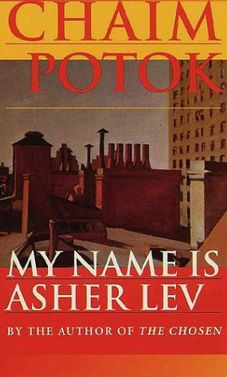
372 pages
How to describe My Name is Asher Lev? The book opens with Asher himself describing himself as an apostate, a traitor, a mocker — and yet the reader will find no cruel intentions here, only a young man struggling with feelings and attempting to give them form. Young Asher is the son of an important man in the Ladover Hasidic community, the right hand of the rebbe of a worldwide movement. He is the heir expectant, and despite his faithfulness to his father’s ways, young Asher has no interest in schooling, yeshiva or otherwise. Hee is drawn to art, pulled by it despite the protestations of his parents and the mocking of those around him — mesmerized by another tradition he is repeatedly warned against, enraptured by images forbidden to him and which cause confusion and pain to those around him. This is an extraordinary novel, one that dwells on both the struggle of a young man to find his own identity apart from his parents, of being understood by them despite being distinct, and at the same time an exploration of the power of art.
The story takes place from the late fifties to the sixties, ending not long after JFK is shot in Dallas in 1963. Like Potok’s protagonist in The Chosen and The Promise, young Asher is born with a place already established for him: he is to absorb the traditions of his people, watch his father studiously, and assume his elder’s position when the time comes. But Asher, growing up and seeing how heavy his father’s mantle of responsibility lies not merely on him but his mother — who is often sick with worry for her husband’s sake, as he travels abroad in Russia and other places hateful of Jews, and who works to keep the family fed during these long seperations — is moved by the intensity of their feelings and seeks to capture them on paper and canvas. He is discouraged repeatedly, but reveals an enviable talent that others around him feed, and soon art commands him to rebel. He ditches school and wanders into museums, studying the paintings there that strike him, and attempting to copy them in his sketchbook. To make images as as an Orthodox Jew is one thing, but some of the paintings he copies (learning forms, shading, perspective, etc), some of the subjects that fascinate him, are scandalous to his father and to their entire community. What kind of Jew is obsessed by the Crucifixion of a man whose name is not even permitted in the Lev home? As Asher’s father takes him further and further afield, Asher has more liberty to pursue that which calls him, and as he comes of age he is fast surpassing even his mentors.
It’s a beautiful drama Potok creates here, a young man trying to capture feelings that overwhelm him, using his family’s pain to create art that astounds the world while at the same time causing even more sorrow to them that love him — for they want to understand him and his art, and yet they don’t, and they are terrified that the dark and intense imagery Asher often uses comes not from Above, but from The Other Side. Despite their alarm, they do their utmost to be patient with him — and the rebbe, who knows the way through this tension is not to resist the art but to embrace and try to use it, even more so. On Potok On Potok drives Asher, his family, and the reader, witnessing increasing maturity born of main and struggle until we reach the culmination. It’s neither happy nor tragic, but markedly appropriate.
“It’s not a pretty world, Papa.’
‘I’ve noticed,’ my father said softly.”I looked at my right hand, the hand with which I painted. There was power in that hand. Power to create and destroy. Power to bring pleasure and pain. Power to amuse and horrify. There was in that hand the demonic and the divine at one and the same time.

 Reading Freely
I have been a fan of Potok’s work ever since I read The Chosen one summer during my college years. Each of his novels is memorable in its own way. I was fortunate to see a dramatic adaptation of My Name is Asher Lev here in Chicago more than a decade ago.
When I did a Google search for the book cover, I saw photos of some stage productions! Were there any significant departures from the novel itself?
Agreed on each of his works being uniquely memorable. The Chosen & The Promise tend to be remembered together, though.
Regarding the stage production, it followed the novel as closely as allowed within the limits of the dramatic time frame. The local company, TimeLine Theatre, produced it more than a decade ago and my local book group read the novel about the same time. I read The Promise shortly after I my original reading of The Chosen, but I haven’t explored any of Potok’s other works.
Pingback: The Jewish Annotated New Testament | Reading Freely