
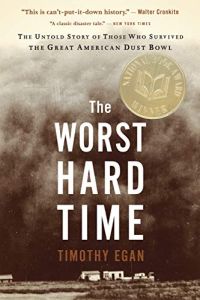
I first encountered the Great Depression and the Dust Bowl in the same history book, and images of houses covered by drifts of dust and those of men standing in line looking for relief or work are forever twinned in my mind. I’ve never read a proper history of either, though, but was prompted to by reading The Four Winds, which a coworker recommended to me. Although there was some overlap in what the books have to offer — driving home how prolonged and miserable the conditions were in the Dust Bowl areas — I did not find The Worst Hard Time redundant at all, in part because the back story and scientifically-informed analysis of what led these conditions. It also explained why Oklahoma has that strange little strip appended to it, sticking into Texas — a strip which, in the 1930s, was known as No-Man’s Land because until 1890 no state claimed ownership of it.
Egan begins his story with conflict between Texans and Comanches, conflict that led to the same result in 1850 as it had for the Creeks in 1814: the US Army, aroused to action by attacks on civilians, drove the Comanche from the land. That land was pure prairie, home to bison and chicken and many other species. It was part of what was called the Great American Desert, a place no stranger to searing heat and prolonged periods of no rain. The first to move in were ranchers and cowboys: in place of the bison, many of whom were killed in order to force the Comanche away, there were thousands upon thousands of cattle. Cows were ecological misfits, though, not providing the same benefits to the prairies as the bison and (more importantly) often not able to stand the prairie winters. The United States government was eager to fill the land with settlers, to fully realize Manifest Destiny: cowboys weren’t quite the ticket to civilization. And so they came — and not just Americans looking for opportunities, but European immigrants like the Volga Germans (there’s an interesting story in itself) who were seeking to escape the thumb of the czar. They were urged on by pamphlets that told them how to ‘do’ dryland farming, and popular dogma that declared rain followed the plow. Tragically, these years of settlement and expansion were unusually wet, marrying people to the idea that Man had nature’s number and could make her dance to his music. Then, the rains stopped — and they would not begin again for eight years. The wind is seemingly constant in the western flatlands, and as crops died and fields lay bare, the dead land began to move. It was first obvious in 1932, when farmers and townspeople alike stood staring at the skies, seeing a new thing that they had no words for: it was though a mountain of roaring dirt was approaching them.
The pictures sent out by the wire service during that winter and early spring told as much, if not more, than Geiger’s prose: people with masks and flashlights, navigating the perils of small-town main streets, cars dodging the drifts and haze of a country road, storefronts boarded up, schools closed, cattle lying dead in the dust.
Dust storms would become a constant hazard in the years to come, and retreating inside only offered so much protection. Dust found a way in, blasting through cracks and crevices and sometimes open windows. It buried towns, cars, attempts at crops, and often people. It filled the lungs and intestines of animals and people alike, leading to something like tuberculosis among the people, and starvation for the animals. As the crops withered and the land grew in desperation — accumulating drifts and closed buildings, beaten by dust and tornadoes and plagues of rabbits and locusts, the population shrank. The government at first responded with aid that would make sense in the light of a short-term disaster, providing food and places to stay — but as the drought lingered and the storms grew worse, sandblasting buildings and people alike, shutting down life in gloom, dirt, and static electricity, the state began appraising why the land was failing so dramatically — realizing what cowboys of days past had warned, realizing what others familiar with the land had said. It was no place for thirsty, heat-sensitive annuals. Industrial man began to reprise the lessons he’d abandoned in the excitement of machinery, beginning to work with the land and climate instead of trying to run over it. As the “Dirty Thirties” began to give way to the forties, the rains came again — coinciding, oddly, with FDR’s visit out there to boost the spirits.
The Worst Hard Time is a sombering book, largely for what has already transpired: Egan is generous with graphic details of everyday hardships, of mothers losing children and having to begin the day washing a film of mud off of faces, and he even integrates one man’s increasingly despairing diary. It’s remarkable that the subject kept plugging on, kept planting crops that he knew he’d lose, but that’s human nature. We are admirable in that way, but sometimes we can persist in mistakes — and that, unfortunately, is a lesson Egan teases we have yet to learn. The land of the prairies was plundered without thought to its constitution, to its unique nature, to its environment — and the people there paid the price for over a decade. But we persist in treating our natural resources as geese that lay golden eggs, not realizing that just as topsoil that took a thousand years to develop can be destroyed in a decade, so to can aquifers that built up over generations be sucked dry. And yet the aquifers continue to be greedily sucked at, and the rivers too, and we in general continue believing that technology is a genie that will give us all we want without consequences: “We shall be as gods!”. The dark years of the Dust Bowl remind us that we know very little despite our accomplishments and ambition.
The Worst Hard Time is a solid piece of history writing, which not only covered the subject amply, but made me interested in other minor topics, like the German Russians who inhabited part of the plains, and has lit a fire under me to begin my next trip west in Amarillo, there to explore places that the whirlwind could not quite kill.
Highlights:
At its peak, the Dust Bowl covered one hundred million acres. Dusters swept over the northern prairie as well, but the epicenter was the southern plains. An area the size of Pennsylvania was in ruin and on the run. More than a quarter-million people fled the Dust Bowl in the 1930s.
The tractors had done what no hailstorm, no blizzard, no tornado, no drought, no epic siege of frost, no prairie fire, nothing in the natural history of the southern plains had ever done. They had removed the native prairie grass, a web of perennial species evolved over twenty thousand years or more, so completely that by the end of 1931 it was a different land—thirty-three million acres stripped bare in the southern plains.
The ground could be mined at the deepest levels for water, using new and powerful centrifugal pumps, to create the garden state of Oklahoma. They could grab onto that underground lake, the Ogallala Aquifer, like the Sooners had grabbed the old Cherokee lands, and so what if the water was nearly seven hundred feet deep and had taken at least a hundred centuries to build up—it was there to be grubstaked.
It’s the earth itself, Bam said. The earth is on the move. Why? Look what they done to the grass, he said. Look at the land: wrong side up.
The great unraveling seemed to be caused by man, Bennett believed. How could it be that people had farmed the same ground for centuries in other countries and not lost the soil, while Americans had been on the land barely a generation and had stripped it of its life-giving layers? “Of all the countries in the world, we Americans have been the greatest destroyers of land of any race of people barbaric or civilized,” Bennett said in a speech at the start of the dust storms. What was happening, he said, was “sinister,” a symptom of “our stupendous ignorance.”
High Plains nesters were more intimate with the elements than perhaps any other people in the country. They knew black dust came from Kansas, red from eastern Oklahoma, a yellow-orange from Texas. And sometimes all of Kansas, Oklahoma, and Texas seemed airborne at once: black, red, and orange converging. The sunlight that filtered through these dusters took on eerie hues—sometimes even green. People knew that when the wind blew from the southwest, the duster to follow would go through a range of colors—everything but the golden light they remembered from the first days of breaking the sod.
Bennett had told Congress that fifty-one million acres were so eroded they could no longer be cultivated. It would take a thousand years to rebuild an inch of topsoil.
Strong men still wept, hiding their lapses like alcoholics sipping in secret. The men cried because they had never seen anything like this and had never before been without a plan of action. Always, they had been able to hammer at something, to dig and scrape and cut and build and plant and harvest and kill—something forceful to tip the balance, using their hands to make even the slightest dent during the bleakest times.

 Reading Freely
Interesting… and already on my Amazon Wish List (since reading ‘Grapes of Wrath’ I think).
The subject is so depressing, but I find it absolutely fascinating to read about The Great Depression/Dust Bowl. THE WORST HARD TIME has been on my bookshelf for ages. I need to read it already. Like you, I haven’t read a non-fiction book on this subject. It’s nice to know it offers new information. Glad you enjoyed it!
Susan
http://www.blogginboutbooks.com
I read this book several years ago.
Excellent review.
Thank you!
Pingback: Tis time for teasing tuesday | Reading Freely
Pingback: Nonfiction November, Part II | Reading Freely