
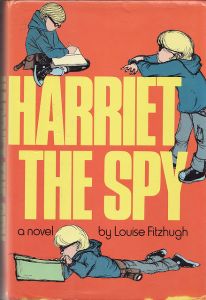
At some point in 1996 or ’97, I got to watch Harriet the Spy. I also began keeping a journal in 1997, which is not an accident, though I found California Diaries at the same time. As part of this week celebrating children’s literature of the 1990s (or at least, children’s books I read in the nineties, never mind when they were published) , I wanted to go back to the original book and see what it was like. I can’t compare the book and movie because I remember nothing about the plot of either, only that Harriet was constantly scribbling in her notebook. Harriet is the only child of a fairly wealthy home (wealthy enough that she has a nanny and a cook!), who wants to know Everything in the world and has a spy route in her town. She’s found different hiding places (trees, dumbwaiters, etc) to access and eavesdrop or watch on them. Harriet would be a menace had she been born in a different time, because she writes down seemingly everything she sees or thinks, and it’s often disparaging of her classmates and neighbors — but reveals a child’s inexhaustible curiosity and frank observations. When her classmates read her notebook, she promptly becomes persona non grata at school, exiled from all social interactions and subject to the slings and spitballs of outrageous fortune. Even worse, her chief ally in the world, her nanny Ol Golly, has gone and fallen in love, so she’s on her own. Harriet doesn’t have much in the way of emotional self-control, so when she engages in a vengeance campaign against her classmates (involving planting frogs in desks, cutting their hair, etc) her parents sent her to a shrink. Things get better, though. This was a….chaotic read, with some good writing, though I wasn’t sure where the story was going.
Janie Gibbs was Harriet’s best friend besides Sport. She had a chemistry set and planned one day to blow up the world.
Harriet was getting tired of standing up and screaming. She wished she could sit down but it wouldn’t have done. It would have looked like giving up.
There is more to this thing of love than meets the eye. I am going to have to think about this a great deal but I don’t think it will get me anywhere. I think maybe they’re all right when they say there are some things I won’t know anything about until I’m older. But if it makes you like to eat all kinds of wurst I’m not sure I’m going to like this.
“[Love] feels…it feels—you jump all over inside…you…as though doors were opening all over the world…. It’s bigger, somehow, the world.”
“That doesn’t make any sense,” said Harriet sensibly. She sat down with a plop on the bed.
“Well, nonetheless, that’s what you feel. Feeling never makes any sense anyway, Harriet; you should know that by now,” Ole Golly said pleasantly.Her mother came to the door. She looked down at Harriet lying there with the chair on top of her. “What are you doing?” she asked mildly. “Being an onion.” Her mother picked the chair up off Harriet’s chest. Harriet didn’t move. She was tired. […]
“It’s for the Christmas pageant…is that it?” “Well, you don’t think I’d just be an onion all on my own, do you?”You’re eleven years old which is old enough to get busy at growing up to be the person you want to be.
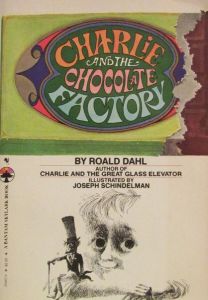
Next up, an old Very-Favorite: Charlie and the Chocolate Factory! I was pleased to discover that my library has a copy of the original edition which I read back in he day, with the same illustrations by Joseph Schindelman that I remember as a kid — and they’re imprinted enough on my mind that neither of the movies really took over the characters in my head, except for Julie Dawn Cole as Veruca Salt. She owned that role. I can’t tell you how many times I read this book as a kid, and its original dramatization is one of the first movies I ever saw, as we watched it in class. I’m sure anyone reading knows the story: our character is Charlie Bucket, who is desperately poor and starving, living with his four grandparents (all of whom are in their ninenties) and his parents (who aren’t old enough to be the kids of 90 year-olds, but this is in a book that involves snozzberries, Ooompa-Loompas, and magic elevators). Willy Wonka, the eccentric genius candymaker, has offered five children a chance to tour his factory — those who find the Five Golden Tickets in his candy bars. Charlie is lucky enough to come across one, and he joins his four fellow tourists for a tour of a wonderful place with a very eccentric owner and guide, one is mischievious and sometimes manic. The other kids have serious character flaws which lead them into ghastly accidents, and soon Charlie is all alone and — well, I’ll not spoil the rest. Wonderful writing. I remember reading James and the Giant Peach and this book’s sequel back in the day.
Everything in this room is eatable, even I am eatable! But that is called cannibalism and is in fact frowned upon in most societies.
Whipped cream isn’t whipped cream at all if it hasn’t been whipped with whips, just like poached eggs isn’t poached eggs unless it’s been stolen in the dead of the night!

 Reading Freely
I read ‘Chocolate Factory’ for the first time last year and thought it was pretty good. My review is here:
https://cyberkittenspot.blogspot.com/2022/05/just-finished-reading-charlie-and.html
Thanks for the heads up! Somehow missed that last year.
Roald Dahl was another favorite of mine, though Matilda will always be number one for me. I loved Harriet the Spy as a kid, but looking back as an adult she definitely needed a bit more parental control. 😐
Yeaaaah, sneaking into people’s houses and hanging out in their dumbwaiters is probably not ideal….
Right?! LIke, she’s naughty! And she needs a therapist.