
Team of Five: The Presidents Club in the Age of Trump
© 2020 Kate Anderson Brower
320 pages
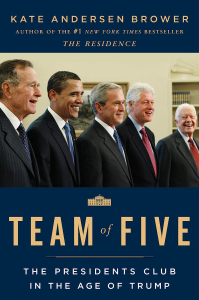
Nancy Gibbs’ and Michael Duffy’s The Presidents Club offered a history of how American presidents have rallied together after their respective terms in office to support the sitting executive, offering him counsel or direct service as needed. Team of Five looks at their association and the lives of former presidents more broadly, and at the same time points to how differently then-president Trump related to the Club. To put it bluntly, they don’t relate. While other rivalries have been transmuted into intimate friendship by the singular burden of the office, Trump’s relations with his predecessors remain as antagonistic as they were prior to his running against the establishment, and he appears to be largely unaffected by his time in office. The heart of this book is the relationships between the other presidents, and frankly it’s enough to warm even my cold, cranky anti-government heart.
Like many potential readers of this book, I have a love-hate relationship with the presidents: my own politics lead me to despise pretty much everything that’s happened in DC since the election of Theodore Roosevelt, but I have read biographies of most modern presidents and can separate my feelings for the men from the office’s abuses, realizing that the Beast on the Potomac destroys and perverts even the best of intentions: witness Bush’s compassionate conservatism giving way to a post 9/11 police state, and Obama’s attacks against the terror war resulting in him maintaining and expanding DC’s interventions abroad. This book focuses far more on the human side of these men — the toll the enormous responsibility takes on them and their families, and their need for one another despite one wearing a blue tie and the other wearing a red, as well as the ways they’ve found to stay active (or avoid politics) after retirement. Power is a hell of a drug, and many former presidents, especially those who are deemed ‘failures’, have yearned to stay relevant in the years after they leave office: Hoover, Nixon, and Carter are especially salient examples. Especially striking are the near-familial bonds formed by the first families after leaving office: I was surprised to learn of George H.W. Bush and Clinton’s near father-son bond, and charmed by accounts of the close relationship between George W. Bush and Michelle Obama – -as well as the embrace of those families’ daughters.
If you are looking for a book to kindle some meager flame of belief in the Public Thing, the republic, Team of Five definitely will help, especially when they express the hope that the solidarity of the former presidents will help the government weather the storm of the current occupant. Interestingly, the only former president Trump ever communicates with is President Carter, who himself is something of a dark horse among the presidents’ club, known for going off on his own and sometimes disrupting the policy aims of the current administration. Trump isn’t the first president to ignore his predecessors (Roosevelt and Eisenhower were similarly contented to go it alone), or even be outwardly antagonistic towards them (Roosevelt, again), but whereas they were only ignoring one man, Trump ignored the experience of decades. Granted, that was his whole appeal in tweeting against the machine. Likewise, if you’re looking for a reason to further scowl, then reading of the enormous fortunes these families make (while, in the case of Clinton & Obama, endlessly lecturing us peasants about income inequality) in combination with their status as the biggest welfare recipients of DC outside Israel & Saudi Arabia , there’s no shortage of privilege to get outraged about. I’ve long thought that Carter and Ford were two of the most decent men to serve in the oval office, and learning that most of Carter’s income goes straight into a charitable foundation (instead of paying for multiple mansions & private island vacations like some) made me think all the better of him.
The Five was a most interesting book, more generally interesting than the presidential-ops oriented Presidents Club. It’s left me in the curious state of disliking these people more for what they say and yet being more tolerable of them as people.
Highlights:
In March 2011, Carter, Clinton, and George W. Bush went to the Kennedy Center to honor Bush, who was then eighty-six years old. The event raised money for his Points of Light initiative encouraging volunteerism. “I literally came to love this man,” Clinton said unabashedly from the podium. Backstage, Laura Bush asked twenty-seven members of the Bush family to gather together and pose for a photograph. “Bill, Bill! Brother from another mother! Get in here!” hollered Neil Bush, one of George and Barbara’s sons. Clinton smiled and got in the family portrait. “The family’s black sheep,” Clinton said. “Every family’s got one.”
At 2:30,[on 9/11/] Bush finally reached his mother. His parents had been traveling to Minneapolis, but the Secret Service had moved them to a motel in Wisconsin. “Where are you?” he asked her. “At a motel in Brookfield, Wisconsin,” she told him. “What in the world are you doing there?” he asked her. “Son,” she said, “you grounded our plane.”
George W. said the most surprising moment during the early days of his presidency came directly after the inaugural parade, when it sank in that he was indeed president. “I decided to go into the Oval Office to see what it felt like,” he recalled. “Unbeknownst to me [chief of staff] Andy Card had called upstairs in the residence and asked Dad to come in so I was sitting in the Oval Office at the desk there kind of just taking it all in, and in walks my dad, and I said, ‘Welcome, Mr. President,’ and he said, ‘Thank you, Mr. President.’” Barbara Bush was decidedly less sentimental. “Get your feet off the Jeffersonian table,” she told him.
Bush’s respect and admiration for Obama was returned. Obama did not call his fellow Democrat Bill Clinton often when he was president; so much had changed in the world since Clinton was in the Oval Office. He spoke more often with Bush. The terrorist attacks of 9/11 had changed the presidency, and it was Bush and now Obama who had to deal with the fallout.
Eisenhower, more than many presidents because of his high rank in the military, was used to being surrounded by aides who did everything for him, down to making simple phone calls. On his first night out of office, he decided to experiment and call his son John. He had grown accustomed to picking up the phone and having a White House operator answer and quickly connect him to anyone, anywhere in the world. When he picked up the phone and heard a dial tone, he was livid. When an aide showed him how the phone worked, he exclaimed, “Oh, so that’s how you do it!” He never did get the hang of driving and kept an Army sergeant on staff to drive him around town.
In the past fifteen years, Bill and Hillary have delivered more than seven hundred speeches, averaging about $210,000 per speech. And they wasted no time: just days after leaving the White House, the president was paid $125,000 for a speech at Morgan Stanley Dean Witter, in New York, according to financial records. He accepted fifty-nine paid speaking offers in 2001 alone, including $550,000 for a three-day trip to Sweden, Austria, and Poland. Between 2001 and 2012, Clinton made $104.9 million in speaking fees, according to an analysis by the Washington Post. His astronomical speaking fees led to criticism that he was selling American power and influence to foreign interests, especially when Hillary was secretary of state, which coincided with a surge in his speaking fees. He was paid $500,000 or more each for thirteen speeches delivered around the world, and eleven of those occurred when Hillary was secretary of state, including one in Hong Kong for $750,000 and another in Nigeria for $700,000.
When Carter criticized Rafshoon for a suggestion he made, Rafshoon replied, “—- you, Jimmy.” The room went quiet for a moment. Strauss eventually said, “Don’t you mean ‘—- you, Mr. President?’” Everyone erupted in laughter, including Carter, and the meeting continued. It is impossible to imagine an adviser saying that to Clinton, Bush, Obama, or, especially, Trump.
Carter’s post-presidency costs taxpayers less than half of those of the other living former presidents. According to the General Services Administration, the total annual bill for Carter is $456,000 a year, including his office, staff, and pension. George H. W. Bush’s office, pension, and expenses used to cost taxpayers $952,000 a year, and every other living former president—Clinton, George W. Bush, and Obama—costs more than a million. Obama’s 8,198-square-foot office in Washington, D.C., alone costs taxpayers $536,000 a year. Clinton’s office costs $518,000, George W. Bush’s is $497,000, and George H. W. Bush’s was $286,000.
Before he needed a wheelchair, Bush walked up and down the hallways of the West Wing that he knew so well, and teased Obama’s aides, many of whom were in their twenties and thirties and were little kids when he was president: “Have you ever gone skydiving? Well, what are you waiting for?” He exuded graciousness and old-world manners, and because of his large, close family, he seemed to convey the message that politics is something that is a part of one’s life, but it should not define one’s life.
When Obama learned of Bush’s death, he told George W. Bush that he would of course attend the funeral but that Michelle would be on her book tour in Europe and would be unable to make it. The former first lady then decided to cancel her stops in Paris and Berlin. “It’s important to me to join the Bush family in celebrating President George H. W. Bush’s exemplary life,” she said.

 Reading Freely
It sounds like a remarkable book. It humanizes these folks.
I had no idea they were that close…guess I assumed it was all for the cameras. Very interesting!
Someone was telling me recently that we must strive to elect the most decent people. But even these presidents with good intentions and moral compasses made some really awful decisions in office. Our system of representative leadership needs reforms throughout its processes and layers, *in addition to* electing decent people. At least, that’s where my mind is at right now…
It’s the reason I call DC the beast. It’s too large, vast, and complicated for one man to effectively make an action. Everything is filtered through a myriad of organizations and people. Even Trump, with his open hostility toward DC, even with his independent income and his history of going his own way and to-hell-with-you-ness, couldn’t do much. The American dream was decentralized government where men and women could be masters of their own lives, but that’s been gone for over a century now.
Nine years ago I wrote a post called “The Emperor Drives an AT-AT” about the structural problems of government:
“he politics of the modern state put a leader in a position of having to exercise enormous power that he can’t really control; he is made captain of a runaway locomotive. The tracks dictate his course; he can blow all the whistles he likes, but the machine is moving on its own inertia. This brings to my mind — my SF-addled mind — the image of someone trying to drive an AT-AT. [….] For this reason I have lost interest in national politics, because it doesn’t matter who is captaining the AT-AT: it’s going to ignore important matters, crush life underfoot, and stumble ever-forward intending destruction. The state, I think, is a machine that answers to no one’s direction, and takes would-be commanders of it along for a ride.”