
Alllrighty, short rounds time, featuring: British Soldiers, American War; The Very Secret Sex Lives of Medieval Women; and The President’s Club: Inside the World’s Most Secret Fraternity.
First up, British Soldiers, American War. This is an interesting volume in which the memoirs of British soldiers who participated in the American War of Independence (and by “participated in”, I mean ”were the baddies”) are presented, each prefaced by the author to give some context as to what aspect of British soldiers’ lives a particular memoir illuminates. As mentioned in my review of Holmes’ Redocat, I first knew the described uniform as that of the enemy: my first encounter with historical fiction, in fact, was a revolutionary war story in which the main character was being menaced by two British soldiers looking for the MC’s father, who was involved with the rebellion. The image painted in my mind’s eye at that young age, of two armed men in brilliant red standing out amid the grey-black trees and blinding white snow, has remained with me 30+ years. Here the men tell their own stories, and easily the most important fact driven home is that these men were all volunteers. On the whole, they were not criminals or conscripts, but ordinary men of varying classes who saw in His Majesty’s Army a stable income and a path to adventure, loot, and possibly even glory. Some were restless, but if they looked for a curative for that in army life, at least one was met with death instead: his penchant for wandering away from the army and them coming back when he felt like it was rewarded with a court martial and firing squad. Surprisingly, many of them included here settled in America after independence.
Related:
Redcoat: The British Soldier in the Age of Horse and Musket, Richard Holmes
The Making of the British Army, Allan Mallison
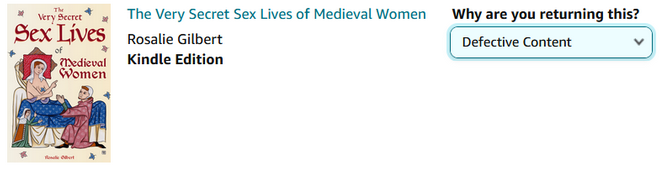
I’ve never tried to return a Kindle title before. I picked this one up because it was cheap ($3), addressed medieval society (a perennial favorite of mine), and promised to be amusing. It helped enormously that the author opened the book by attacking Victorian arrogance about the medieval era, making me think she was capable of appreciating the epoch on its own level, since she recognized the Victorian’s own failure to do so. Ms. Gilbert does try to be amusing, but my tolerance for her snark quickly nosedived after I realized how trite and superficial her grasp on medieval society was. About a third of the way in, covering the days on which sex was officially discouraged by medieval society, she notes that Wednesdays and Fridays were ‘arbitrarily’ included for ‘no apparent reason’.
If an author is going to write a book on an aspect of medieval society, they’d better have at least a tenuous grasp on medieval society in general, which would include its manifestly Christian nature. The Church was integrated into medieval society at every level. Wednesdays and Fridays were fasting days set apart to remember the betrayal and crucifixion of Jesus, respectively, and fasts would have included abstention. Ms. Gilbert’s superficial grasp on her subject reduces this merely to a collection humorous anecdotes and folklore about sex in medieval Europe, one that was saved from one of my very-rare one-star ratings on goodreads by merit of its medieval illustrations.
Related but Manifestly Superior :
Marriage and Family in the Middle Ages, Frances and Joseph Gies. I mention the Gies at every ocassion because their works are not only enormously attractive, but rescued me from my own ‘chronological snobbery’, as Lewis put it. Cathedral, Forge, and Waterwheel was especially helpful in that regard, smashing the Victorian lie that the medieval era was a prolonged period of stagnation. Marriage and the Family in the Middle Ages has sections on sex specifically.
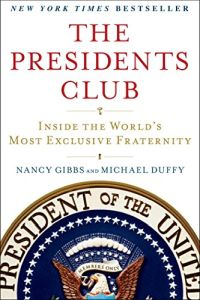
And lastly, The Presidents’ Club. If I had known what this book was about, I would have read it much earlier. I had the (wrong) impression that it was about American presidents in general, analyzing what it took to succeed in the fight for the One Oval Office , etc. It isn’t. Instead, it’s about how the men who become president take on a unique burden that only they can understand, and that the bond they have in protecting The Office and (usually) supporting its current occupant regardless of personal politics. The Presidents’ Club owes its life largely to Harry Truman, who took office following the abrupt death of Franklin D. Roosevelt, and who drew on Herbert Hoover for support. Roosevelt himself had never bothered consulting Hoover, the patrician finding poor Herb far more useful as a perennial scapegoat. Truman and Hoover became fast friends, but Truman’s hopes of maintaining the same relationship with Eisenhower were soured by Eisenhower’s failure to defend their mutual colleague George Marshall against McCarthyism, and not until JFK was assassinated in Dallas did the two rekindle their close bond from the war years. At its height, the Club had six members, a feat aided by the quick turnover of the sixties and seventies. The President’s Club does not attempt to be a history of each man’s presidency, but rather the key moments in which presidents came together to aid one another — JFK seeking advice from Eisenhower after the Bay of Pigs, LBJ drawing on Truman and Eisenhower to inform his Vietnam policy, etc. Some presidents were used to go on ‘missions’ for the sitting occupant, and the men also provided moral support to the current occupant who had an otherwise intensely lonely position. The book has a salient bias against Nixon and Reagan (who “conspire” with one another, not “consult” as anyone else does), but isn’t too obnoxious — and the section on Watergate demonstrates that Nixon bugging his rivals was not his novel crime, but something done routinely by LBJ, etc. Although I consider myself fairly well-versed in presidential history, Gibbs’ and Duffy’s work offers a lot of behind-the-scenes content that makes certain things I knew about already more understandable, like the troubled relationship between Truman and Ike. Because of its timeframe, it also offers a look into how the political parties changed with their bases. I was amused to learn that Nixon was something of a presidential geek, studying the speeches and lives of past presidents obsessively before he ever took office. One wonders what this book would be like written today, given Trump’s professed antagonism toward the DC power-elite, and their disdain for him. There’s a book called Team of Five: The Presidents Club in the Age of Trump, but it’s not by the same authors. I’ll have a look regardless!

 Reading Freely
Pingback: July 2023 in Review | Reading Freely
this seems odd but full of fun facts, maybe not for one who knows the subject matter though! You’ve got so much interesting content linked off from your TTT today!