
More short rounds today, bringing together a lite SF title and a collection of Wendell Berry’s farming essays.
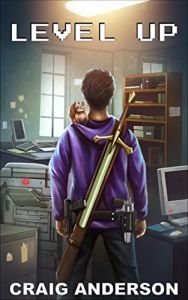
First up is Craig Anderson’s Level Up, a title in the relatively new field of ‘litrpg’ in which video game elements are part of the story. I can’t remember how I encountered the word, but I recognized the idea immediately: Ready Player One is a prime example, and Daemon is arguably a prototypical example, given that the artificial intelligence there actively recruited gamers as its initial agents, and used a leveling system to reward them for performance as it expanded. In the case of Level Up, we’re introduced to a young and unhappy business analyst named Marcus who works at a job he loathes but hasn’t left because he’s supporting his mother and continually chained to his desk with promises of promotion. He seeks escape and meaning in the world of videogames, and when an old flame wanders into town who is working on a VR rpg and needs a tester, he’s more than happy to give it a shot — if only to be around her. During the initial tests, though, Plot Things Happen and Marcus is surprised to find video game elements now present in real life. He has a health bar, for instance, and a Quest menu has suddenly appeared within his vision. Reality itself is behaving like a game: beaten-up mobs inside a bar respawn the moment he leaves and re-enters. I say “Plot Things Happen” both because I don’t want to spoil the entire premise of the book, and because it’s not deeply developed. The results are fun, though. This is not serious SF like Daemon, but it’s a light urban fantasy-adventure saturated with videogame tropes and humor, presumably aimed at younger readers (teens and very young adults) but with some easter eggs thrown in for older audiences. There’s a lot of humor here and we get to see Marcus do something like Biblo in The Hobbit, the adventure forcing him to grow beyond his passivity and learned helplessness.
Related:
Besides the aforementioned titles, One Word Kill is also in the neighborhood. It’s a mix of science fiction and RPG elements set in the eighties.
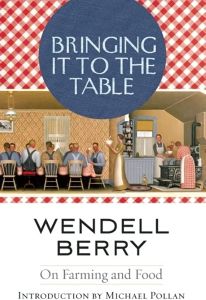
On a completely different note, reading The Dirty Life prompted me to finish Wendell Berry’s Bringing it to the Table. I’d started this a few months back after a friend gave me a copy, but I’ve read so much of Berry before that it was deeply familiar terrain and more of a reminder of what I already believe — so, I was distracted by other things. The book is a curious anthology: half farming essays, a third visits with farmers who are still maintaining traditional farming and husbandry despite the pressure to get big or get out, as the cretinous corpocrats in DC and K Street urged in the 1970s, and a dash of excerpts from Berry’s fiction in which food culture appears. The core message of Berry’s farming essays is that industrial agribusiness as reduced the integrated elements of agriculture into objects to be manipulated and used to exhaustion: the land and livestock are mere objects subject to the will and desire to maximize profits, and farmers themselves are reduced to clients. I saw this first when watching Food, Inc ten years ago and learning how chicken farmers are held in continual bondage to the big distributors like Tyson, who constantly demand equipment upgrades and perpetuate debt cycles. Here and in The Unsettling of America, Berry expands his criticism of the shift from farming to agribiz to the nation itself, pointing out that the system is becoming increasingly more fragile as it becomes more centralized, and the efficiencies of economies of scale are eaten up by the inferior quality created by mass production and the loss of attentive care. The same arguments are being made — and practiced today, with small-scale but intensive farming (like that practiced by Mark and Kristin) undermining the theory that agriculture must consist of county-sized monocultures tended to by dirt-compacting machines, or vast factories in which thousands of animals stand in their own offal, the horrors of their environment compounded by the drugs they’re continually injected with to counter those horrors. Quotes to follow.
And speaking of agribiz, up next is psychopaths!
Related:
Oh, my. Anything by Berry or Salatin, and throw in Schumacher, Sale, and Seeing Like a State to boot.

 Reading Freely
Aren’t companies using ‘Gamification’ to both motivate & reward their employees ATM? I can certainly see how that would work. The AI in Season 3 of ‘Westworld’ used people to do its bidding (mostly to remove anyone it struggled to predict) but paid them with money rather than XP – which they seemed to like a lot.
I hadn’t heard of that beyond Rogan’s criticism of the ‘video game problem’ — companies/organizations using rewards to keep people grinding for them, rather than doing something that would make them happy — but I did a google search and…O_O Wow. Ranges from interesting to creepy & dystopian. Adding “You’ve Been Played” to the goodreads wanna-read…
Oh, yes. Gamification is BIG in some places out there. Micro-rewards & punishments are, I think, going to be quite the thing going forward……
I’m either going to wind up with the Amish or in a cabin a la Ted Kaczynski….
I keep meaning to read Wendell Berry. Not sure whether to start with his novels or his poetry (I think he has poetry) or his nonfiction…
What chiefly interests you about Berry? His essay collections have a good variety, I think, as he’s concerned about society and its underlying structure — but he sometimes writes on more specific topics like racism, with his “Hidden Wound” and “The Need to be Whole”. His fiction is rich. Every book and every short story are stories in themselves, but because the people of Port William’s lives are so bound up together, their threads intertangle — so the more you read of Port William, the richer the story gets. The first time I read Jayber Crow, it became my favorite novel ever — but I’ve only grown to love it more as I’ve encountered more of the town people, as they grew to not be ‘characters in Jayber’s story’, but …people, in ink form.
I also enjoy his poetry, especially “The Peace of Wild Things”, but haven’t read one of his collections in full.
I don’t know a lot about Berry, but it’s his philosophy of life that intrigues me.
The World-Ending Fire might be a good place to start, then, because it’s a cross-section of Berry’s essays. The editor, Paul Kingsnorth, has an interesting substack and I’m hoping to start reading his own books soon.