
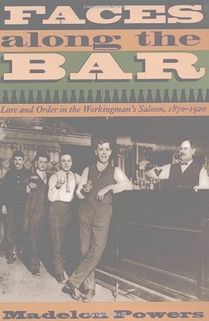
Faces along the Bar: Lore and Order in the Workingman’s Saloon, 1870-1920
© 1998 Madelon Powers
331 pages
Men’s thinking on this issue seems to have involved an interesting mixture of solicitude and defiance. On the one hand, decent women should be protected from the rough world of men; on the other, the rough world of men should be protected from decent women. In the saloon, according to Hoke, ‘One ceased to be a man among women. One breasted the bar, downed a drink, and became a man among men.’ To allow women into this workingman’s world would not only cramp its style, but defeat its purpose as well.
In the large cities of Victorian America, well-heeled men of means could often be found in gentlemen’s clubs, private associations in which important matters of industry, business, and politics could be discussed in refined settings over gourmet meals with worthy company. The working man had his answer to that, though: the saloon. Long before bars became hookup locales where young people practice seduction over loud music and sickly-sweet mixed drinks, they were places where men could close the day with a pint, a song, and some uproarious stories – but more importantly, they were places where these men could be among their fellows, imbibing not merely in drinks but in comradeship. In Faces along the Bar, Madelon Power dives into the markedly different saloon culture of the 19th century, offering a sociology not of drinking but of how saloons were effectively workingmen’s clubs – something interesting in itself, but all the more because prior studies on the working class tend to focus on their labor, and not their leisure. Faces draws heavily from period accounts, from nonfiction memoirs like Jack London’s to fictional renderings of bar life in Upton Sinclair’s The Jungle to offer both an engaging social history and more serious analysis of what the saloon meant.
One of this book’s included photos demonstrates well how common saloons were in the working quarters of cities, with a dozen around one block along. Their commonness owed not just to the density of city populations, but to their diversity: given bars had affiliations with certain ethnic groups, occupations, or political leanings. Some saloons were strictly for particular unions, for instance, and ethnic divisions could be fine-grained indeed: a given saloon might not be just for Italian men, but for men from a particular part of Sicily. These ethnic bars were especially valuable in helping newcomers find jobs and places to live, as the bartender tended to collect, digest, and dispense useful information. Saloons were not merely places to drink: they served lunches that were free with a nickle beer, and these lunches were often better fare than could be found in restaurants, being subsidized by breweries who supported the expansion of saloons that they could then be the sole suppliers of booze to. Saloons were also primary source of recreation, from singing to boxing – and proper boxing, not just drunken bar brawls. Saloons were also a vital part of political organization, continuing an American tradition from the colonial days – one of the many reasons they attracted nativist attack, and one reason saloons were generally less common in the South than elsewhere. Despite the fact that many saloons were dominated by one group or another, saloons in general still aided in the American melting pot: Jewish barmen might hire assistant bartenders of another nationality to expand their clientele, and the free lunches and music offerings introduced ethnic groups to one another’s offerings. Black food & music made significant inroads in this fashion.
These free lunches were one of the few occasions in which women were permitted to invade the masculine space of the bar, which was a place above all where a man could be with his equals – no bosses, no wives. Kids could come in to sell newspapers or to get a pitcher filled with beer for the house, but the saloon was a place for men alone – and older boys coveted their future place there, playing make-believe barmen at home and being inculcated into the traditions and mores of masculinity once they were finally of age. The spittoons and urinal trenches testified to the saloon being a place for total ease and male solidarity. Men here groused and complained, entertained one another, shared information, or just enjoyed one another’s company . They developed elaborate drinking rituals in which they bought drinks for the fellas they were clubbing with, and received drinks in turn. Buying a drink on one’s own nickel and then leaving wasn’t just odd, it was positively antisocial. The men who claimed a bar and met there regularly had a sense of ownership in it, and when the day arrived that the bartender recognized them as a trustworthy regular who could maintain an open tab, it was a proud one.
Ultimately, Powers writes, though the saloon culture was overtly destroyed by the forces of the Anti-Saloon and temperance leagues – Klansmen, antagonistic wives, etc — in truth the saloons were undermining themselves by their own success. The closeknit communities they were fostering inside the bar often developed into organizations outside the bar: the early 20th century abounded with civics groups and fraternal organizations that built on the bonds developed from pubs, just like a group of men who ‘clubbed’ their books together in a Philadelphia tavern gave rise to American public libraries. The squelching of bar culture during the dark days of Prohibition meant that these organizations supplanted saloons entirely: they became, as the 20th century wore on, merely a place to drink and talk, not nuclei of community.
I thoroughly enjoyed this work, given my interests in social history of the late 19th and early 20th century, the importance of Place and community, and male society in general. I was a little suspect of this book from the start, given its female authorship, but Madelon Powers was more interested in learning about her subjects than judging them, and she appears genuinely fascinated by the rich saloon culture that was such a driving force in the late 19th century. They were genuine third places, but arguably even more than.
Related:
America Walks into a Bar: A Spirited History of Taverns and Saloons, Speakeasies and Grog Shops, Christine Sismondo
The Great Good Places: Cafes, Coffee Shops, Bars, and the Other Hangouts at the Heart of a Community, Ray Oldenberg
Last Call: The Rise and Fall of Prohibition, Daniel Okrent
Drink: A Cultural History of Alcohol, Ian Gately

 Reading Freely
The phrase ‘Victorian America’ has long intrigued me. You don’t hear of Victorian France or Victorian China, so why America – considering she was our Queen and not (obviously) yours? Is it just short-hand for 19th century? Or is there something else going on there that I’m unaware of?
I’ve wondered myself, since I’ve never heard of Georgian America, or Edwardian America. The main component, I think, would be the strong cultural ties between the United States and Great Britain — the base population was overwhelmingly Anglo-Saxon then, supplemented by the ‘other’ British, and it’s possible that in the wake of outside immigration (from Italy, etc) that the WASP population was doubling down on its Anglo-British roots. I can only speak from personal experience, but I always derived a sense of strong and indelible connection between Britain and the United States — that England’s was “our” story, even if after the Revolution the two countries were sometimes opposing forces. That sense of fraternal bond was cemented by the wars, of course. It may also have something to do with the sense that, after the Republic was effectively replaced by a more centralized and aggressive state that pursued ‘the empire of liberty’ that American elites looked to Britain for an imperial example and aped more of its conventions, just as Russia borrowed from Byzantine imperial culture as it tried to claim the mantle of the third Rome.
As a librarian you should have access to this:
American Quarterly Vol. 27, No. 5, Dec., 1975, Special Issue: Victorian Culture in America.
I’ll try to access it through JSTOR.
It’s not coming up via Alabama Virtual Library, but in the fall once I begin the master’s I should have uni access to JSTOR.
Cool! JSTOR was one of the perks I *really* enjoyed during my Masters degrees. Presumably you’ll start in October??
End of August or early Sept, I think. I’m registered for one intro course. Going to take things slow until I have a better idea of the course load.
Stephen – You can sign up for a free JSTOR Personal account! The current limit is 100 articles a month. I haven’t reached it yet 🙂
Oh, wow! Thanks!
Pingback: Midyear Review & June 2023 | Reading Freely