
The Great Explosion
© 1962 Eric Frank Russell
187 pages
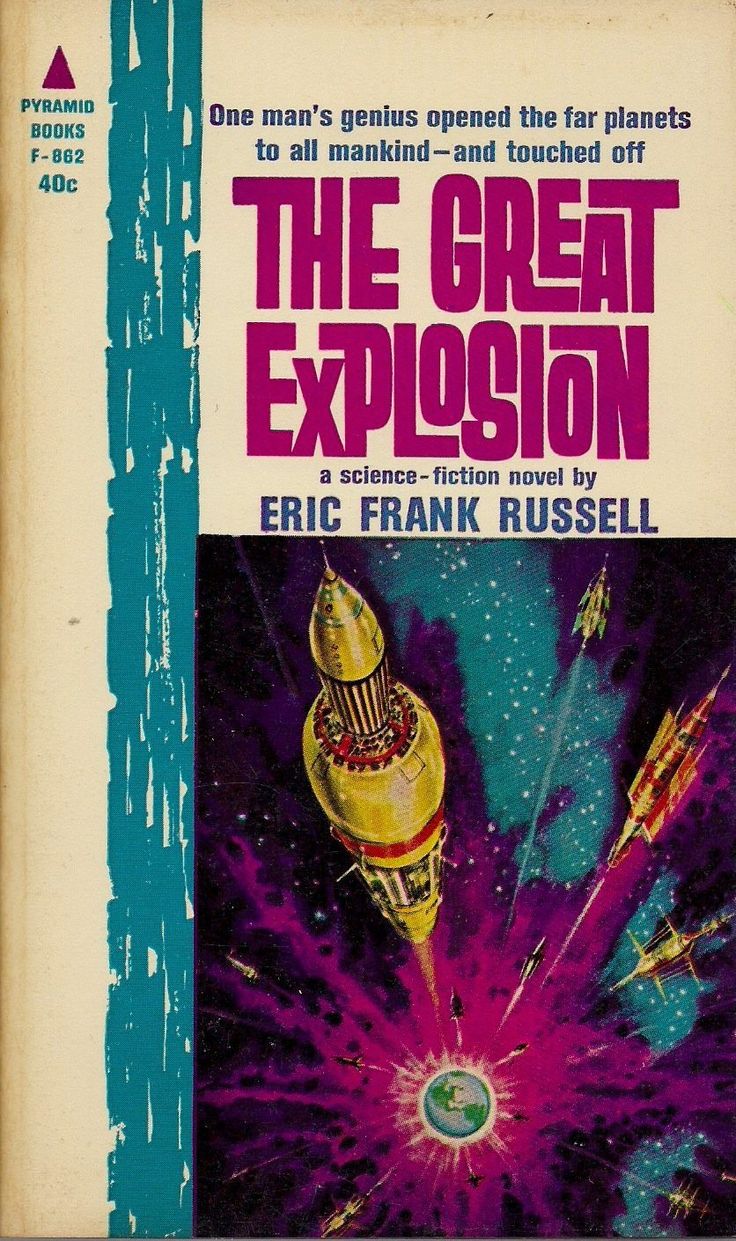
Following the discovery of faster-than-light travel, Earth’s population fell by half as her children fled to the stars. After decades of benign neglect, the powers that be on Earth — the military and politicians — have decided to reassert their authority. A grand ship is built, and ordered to fulfill an even greater commission: arranging a meet between the imperial ambassador and the local leaders, so that his lordship can declare to them that it’s time to rejoin hands with Earth and march together into the future. But as the Dude would say — yeah, well…that’s just, like, your opinion, man.
The Great Explosion is a SF comedy, an expansion of the author’s amusing “And Then There Were None” (1951). The plot is straightforward: a ship with hundreds of crewmen, soldiers, and government flunkies visit a series of planets and attempt to reunite them to the lovingkindness (a compound word translating to “rules and taxes”) of Earth. Shockingly, however, no one who left the Man behind on Earth is eager to see him come back — whether they’re criminals, nudist health freaks, or libertarians. Anyone who has had an ill experience with government functionaries — from IRS auditors to DMV clerks — will find vicarious amusement here, as a series of rebellious characters annoy, exasperate, obfuscate, and harass humorless G-men and their pompous, pot-bellied prince.
The third story is the heart of the book, as the ship lands on the planet ‘Gand’. The imperials are utterly tactless in their approach to the locals, regardless of the planet, but Gand is a particularly bad place to be grabbing people and pressuring them for information. Gand is composed entirely of some tribe of libertarian anarchists, who don’t cotton to authority. So deeply do they loath the idea of uniformity or regimentation that there isn’t even a common style of clothing. Every intrusive question is answered “Myob*!”, and attempts to physically coerce the Gands is met with civil disobedience. One exploring sailor on his bicycle, out of uniform, manages to discover what makes the Gands tick. Close to the Gandian heart is cooperation; they don’t even use money, instead using a barter system of favors, or “obs”. The Gands live in small communities in constant contact with one another, meaning that free riders (‘scratchers’) don’t get away with it for too long. Those who break rules are shunned. The Mahatama would be intrigued.
As a novel there are faults; the health-nudists of Hygeia, for instance, insist that Earth deal only with them, and ignore a smaller community on their planet. Why? Who knows, because the Earthers leave without this other community ever being mentioned again. There the ship goes directly to another planet where there were settlers, but now…there aren’t. Every sign of civilization also points to the planet’s population being long gone, their structures surrendered back to Nature. What happened there — again, who knows, because the Earthers enter orbit, decide not to risk a pandemic, and break orbit. As a rule, creators of fiction avoid introducing elements have have no functional element in the story, so to see two instances of it back to back was rather odd.
Still, I enjoyed the original short story, and this expansion of it. It’s a short bit of comedy with some food for thought sprinkled in.
*Mind your own business!
Related:
The Moon is a Harsh Mistress, Robert Heinlein. Another libertarian society where culture is more important than force.
The Martian Chronicles, with another chapter of free-spirited settlers being chased down by humorless drones working for the government.

 Reading Freely
I've definitely read (and enjoyed) the Gand story. Some of your comments – especially about the bicycle and the 'obs' – definitely rang loud bells. Have you read 'The Dispossessed' by Ursula K LeGuin? You probably have but just in case not I can really recommend it to you.
I've certainly heard her name, but I don'think I have read anything by hee..
Then you'll definitely like it (I think). It's about two world orbiting each other. One world is based on Anarchism and the other (much more prosperous) world is very much like our own – a mess. I'd be really interested to hear your 'take' on it if you do manage to read it. It's one of the very few books I've read more than once – 3 times now if memory serves….
Ursala lives not too far from us; i've read a lot of her work: even had a course on her in uni… she's a self professed Taoist; and lectures on the subject occasionally; or used to anyway…
the Russell story rings bells with me also; quite sure i read it at some point; i know i've read other pieces by him…
@Cyberkitten: That does sound like something worth looking in to!
@Mudpuddle: This is the only thing I've heard of, personally…I can't even remember how I found the story!
Stephen,
Thanks for the review. I remember MYOB, but I had forgotten where I got it from. I don't remember the title of the book, but I do remember the stories in it. I wonder if it came out under a different name.
Russell also appears to have originated the colloquial initialism “MYOB” for “mind your own business”, which appears frequently in the novella “… And Then There Were None” (Astounding, June 1951) and in the novel The Great Explosion based upon it.
MYOB! I should really use this, that’s great! haha I this sounds like a fun read, I was not expecting it to be a comedy when you told me about it. I think there is a lot of joy and entertainment to be found in watching government flunkies be annoyed 😂 Also weird about the random elements that add no function to the story, I wonder if that’s just a standard modern readers expect but was maybe less of a consideration when this was written?
That might be a question for a literary scholar, but I don’t think so — I know the principal as Chekov’s Gun (“A gun introduced in the first act must go off by the third”), and he predated this book. Bard claims that the general principle was first argued in Aristotle’s “Poetics”, but take that with a pinch of AI-generated salt. I suspect those elements were introduced for padding, but I haven’t read enough of this author to know if he made a habit of it or not!
Hmm okay I see what you mean. I guess it’s good to pay attention to details like that anyways to see if it does become a habit & hahah don’t even get me started on the type of AI ‘advice and knowledge’ we’ve been getting lately 😂😥
By the way, I was trying to comment on your priority list of authors, but it looks like it’s appearing as a page that doesn’t allow comments.
OH Yes, I was very frustrated with myself this morning when I realized I should have made it a page and not a post. So I deleted the post and made a page instead.. since I wanted to pin it on the side in my widgets…I don’t believe you can do that with a post? I am still learning how to work this WordPress thingy 😛 Let me see I have uploaded it to allow comments I hope it works now! Thank you so much 😁
Yep! Comments are enabled now. Honestly, I’ve been using WP for years but haven’t experimented with it too much. There’s a way to pin posts to the top of a page, but not to the side — as far as I know.
Okay thanks for checking! & yeah that’s what I learned today haha 🙂
Pingback: A Prayer for the Crown-Shy | Reading Freely
Pingback: The Dispossessed | Reading Freely