
By luck of the draw, I’ve had a series of books too short to review properly, so I’ve bid them all wait until I had enough for a short round post.
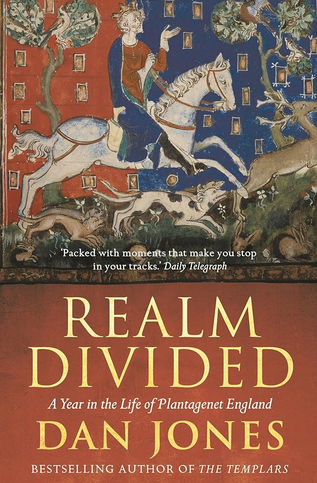
First up was my first proper experience with Dan Jones — or perhaps I should append a question mark to that, because as histories go, this one is rather short, not like his girthy Plantagenet history. Specifically, it’s a history of the year 1215. If you’re up on your English history, you may recognize that as the year that John was forced by his barons to sign the Great Charter. This document which has been hailed as the foundation of English and thereby American liberty, by establishing the principle that the King is under the Law — even if he is in the position of making the law. A Realm Divided is not entirely about the political drama that led to the council at Runnymede, though, as it also includes several chapters on social matters in case one’s eyes start closing over the constant feudal squabbling. While the book is relatively short (in the area of 200 pages), it’s a read dense with facts and surprises, and it includes the Charter itself at the end as well as a few other documents. One minor surprise here was learning that John had contemplated going on a Crusade, which I found amusing. It’s hard to think of a selfish scoundrel like John facing the rigors of travel the way Richard and Frederick did. Another surprise was learning that there was a document that preceded the Great Charter, one which contained most of its clauses and which served as the basis for debates between the barons and the king. While I’ve read Jones’ historical fiction debute and his adaptation of a medieval ghost story, this is my first proper history by him. I like his style and will be reading more: I had thought to pair this and his book on the Magna Carta proper, since he was researching them at the same time, but unless I’ve been in the hospital I prefer to cap my short rounds at 3.
Next up, the first volume in Oxford’s History of Britain, opening with Roman and Anglo-Saxon Britain. This is an extremely cursory introduction, under 200 pages, and if you are vaguely familiar with either era there’s nothing much here for you, except (in my case) the observation that archaeology hints that the Anglo-Saxons were in Britain even before the Romans left, and not simply as mercenary guards. All the usual players — Claudius, Boudica, Alfred, Edmund, etc — make their appearances. If you know nothing at all about Roman Britain, or the early Anglo-Saxon period, this is useful; otherwise, it’s simply a reminder.
About The Peopling of British North America I can say even less, because it consisted of three essays that barely get to 150 pages altogether, all of them have strange names (“The Rings of Saturn” — what?), and the gist of all of it is “You know, it’s all very complicated and we really can’t figure out any exact patterns, people just wandered over to America in all kinds of ways. Can I have my advance before it hits the printers, please?”
The latter two were donated to my University library by my former professor of medieval Europe and English history, a man who claimed to be descended from Norman warlords and definitely looked the part. I can understand why he was willing to release them. They won’t be lingering long on my end, either.
Coming up this week..
This is my final week of schoolwork for this term, and I have a 6 page paper due Friday so I may not be reading as much as I’d like. At least, not reading what I want to. I have to re-read my textbook and various articles from this term for said paper. I’ve got Dan Jones’ second historical fiction book at the ready, and his aforementioned piece on the Magna Carta. Still trying to get into Rebecca but I suspect I won’t make progress until after I submit this paper. My leisure read at the moment is Clouds of Glory, a biography of Robert E. Lee by Michael Korda: I’ve had it checked out for a bit (had planned to pair it with my Ulysses Grant biography), but it’s a beefy boy and not until this present weekend did I have time to really sink my teeth into it. I was dogsitting at a house with no internet or electronic distractions, so I got to settle in with ol’ Marse Robert the last few days. I’m 200+ pages in and just arrived at 1860. So far it’s been a delight: who knew General Lee had a penchant for watercolor and loved flirting?

 Reading Freely