
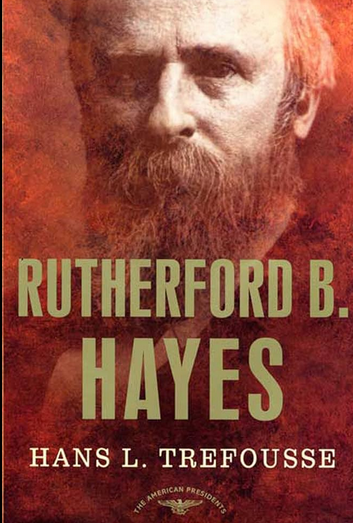
In my Hail to the Chief series, I am embarking on a Trilogy of Unknowns: Rutherford Hayes, James Garfield, and Chester A. Arthur. The only one I’d recognize in a lineup is Arthur because of his wonderful lambchops: they know how to style facial hair back then! Hayes, on first reading , is remarkably like Grover Cleveland, at least one moves past the military record. While Cleveland had no apparent interest in the War, Hayes was a zealous Unionist who served as an officer in the war, taking credit for helping to create the Battle of South Mountain and being wounded in the process. Where they converge is that Hayes became a successful attorney, and on seeking public office, rose to the role of Governor and was known for his dedication to clean government and solid money. Despite this, though, he entered into office under a storm of scandal: because Reconstruction was already fading fast away, there were disputes over who had truly won three states, and particularly who had won Florida. Deciding the vote ultimately came down to a commission, which voted entirely on party lines: the newly appointed President Hayes now had to execute the responsibilities of his office while knowing half the country viewed him as entirely illegitimate. John Quincy Adams labored under similar circumstances, his own election having been decided in the House of Representatives. Hayes applied his principles by being a stick;er for the gold standard, and on ending the spoils system that allowed political offices to be given out as a reward for electoral support, rather than merit. Although he sometimes catches flack for “ending Reconstruction”, the author points out that most of the South had already been ‘redeemed’ by the Bourbons, and that the last three were fast on the way. The North had lost interest in occupying and managing the South, but Hayes did his best to safeguard the new rights of black Americans and to bring the country together again. This biography delivers a strong impression of him as a man of principle, even sticking to his early declaration to only serve one term so that his actions in office would not be predicated on the desire to be popular, only to do the right thing.
(My punny title comes from the fact that Hayes was a huge fan of proto-baseball, and was playing it well before there were standard rules. This was alas, not mentioned here.)

 Reading Freely