
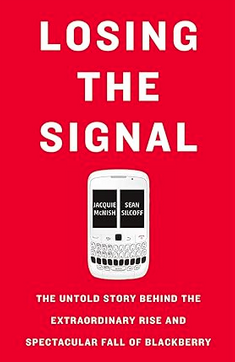
Despite coming of age as cellphones were becoming ubiquitous, I developed an immediate dislike for them on arrival; I grudgingly bought one in 2005 when I began working, purely to keep in the car for emergencies, and but was not until 2018 when planning a trip to the Grand Canyon that I bought my first ever smartphone, a Galaxy S7. I therefore missed the BlackBerry age, but have retained a curiosity about them and their role in the ‘history of the future’. Losing the Signal was an interesting history of BlackBerry’s rise and fall, one that shed a lot of light on an era I technically lived through, but was largely oblivious to. The author generally includes all parts of the story, from BlackBerry’s personnel, to tech challenges and struggles with telecom carriers.
To the extent that I was aware of BlackBerries in the mid-2000s, it was as cellphones with internet, or at least email. Not until reading this did I appreciate how wildly inaccurate to BlackBerry’s total story that was: BlackBerry originated as a Research in Motion project that wanted to shake up the pager market by introducing two-way paging, or messaging between devices. In a market cluttered by personal assistant devices, BlackBerry succeeded by optimizing one thing very well: portable, secure, emailing. Only later did the BlackBerry begin operating as a cellphone! As someone who is not familiar at all with the high-tech business world of the late 1990s (my idea of high-tech was a GameBoy Pocket), I was amazed that email alone made the BlackBerry its fortune. True, there was an incredible amount of thought given to the user experience, from the aesthetically-pleasing clicky keyboard to the software the devices used. Designers experimented and guessed as to how first-time users might try to navigate a new tool, and the paths that people groped for were readily provided. A lot of the features implemented into the proto-Blackberry’s software, like automatically capitalizing the first words of sentences or anticipating when new sentences might be beginning, were first implemented here. (As was a ‘wheel’ access tool, borrowed from VCRs and more famously adopted by iPods.) Another aspect that BlackBerry managed to bake in was addiction: even when the device was still in development, executives who were equipped with products to test-drive found them too compelling not to look at every few minutes. Mind, this was before social media or YouTube; here the draw was simply email, and yet it was so compelling to have instant information that companies were forced to ask for phone-free meetings, and families began ‘phubbing’ one another when the BlackBerry invaded consumer markets instead of remaining a business-oriented product.
Unfortunately for BlackBerry, when its great challenger and ultimately successor arrived, the company’s CEOs were distracted — by a patent lawsuit, by an SEC investigation, and by one exec’s obsession with buying a hockey team. Perhaps if attention and money hadn’t been tied up in these matters, they would have taken the threat that Apple posed more seriously. After all, RIM’s chief owner-engineer Mike Lazaridis had opened up an iPhone to discover that it was a full-fledged Mac: BlackBerry wasn’t competing against PDAs and ordinary cellphones anymore, it was sailing into new waters entirely. Customers, too, were surprising: they evidently didn’t care that the battery in these iPhones didn’t even last a full working day; they didn’t care that it operated on a previous gen’s network. They could listen to music, and watch grainy videos, and even use a full browser online instead of a stripped-down mobile one. Unfortunately, as optimized as BlackBerries were for the early 2000s — with a minimalist operating system — in the post iPhone world they were past tense. BlackBerry needed to completely overhaul not only its technology and software, but the entire way they thought about the product — and they were too resistant. The iPhone was a toy, surely? Its text messages weren’t even secure! BlackBerry was the only communication service standing during the chaos of 9/11, it wasn’t going anywhere! ….and yet BlackBerry hemorrhaged marketshare and eventually disappeared. Even as they began grudgingly making devices that were more like iPhones, they kept dragging the past with them — from a ‘clickable’ touchscreen to their very last phone still having a physical keyboard.
This proved an interesting book on multiple levels, both in itself and as a comparison against the BlackBerry movie, which is very loosely based on this. (Very loosely: when asked to compare the two, the author Jacquie McNish replied, ‘Well, the facts are very different.’) It’s a fascinating case study in how people and companies can be absolute trail-blazers, and yet for one reason or another — personal biases, the technologies or partnerships they’ve been locked into — plateau and fade even as newcomers continue down a road that was opened for them.
Related:
The One Device, on the origin of the iPhone
Quotes
“At a focus group in Sunnyvale, California, one participant grew antagonistic when shown a device announcing emails with a buzzing noise. ‘If this thing buzzes every time I get an email, you’d better ship it with a hammer,’ he warned.”
“‘Remove think points,’ was one of his favorite phrases. ‘I liked teaching people to put themselves in the minds of the users,’ Lazaridis says. ‘I wanted to get to the point where users prefer to use [the device] to send messages than actually power their computers.’ He believed that using the Leapfrog for email should be so instinctive that users would never have to interrupt their train of thought to hunt for a command.”
“On this day, Lexicon’s staff was assigned to test commuter attitudes about mobile devices. When the questions turned to emails, the results surprised them. Email wasn’t a convenience; it was a stress point. Mentioning the word inspired dread about work piling up in inboxes.”
“The point was driven home in Atlanta, where BellSouth executives, including CEO Duane Ackerman, were among the first users to receive free Blackberries. Before long, they were so addicted that Ackerman forced them to place their devices on the desk during meetings to ensure nobody was distracted. ‘I think that was kind of the closer,’ says Hightower.”
“BlackBerry messages traveled through RIM’s in-house network, which was plugged directly into the carriers. The unique connection gave RIM a back door to sneak in services carriers wouldn’t allow. In the mid-2000s, RIM began shipping Blackberries secretly loaded with sleeper applications. Carriers and customers had no idea the applications existed until RIM sent an alert to BlackBerry users about a software upgrade. Hidden within the digital transmission was a file that unlocked the applications on the device—a web browser and links to popular instant messaging services. Icons immediately popped onto BlackBerry home screens around the world. By the time carriers realized what was happening, millions of customers were using the internet and exchanging instant messages on their Blackberries.”

 Reading Freely