
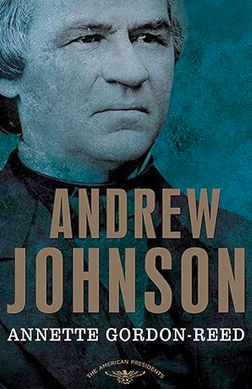
Andrew Johnson is one of those presidents who can’t get away with merely being forgotten; he is no Pierce or Fillmore, whom the general public knows nothing about. If Johnson is mentioned, his reputation is closer to that of his adversary Buchanan — a man who history has judged as having been found wanting. This owes entirely to his attitude in Reconstruction, which was contra to the ‘radical Republicans’ who dominated Congress following the War of the Rebellion: so different were Johnson and the Republican Congress’s views that they attempted to impeach him simply to get him out of the way. No executive had been impeached since the creation of the Union, and none would again until Bill Clinton lied to Congress and got caught in the 1990s. Johnson has since become a whipping boy of history, the man to assign blame because Reconstruction did not work exactly the way Congress intended. Johnson has been labeled a vile racist as though he were different from most people in the Union, including the Republicans — many of whom did not want slavery in the Territories because they did not want blacks in the territories, and who insisted that freemen or ‘contraband’ remain in the South rather than migrating en masse into lily-white Puritania. Annette Gordon-Reed delivers a surprisingly fair appraisal of a man who is now largely condemned despite having real reasons to dislike him.
After reading this, the most startling fact about Johnson is how unprepared he was to be president. Johnson grew up in near poverty, and began life as a tailor. Like Benjamin Franklin, he ran away from the de facto indentured servitude of apprenticeship and put out his own shingle. He realized a talent and love for debating while hanging around a bar, and from there established a debate club and then a career in politics, serving as first a legislator and then later a mayor and governor. (Tennessee’s constitution at the time made the office of governor nearly impotent, however: he was effectively the manager of prisons and the post office!) He came of age at the right time — the Age of Jackson was nigh, and advocates for the poor working man found plenty of wind to fill their sails. Johnson’s priority was the white working class, and he viewed the plantation elite as their enemy and slaves as the enemy’s device — and that, along with the racial views that were normal in the 19th century, gave him an especially salient animosity toward blacks. Gordon-Reed comments that this is the tragedy of Johnson’s life, because he could have pre-empted the Wobblies and fought for solidarity between the white working class and black slaves, both of whom were dominated by the plantation gentry.
Perversely, Johnson would end up defending and re-empowering the plantation gentry when the Congress made it clear they wanted to completely dismantle the old South and give the vote to field hands, and possibly divide up the old plantations as well. Johnson may not have liked the plantation gentry, but the idea of the federal government trying to shape the South like clay was evidently enough to activate some sense of Southern partisanship. There was also, too, the question of authority: just as Buchanan and Lincoln had to work out their own approach to what the Constitution permitted in terms of responding to secession, Johnson and Congress had to figure out how Reconstruction might proceed, and under whose direction it should proceed. Johnson, following Lincoln’s lead, thought it belong solely to the executive office’s purview — but Congress had their own ideas, especially given that Johnson’s approach to Reconstruction was a ‘let’s pretend the last four years didn’t happen’ one. Johnson may have been good at rousing voters and getting elected, but he was not an able politician: not only did he increase his enemies while in office, but he didn’t bother cultivating alliances with moderates, preferring instead a bullheaded approach that led him headlong into historical infamy.
I was very much surprised by this: given the author’s previous work on antebellum slavery, I assumed it would be something of a hit piece like Finkelman’s unprofessional treatment of Filmore in this same series. While Gordon-Reed is definitely not a fan of Johnson, her treatment is far more fair-minded than expected, save for the use of ‘neo-Confederate’ to describe his attempt to coddle the plantation elite after the war in hopes of adding them to his electoral base: not only is that polemical slop, but it’s absurdly disingenuous given that he was a staunch Unionist who rebuked secession, refused to give up his seat after Tennessee seceded, and answered Lincoln’s call to serve. That said,. Gordon-Reed is generally quite kind to Johnson, and I learned quite a bit about the man. I don’t know that I’d want to read a large biography of him, but this was a slim little volume of surprises that remedied gaps in my knowledge.
Next up, the butcher of Cold Harbor!

 Reading Freely
Thanks for this nuanced take – Reconstruction was messier than the textbooks suggest