
The first month of 2026 is now ‘in the books’ so to speak. In Alabama, winter finally came in and made itself comfortable — taking off its boots and growing to be a pest, ordering us to leave the water running and forcing us to leave bed early because we had to deice the car windshield. While my usual habit is for January to be a fairly diverse month, a showcase for the different kinds of books I read throughout the year, that did not happen this year. January was dominated by history: it was the only nonfiction I read! What I’ll remember most is diving into the catalogue of Los Angeles Theatre Works.. I listened to three of their two-hour plays this month, and angrily DNFd another. (The DNF was a play about Benedict Arnold, and I was really enjoying it until George Washington began making appearances: he’s portrayed as foul-mouthed and generally crass. As much as I enjoyed Richard Dreyfuss as Arnold, making Washington sound like a vulgar bar rat was enough for me to pull the plug.) I also enjoyed two of the Harry Potter full cast audio editions, both of which were great fun, as well as another play that I’ve seen on stage several times, “The Importance of Being Earnest”. The play is hilarious, of course, and Stephen Fry here features as Lady Bracknell, which was as entertaining as you can imagine.
In book news, Rod Dreher announced that his book proposal for The Totalitarian Temptation (or as he preferred, Warning to Weimar America) has been picked up by someone. It will be interesting to watch him “write” a book again from a substack window: he’s been writing about his Weimar reading for months now. It will be especially interesting when compared to his Live Not By Lies, on soft totalitarianism. (Criminy, I never reviewed that! Need to give it a reread. His premise is that American society meets many of the conditions Hannah Arendt argued fostered a totalitarian society — particularly widespread atomization, loneliness, and a meaning crisis.
Coming up in February…
Well, Harry Potter and the Goblet of Fire releases a full-cast audio edition, so I’ll be jumping on that. It should be longer than the three preceding ones, though, so I probably won’t wolf it down so quickly. Black Baseball in Alabama has been ordered by my library but not yet shipped, so I may see that one coming in. Michael Shermer just released a book called Truth: What It Is and How to Find It, which I want to read but am realizing I still haven’t read his last book on conspiracy thinking yet.
America @ 250
- President without a Party: The Life of John Tyler, Christopher Leahy
- Boston in the American Revolution, Brooke Barbier
- American Lion, Jon Meacham
- The Chorus of the Union, Edward Robert McClelland
- And Then There Was Light, Jon Meacham
- The Rivalry, Norman Corwin. Performed by Paul Giamatti & David Strathairn
- James Madison, Richard Brookhiser
- No Love Lost | Together Tonight, Norman Corwin
- The Real Lincoln, Thomas DiLorenzo
- James Monroe, Gary Hart
- John Quincy Adams, Robert Remini
Nonbook Commonplace Quotes
The aim of the Christian, after all, is to practice humility. This sounds nice on the surface, but in order to be humble, you first have to be humiliated, and none of us wants that part. – Paul Kingsnorth, “Of Slugs and Saints“.
“This world is intricately stitched together, boys. Every thread we pull, we know not how it effects the design of things. We are but children on this Earth, pulling bolts out of a Ferris wheel thinking ourselves to be gods.” (Train Dreams, movie)
“It sounds silly to say but I think a surprising amount of a good life is noticing what makes you feel worse and not doing it. Put simply, most of a good life is refusing to do what is bad.” – Tommy Dixon, “What is Social Media Good For?“
“Our discourse is so trivialised…I don’t think we can have something as serious as democracy when discourse is as trivial as ours. […] We’re in this strange paradox whereby people are less informed by politics and more interested in it.” “The Slopification of Literature“, Unherd. James Marriott.
Long-term illness, like baptism, is a form of rebirth. All of the saints in the Christian tradition speak to this reality, again and again. ‘It is absurd’, declared St Anthony the Great, ‘to be grateful to doctors who give us bitter and unpleasant medicines to cure our bodies, and yet to be ungrateful to God for what appears to us to be harsh, not grasping that all we encounter is for our benefit and in accordance with His providence.’ How could sickness be ‘providential’? It is hard to think of a notion that is likely to meet with more mockery or confusion in today’s world. But the Christian understanding has always been that illness can serve a purpose. Suffering changes you. Sickness knocks you down. Pride becomes harder when you’re largely useless to the world. I have been a Christian for years now, but I have never felt closer to Christ than I have these past three months. – Paul Kingsnorth, “Going Down, Coming Up“.
My thoughts, left unattended, behave like unruly children in a grocery store. They pull everything off the shelves. To be present with another person is a discipline, not a default setting. I begin to see how poorly I love, how naturally I love myself first and best, and how insistently Christ calls me to reverse the order. – Kenneth B, “Confession is Ruining my Self-Righteousness“.
When our heart is filled with anger when others are wrong the devils rejoice. We shouldn’t feel anger at others but sorrow towards their sin. Our calling is not to fight the evil in others but the evil in ourselves. – Alexandru Constantin, “An Apology to my Readers“
The question with fiction is not if it will shape you, but how? The fiction you read is molding your thoughts, behaviors, and attitudes, whether or not you realize it. It is incumbent upon the storyteller to direct its creation—and thereby, its readers—towards goodness, truth, and beauty, since storytellers are not only the custodians of the imagination; they are the custodians of the soul. – Liana Graham, “The Slopificiation of Women’s Literature“

 Reading Freely
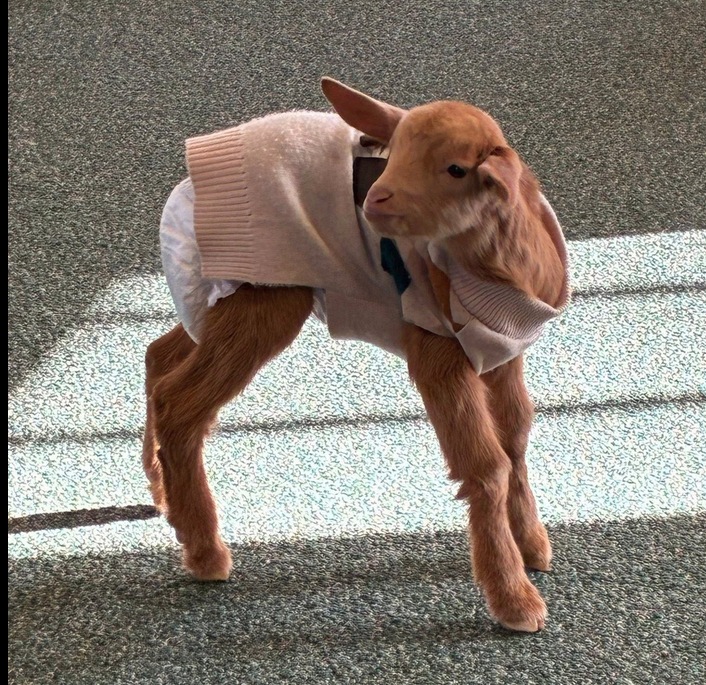
The baby goat!!!! 😍😍😍 The days that animals came in the library {not the smuggled in kind} were always great days. They’ve even had a therapy horse visit, but of course that had to happen after I left, lol
Stay warm! Winter feels like it finally discovered what all the fuss about “the South” is and decided to stay. Brr!!
The “feels like” temp is 8 F / -13 C today, but the worst should be over (for now) by Tuesday morning.
We have lots of animal visits during the summer — petting zoos, reptile shows, etc. This was more impromptu. Unfortunately, one of our teenage employees soon discovered she had a goat allergy!
Our feels like has been 4 or below all day and we’ve got INCHES of snow – and it’s still falling 🥶 tonight is going to be brutal, but if we can make it to Monday it might level out some? 🤞
Yeah, summer reading was a big time for weird animals to visit 🙂 Oh no to the goat allergy!
I would have also pulled the plug, too (on anything that presented GW as foul mouthed). How short-sighted.
So when you say Dreher is writing a book via Substack, does that mean he will be posting installments of his “book,” like they did in magazines long ago? Just trying to understand. Sounds like another important topic. I read Live Not By Lies a long time ago, but it is something one should reread.
BTW, we’re getting that cold front right now (Saturday) and it will be here until Monday. Twenty-four degrees! 😦 I’m definitely looking forward to it being 1000 degrees again.
His substack is called “Rod Dreher’s Diary”, so it’s more casual than most substacks. He writes about what he’s reading and thinking about, and while he was working on LIVING IN WONDER, this resulted in his readers basically getting to witness the writing process from soup to nuts. He’d talk about the books he was reading for the project, he’d talk about how he was going to such and such a place to interview some people, and share a bit of the jist of the interview, and he’d leak stories he was going to share in the book. At the end of it, his (paying) members got to vote on which book cover we liked best. With this one, it’s happening again — from the brainstorming for a new book (he mentioned 3 different ideas before deciding on this one, to now the reading.
I cannot say I am looking forward to it being hot again, but I WILL admit to wanting to turn my water faucets off!!
TOTALLY off topic….. We spoke a long while ago about why the Royal Navy spent so much time & effort to defeat Bismarck… I’m watching a VERY detailed YouTube vid about it and thought you’d appreciate it. Its long (about an hour) but both informative and entertaining.
Bismarck was a Mid Battleship
Cool find! Thanks!
Oh my goodness gracious a baby goat! And you got to hold it? That’s the best and how cute!! The Library is full of unexpected adventures!
I’m glad you got to watch The Importance of Being Earnest, I’ve never read it not watched it but I have been curious about it and it sounds really funny.
!! Do you keep a commonplace book? I have been debating whether I should start to, I find the idea really appealing except for the fact that whenever I try to start any kind of journaling I never seem to be able to keep it up for long 😅.
I really like that quote from the Slopification of Literature, it feels so relevant.
I’ve watched Earnest two times — once at Alabama Shakespeare Festival, the other at community theater. This time was just a listen, but since I’d seen it twice I could imagine everything anyway. 😀
Yes and no — I used to write down any interesting quotes (from books, lectures, etc) in my journal, but I lost one when I was moving back from college and it so demoralized me I lost my journaling habit. However, this blog has been collecting book quotes for a long time. I started to start collecting non-book quotes, too, since I listen to a lot of podcasts, lectures, and so on.
Amazing reading history program!
https://wordsandpeace.com/2026/02/01/2026-january-wrap-up/