
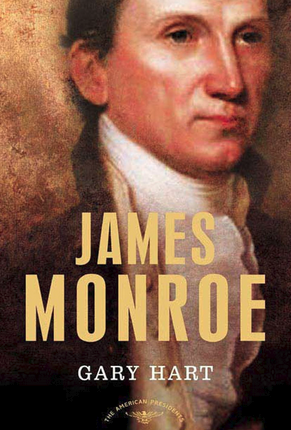
What do I know of Jimmy Monroe? I retain from Founding Rivals some notion of Monroe as a fundamentally military man, in opposition to his strictly-political allies like Jefferson and Madison, and that he was the last of the “Virginia Dynasty”. As it turns out, while Monroe did not theorize about politics as much as his more literary predecessors, he was quite good at practicing it. An early biographer argued that Monroe was unique among the founding generation in that he did not have a ‘retiring’ idea of America; he saw navigating European relations a vital part of creating a future for the fledgling nation. Managing both the departments of State and War during the War of 1812 made that grimly clear. Navigating relations could take different forms, of course — working with his Sec. State John Quincy Adams to propagate the Monroe Doctrine, which declared the Americas off-limits to future colonization — as well as navigating Russian claims along the West Coast, and figuring out how to respond to the burst of Bolivarian republics as South America began driving the dons out. Given how acrimonious relation had been between the Federalists and Republicans, Monroe’s ability to work with men like Adams and Jackson is a pleasure to witness. Monroe and Adams were rivals, but accomplished collaborators — prompted by Monroe’s realism and Adams’ inherited sense of duty and responsibility. Monroe strikes me in this book as an independent actor: despite being a soldier devoted to his commander in chief, Monroe was not afraid to push back against some of Washington’s policies, and he exchanged letters with Jefferson, another mentor, arguing about foreign policy. After leaving office, Monroe was greeted with tragedies — the deaths of his wife and son-in-law — and died in near poverty some five years after Thomas Jefferson — but, like Jefferson and Adams, on July 4th. All told, this is a very compact but readable and fair guide to Monroe’s presidency, and it has some fun surprises like Jackson seizing Pensacola just because he could, and Monroe having to break up a duel between two men whose spat began with the apparent quoting of Shakespeare.
Quotes
Though an ardent revolutionary, Paine had complained to the Directory against the execution of the French king and had been incarcerated in the Luxembourg prison for his troubles. Monroe secured his release and gave him lodgings on the condition that Paine refrain from pamphleteering against U.S. policy. Paine returned Monroe’s hospitality by promptly using confidential conversations with Monroe as grist for his anti- Washington mill.
The story is told of a ministerial dinner at which the British minister Sir Charles Vaughan saw the French minister Count de Serurier, directly across from him, bite his thumb every time Vaughan made a remark. “Do you bite your thumb at me, Sir?” Vaughan finally challenged.
“I do,” was the Frenchman’s reply. They promptly withdrew and were at sword points in an adjoining hall when President Monroe arrived and threw up their swords with his own. Their carriages were called, and Monroe sent them, separately, away.John C. Calhoun perhaps best described the workings of Monroe’s mind: “Tho’ not brilliant, few men were his equal in wisdom, firmness and devotion to his country. He had a wonderful intellectual patience, and could above all men, that I ever knew, when called on to decide an important point, hold the subject immovably fixed under his attention, until he had mastered it in all of its relations. It was mainly to this admirable quality that he owed his highly accurate judgment. I have known many much more rapid in reaching a conclusion, but few with a certainty so unerring.”
I’m trying to figure out if thumb-biting was legitimately offensive, or if these guys just took Romeo and Juliet very seriously. For those who don’t get the reference:
ABRAHAM: Do you bite your thumb at us, sir?
SAMPSON: I do bite my thumb, sir.
ABRAHAM: Do you bite your thumb at us, sir?
SAMPSON: [Aside to GREGORY] Is the law of our side, if I say ay?
GREGORY: No.
SAMPSON: No, sir, I do not bite my thumb at you, sir, but I bite my thumb, sir.
GREGORY: Do you quarrel, sir?
ABRAHAM: Quarrel sir! no, sir.
SAMPSON: If you do, sir, I am for you: I serve as good a man as you.
ABRAHAM: No better!

 Reading Freely
I like learning about American history and this sounds good. So does the Lincoln book you reviewed.