
Bashir: “In time of war, the law falls silent.” Cicero. So, is that what we have become – a [new] Rome, driven by nothing other than the certainty that CAESAR CAN DO NO WRONG?
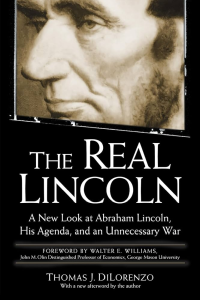
Jon Meacham’s And There Was Light was a fairly flattering biography of Lincoln, seeing him as a visionary who checked his hatred of slavery only for politics’ sake, and who was finally allowed to lean in to and even weaponize it during the Civil War. The Real Lincoln takes a far more critical approach, firing two barrels: the first shot argues that Lincoln was far more interested in saving and consolidating the Union than he was bothering with slavery; the second argues that Lincoln committed gross abuses of power in service to said saving and consolidation. Cleverly, DiLorenzo draws on sympathetic sources to feed his charge of Lincolnian tyranny — putting men who argued that Lincoln was a benevolent tyrant on the stand, rather than Southern critics who could be unthinkingly dismissed. While I have absorbed knowledge of Lincoln’s wartime abuses over the years, I was intrigued by the prospect of Misesian criticism of Lincoln’s economic opinions. Though at times this book functions purely as a hit piece, with no quarter given, the economic angle remains novel enough — and the abuses of civil liberties remain serious enough — to warrant serious consideration. I’ll confess my interest in this book was ignited somewhat by learning of Lincoln’s treatment of Clement Vallandigham, who was exiled to Canada for daring to attack ol’ honest Abe, while studying the life of President Pierce.
Key to understanding The Real Lincoln as more than a catalog of “Lincoln behaving badly” factoids is DiLorenzo’s emphasis on the” American System”. Championed by Henry Clay—Lincoln’s lifelong political idol—this program combined a national bank to manage the money supply, heavy spending on internal improvements, and high protective tariffs intended to foster domestic industry. Lincoln embraced this agenda early, declaring himself for Clay’s system even before he had been admitted to the bar. DiLorenzo argues that Lincoln’s devotion to the American System helps explain both his economic views and his willingness to concentrate power at the federal level. The aims of the system were not difficult to sympathize with: canals and railroads promised progress, and a young nation sought economic independence from Britain. But as later experiments with protectionism and import substitution would demonstrate, such policies often carry severe trade-offs. An economic program can be reasonable in its goals while proving deeply destructive—or inhumane—in its consequences, a tension DiLorenzo sees at the heart of Lincoln’s political legacy. DiLorenzo argues that the American System proved dysfunctional from the start: numerous northern states who tried kindred policies found themselves grappling so much corruption that they adopted amendments to bar the state government from monkeying around with improvements and state-controlled banks. One of Lincoln’s chief critics, Clement Vallandingham, attacked not only Lincoln’s civil liberties abuses, but the ‘great emancipator’s’ consolidationist, Clay-driven economic policies — policies that passed a Congress largely empty of critics, either because those dissident voices had seceded or were in prison, in the case of New York and Maryland. These included the National Banking Acts and increased tariffs that would shelter northern industry for decades after the war. These economic policies marched along with the bullet and bayonet in service to make these United States into one dominion controlled by DC.
And now, the spice. War is the health of the state; its mothers milk, its sweet succor. Nothing expands the state like war: if we applied Stephen Jay Gould’s punctuated equilibrium theory of evolution to the evolution of the state war is most certainly those ‘punctuation’ marks where suddenly a great deal of change happens all at once — and contra to the hopes of the people and the claims of the politicians, power once seized is rarely laid down. At best, some of it returns — but the government has still grown, and its appetite remembers the feasts-days of war’s horrors. Much of the book is given over to documenting the long train of abuses Lincoln committed in the name of ‘saving’ the Union — of dismantling those freedoms that the young were dying en masse to protect, if I may borrow from Dr. Bashir. Where do we begin? The arrest of legislators in Maryland to ensure they do not vote the wrong way? The mass imprisonment of those who dared to criticize Lincoln or the war. The attacks on New York newspapers that did not follow the Lincolonian line, outright closing them down? These are not criticisms raised by that dreaded spectre, the ‘neo-Confederate’: they were raised by men at the time, including President Franklin Pierce and men like Clement Vallandigham, a man accused of treason and exiled to Canada. DiLorenzo finds and corrals so many crimes committed by Lincoln or in his name that it is easy to think his statue in DC ought to included him gripping a fasces and feature depictions of the vanquished bowing at his feet, as in Rome. This is a hard section to evaluate, to be honest: I would counter DiLorenzo and say that the Constitution does allow for the suspension of habeas corpus in times of rebellion and insurrection — but DiLorenzo fires back, arguing that the Supreme Court ruled during the war that such suspension is not the president’s to conduct: only Congress could. (Congress did, after the fact.) There is a great deal, though, that cannot be explained — and Lincoln’s ‘iconic’ status means it will never really be addressed, only ignored. The Civil War, DiLorenzo writes, was the final triumph of Hamilton over Jefferson — of the Union over the Nation, of the State over the people.
Can a reader give this a fair appraisal? My basic preference for decentralization and libertarianism is thirteen years old at least, and my distrust for the centralizing preferences of Hamilton, Whiggery, and Lincoln is reflexive. All the same, I think the argument suffers for its sheer zeal: DiLorenzo throws charge upon charge upon Lincoln, does not admit the defense into the well, and uses the war crimes of others to attack Lincoln on the basis that as commander in chief, their behavior was his responsibility. I doubt that most admirers of Lincoln would have their minds changed by this: they will come away sputtering, “But — but — but!”. I can understand that viewpoint: I once used to argue with someone more libertarian than I, who saw in Lincoln nothing but a devil: I could at least understand that Lincoln, voted as president of the Union, could not countenance allowing it to fall apart while he was steward. That does not mean I condone what he did in that effort: I was and remain a deep critic of Lincoln, even if I find much to admire about him. I am the same way about other figures, like Napoleon. And I yet I come away from this book more sure in my own conviction that the postwar Union was as different from the prewar Union as the prewar Union was from the Articles of Confederation. A new thing had been created, and it was a thing that would, only within a few decades, become first a world empire and then a world superpower. That road, I think, begins with Lincoln’s creation of a new union as he tried to ‘rescue ‘from the fires of war the old.
Vallandigham’s “crime” was making a speech in response to Lincoln’s State of the Union Address in which he criticized the president for his unconstitutional usurpation of power. For this he was declared a “traitor” by Lincoln and imprisoned without trial. The Democrats in Ohio (a loyal Union state and home to Generals Grant and Sherman) were so outraged that they nominated Vallandigham for the office of governor even though he had been deported.
LINCOLN PURSUED the peculiar policy that it was necessary to destroy constitutional liberties in order to preserve the Constitution, redefining “the Constitution” to mean “the Union,” which is not at all what the founders intended.
I hope readers will forgive me the Deep Space Nine at the beginning of this post. I’m fairly certain that episode was when DS9 started making me think critically about politics: it was the reason that when the War on Terror began, I became a civil libertarian, and then later a regular cranky (and sometimes uncivil) libertarian. The scene for your consideration:

 Reading Freely
♪Will the Real Mister Lincoln♪
♪please stand up, please stand up?
repeat ad nauseum 😉
So that’s why Booth got mad at him in the theater!
Mystery solved!
Pingback: January 2026 in Review | Reading Freely