
Pouring from his narrow chest, More than Greek or Roman sense, Boundless tides of eloquence.
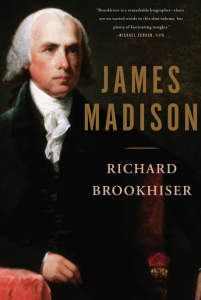
Interestingly enough, it was James Madison who prompted my interest in reading presidential biographies. Early in the blog’s history, I happened upon Founding Rivals, a history of the dynamic between Madison and Monroe: both were members of the Revolutionary generation, both were Virginias who later became president, but they were often rivals. I’ve since read one other book on Madison, but it was closely focused on his connection to the creation of the Constitution; this is the first proper biography I have tried of him. I found it a readable if sometimes overly casual review of Madison’s political life, if not the man himself.
Brookhiser’s account skips past Madison’s upbringing, though we find this modest planter quickly found himself running in the best of circles through his intelligence and obsessive work ethic. Not even a fifth of the way into the biography, we find Madison already in the role we expect to find him — the politician, serving Virginia in various capacities from the Governor’s Council to the Philadelphia Convention that created the Constitution. Madison formed close friendships with Washington, Jefferson, and Hamilton — though he and Hamilton would fall out over Madison’s opposition to the big-government policies adopted by the Federalists. (Brookhiser refers to Madison’s criticism of Hamilton as ‘nuts’, which brought out my John Adams glare of disdain. Call me a snob, but I dislike that sort of informality in a history book.) Brookhiser names Madison as the creator of America’s first political party, the Republicans — sometimes called the Democratic-Republicans to differentiate them from the modern party that was created in the mid-19th century. In their opposition to consolidated government, these Republicans were not unlike Jacksonian Democrats. I have to admire Madison as a man of principle: in the Federalist papers he and Hamilton argued in theory that there need be no fear of the state becoming overmighty, but when the Constitution went into effect Madison took the evidence before his own eyes seriously and struck back against it. He was author of the Virginia Resolution, with along with Jefferson’s Kentucky Resolution argued that the States were the ultimate arbiters of constitutionality. This was written in response to the Alien and Sedition acts of the Adams administration; when president himself, Madison exercised the power of the veto to strike down bills he regarded as unconstitutional. Probably the most memorable part of his presidency is the eruption of the War of 1812, which Brookhiser argues Madison planned poorly for. After leaving office to another Virginian, Monroe, Madison stayed up with politics, sharing opinions with his peers and eventually outliving all of the other founding generation.
This was a fair read; Brookhiser is an accessible author, but as mentioned the focus is entirely on Madison’s political life — as founder, framer, party organizer, public servant — with comparatively little about the man himself. Potential readers may take that as they will: I found it a useful review of the Founding generation’s attempts at working out govenment.
Quotations
Heroes can aspire to perfection, especially if they die young, through the purity of an action, or a stance. But the long haul of politics takes at least some of the shine off almost everyone.
We pay much less attention to James Madison, Father of Politics, than to James Madison, Father of the Constitution. That is because politics embarrasses us. Politics is the spectacle on television and YouTube, the daily perp walk on the Huffington Post and the Drudge Report. Surely our founders and framers left us something better, more solid, more inspiring than that? They did. But they all knew—and Madison understood better than any of them—that ideals come to life in dozens of political transactions every day. Some of those transactions aren’t pretty. You can understand this and try to work with this knowledge, or you can look away. But ignoring politics will not make it stop. It will simply go on without you—and sooner or later will happen to you.
As Madison read, he wrote down his own thoughts, first by copying thoughts he liked into a commonplace book—“The Talent for insinuating is more useful than that of persuading. The former is often successful, the latter very seldom” (Cardinal de Retz, a seventeenth-century French politician). As he grew older, he wrote essays that digested what he had learned. Writing extended Madison’s bookish discussions—it was a form of talking with himself.

 Reading Freely