
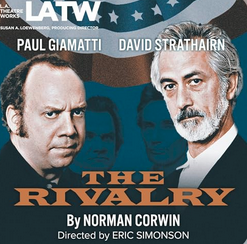
The Rivalry proceeds from an ambitious and fascinating idea for a play. The Lincoln–Douglas debates of 1858 led to Douglas being elected to the Senate, but they also allowed for a sustained public debate over slavery—and gave Lincoln far more name recognition than the Illinois lawyer had previously enjoyed. These debates were long affairs, typically consisting of hours of back-and-forth speeches. It is a testament to the nineteenth-century attention span that debates and lectures of this sort were popular entertainment. (Robert G. Ingersoll, for example, used to deliver lectures three hours long—and spoke to standing-room-only crowds.) The central issue in these debates was popular sovereignty—the doctrine that territories could choose for themselves whether to permit slavery. To Douglas, this was a perfectly sensible approach that made national policy on slavery unnecessary. To Lincoln, it opened the door to slavery’s expansion and relied on the idea that the worth of some people could be decided by the mass opinions of others.
Norman Corwin takes some of the most historically potent moments from these debates and reshapes them into a series of far shorter exchanges between the two men. These are punctuated by brief scenes in which a Republican Party leader announces events, or Lincoln encounters Douglas’s wife, Adele, on a train and they converse. These interludes are not fluff: in Lincoln’s conversation with Adele Douglas, I recognized many of the same historic arguments Lincoln made to the Little Giant himself, though delivered in a much different way — casually, rather than caustically. They also serve to give Lincoln a definite sympathetic advantage, as virtually all of Douglas’ screentime is when he is arguing (and generally on propositions current readers would object to), whereas Lincoln gets to ruminate with Adele and entertain her and the audience with his folksy stories. (Said stories are entertaining, as are his ripostes. It would be interesting to pit Lincoln against Reagan in joke-off.)
Both Paul Giamatti and David Strathairn are superb presences, and Lincoln’s humor is smartly worked in—and well delivered. I enjoyed this very much, though I have been reading about this era for several months now and am a fan of both actors; in fact, I watched films led by each of them shortly before listening to this. As someone who has encountered the debates in books such as 1858 and And There Was Light, I thought Corwin’s adaptation—rendered in a form intelligible to the modern listener—was particularly well done. While the focus remains firmly on the debates themselves, the production includes ambient effects such as cheering crowds, music, and cannon fire. While I imagine this kind of production has a small audience, it’s VERY well done. I must say, I’m loving Los Angeles Theater Works productions, and evidently I’ve enjoyed two of their prior works without realizing they were the source.

 Reading Freely
This sounds really good, and with that cast… gotta be a great performance.
Yes! And it ended on a sweet note, too.
This really does sound like it should be great, both such good actors.
Pingback: January 2026 in Review | Reading Freely