
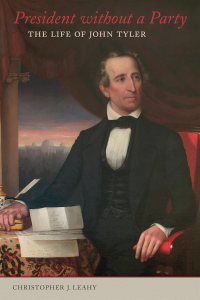
I was instantly intrigued by John Tyler when I learned that his entire Cabinet, with the exception of the Secretary of State, had resigned on him in protest of his actions and that he had been declared excommunicate by his party. Heavens to betsy, what could he have done to merit such opprobrium? (He vetoed his own party’s legislation for being unconstitutional, like some maniac who takes the presidential oath of office seriously.) John Tyler was the nation’s first vice president to assume the responsibilities of president in the wake of the president’s death; largely chosen as a geographic asset, giving the South a reason to support the “Tippecanoe and Tyler, Too” ticket, he set precedents and took such delight in annoying both factions in DC that John Adams might’ve chuckled from his grave. (Mr. Adams’ son, John Quincy, would not like that comparison, but in my reading I have not encountered anything Quincy did like outside of being a moral scold.) President Without a Party is a look at the life of John Tyler, an “Old Republican” who ended his life in a most astonishing way — as a Confederate congressman.
Key to understanding Tyler is that he regarded himself as an “Old Republican” — that is, a Jeffersonian. His father had viewed the Constitution itself with suspicion and malice, seeing it as a worrisome document that destroyed the sovereignty of the states in favor of the national government. John Tyler would grow up with that view, and as a younger Congressmen set his standard against “consolidation” — or the reduction of the States into mere administrative units of the central government. Consolidation’s march has been a continual one from at least McCullough v Maryland, hastening during Lincoln and Wilson’s administrations, but in the early 19th century it was still a threat that could be sighted and fired upon, instead of an overwhelming presence as we have today. Tyler’s resistance to central authority made him sympathetic to the Jacksonian temper: Jackson and his Democrats stood against policies that aggrandized DC, like a national bank and heavy investment made in “internal improvements”. Jackson, however, was not Jacksonian when his own person was concerned: Tyler viewed his authoritarianism and heavy-handedness with contempt, and so found himself drifting into Whig circles.
The Whig party was not one with its own coherent ideology; it was largely a coalition of people opposed to Jacksonianism, but with different motives. They did tend to be more on the side of banks and internal improvements, though, and when Tyler found himself inheriting the responsibilities of the presidency a month into his new job as vice president, he was set against the very people who had effectively put him into office. They expect him to govern for the Whig party; he intended to govern as though he’d won office himself. He boldly assumed that the vice president did not merely inherit the responsibilities of the president: the vice president assumed the office itself, and by taking the oath and moving into the White House Tyler set precedents that all other inheriting veeps down to LBJ have followed. In office, Tyler followed his own policies, not those of Whiggery: after continuing to veto bank bills that he viewed as unconstitutional, Tyler was read out of the Whig party and faced with total Cabinet resignation.
He would soldier on, though, and make the annexation of Texas a key priority. While early advocates for Texas’ admission to the union emphasized its value to the entire country, Tyler’s new secretary of state John C. Calhoun was the paladin of the South and saw it as the Southland’s bulwark. After leaving office — and allowing his more popular successor Polk to finish the work of taking Texas, Tyler retired to a farmhouse he called “Sherwood Forest”, a delightful touch that showed how he leaned into his status as a pariah. It helped, of course, to have the company of a new, young wife: his beloved Letitia had died while he was in office (being yelled at by everyone), but he’d chanced to meet a young woman thirty years his junior who was not only devoted to him, but quite wealthy. It did help that she inherited a fair bit of money from her father who died during a cruise of the USS Princeton that killed several Cabinet members as well. Mr. Tyler did not have a happy time in office — with the exception of his last eight months, where he was joined by a new young wife who kept him busy during his long retirement chasing babies. Tyler’s inability to keep out of politics, though, led to him following Virginia out of the union and (almost) into the Confederate Congress: he died before serving there, and is presumably unique among American presidents in serving a ‘foreign power’ after his tenure in office.
Although this book sometimes got deep into the weeds of policy decisions, its opening and ending thirds are very readable, and I rather liked Tyler by the end of it. Because he had a litter of children from his 2nd wife, nearly thirty years his junior, Tyler had until recent a living grandson: unfortunately, that link to the past died this past May. The Tylers are also unusual in that their family has been able to maintain their historic property: although the Yankees did try to set Sherwood Forest on fire after ending their occupation of it, family servants were able to squelch the flames. This was an unexpectedly fun look at a man who defied party and expectations, preferring the comfort of his conscience to that offered by following his peers — and did so often with a sense of humor. (Possibly my favorite anecdote here is Tyler throwing a big wedding celebration, and as the wine flowed he remarks to a colleague that he could no longer be accused of ‘not having a party’. Ho, ho, ho.)
Readers who grow weary of dead presidents may take comfort in knowing that my next read will probably be on Boston during the American Revolution, or John Grisham’s latest novel.
Quotations
“[Tyler] was an Old Republican who pledged fealty to the states’ rights bible of the Virginia and Kentucky Resolutions, but beyond that it was difficult to pin him down. He became a Jacksonian Democrat but consistently opposed President Jackson. He became a Whig but usually opposed the party’s nationalistic agenda. When he did so in the White House, party members banished him, making him a president without a party. Charges of partisan disloyalty never troubled Tyler. In fact, he seemed to enjoy his reputation as a political renegade.”
“[G]ood and able Men had better govern than be govern’d,” the elder Tyler declared, in a succinct statement of his denition of noblesse oblige. Men of ability should not “withdraw themselves from Society” lest the “venal and ignorant” succeed.
It would be absurd to think he could have done anything else. Custom dictated that he express affection for Letitia rather than passion, because admitting passion meant a man had lost his head, that emotions had overtaken reason, which then called into question his suitability as a husband.
Tyler’s tenure in the House, then, was marked more by what he opposed rather than what he supported. He was not the type of legislator who was willing to do the hard work of crafting a bill and then assemble the coalition needed to secure passage. He was not interested in building consensus, unlike his more rightly celebrated colleague Clay. Tyler was an obstructionist, as all of the Old Republicans were—a member of a principled minority who wore their status as a badge of honor. His constituents sent him to Washington because he agreed with them ideologically and because they knew he would fight tooth and nail against consolidation. It did not even matter if he was destined to lose that war. What mattered was that he gave a voice to the Old Republicans in national politics and defended the people of Virginia—and the South—against unconstitutional encroachments on their liberties.“Let my fate be what it may,” [Tyler] declared, “I have discharged my duty, and I am regardless of the consequences.”
Tyler purchased a farm from his Virginia neighbor Collier Minge for $10,000 called Walnut Grove which he soon renamed Sherwood Forest. Tyler fancied himself a Robin Hood–type figure who enjoyed his outlaw status with the Whig Party.
The proprietor had initially reserved the “President’s House” for them, but an “immensely fat” lady had arrived from New Orleans shortly before they did and insisted that she be allowed to stay there because it was the closest residence to the dining room, declaring that she could not occupy any other and go to her meals unless a railroad were contrived. No tracks having been laid from the cottages to the dining room, the woman was allowed to settle in where she wanted.

 Reading Freely
Pingback: January 2026 in Review | Reading Freely