
Although I ostensibly took a break from the blog on Christmas eve to focus on real life and all that, part of my brain is resolutely blog-oriented and insisted I keep reading so that I did not fail the Science Survey. This is, I should note, my self-imposed challenge, meaning nothing will happen if I fail it — only my own disappointment. I have, for the record, muffed one year, and nothing bad came of it: in fact, I was so annoyed with myself I finished the next year’s survey rather early. I read three science books in the last week, satisfying the Survey, and finished off the history book I’ve been nibbling on for a couple of weeks besides. Are they my last reads for this year? Mm…probably, unless I pick up The Widow (a Christmas gift) and knock it out, but there will be another review coming as I finished Wendell Berry’s latest (a gift from the ladyfriend) on Saturday night. I am also working on a biography of President John Tyler, but it’s a hefty boy so I don’t know that I will finish it before the year’s end. At any rate, I’m presently sitting at a nice round number and am content.
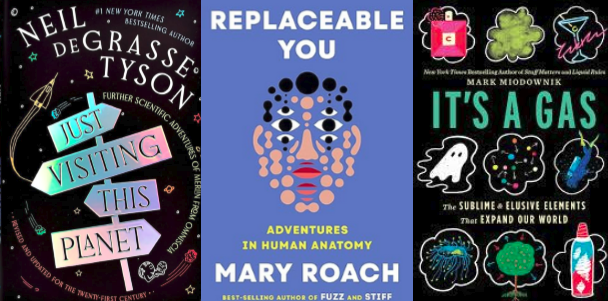
Mary Roach’s Replacable You is a dive into how humans have or are trying to cope with the lost of body parts or body functions; we begin with medieval types replacing noses that got lopped off during saber-drawn hijinks and move quickly into the 21st century. Roach, for those who have not read her, combines science, squickiness, and some level of humor. This is is heavy on the squick, so reader discretion is advised: even her Gut didn’t have so many applications of our intestines. Possibly the most interesting chapter was Roach’s personal experience with using an iron lung — that, or her holding a still-beating heart in her hands.
Neil deGrasse Tyson’s Just Visiting This Planet returns to his “Merlin” character, an ageless and knowledgeable sort from another planet who answers questions from Earthlings via a newspaper column. As the title implies, the focus of Merlin’s answers here is much closer to Earth: the overwhelming majority of questions are about matters of local astronomy. We learn about how the Earth may be viewed from the moon, for instance, and Merlin explains why we don’t feel the rotating earth.
Mark Miodownik’s It’s a Gas! was the most disappointing of this group. It promises to explore several different gases and their role in our lives, but it’s not like some of the several books I’ve read on the elements. Almost none of the gases here are discrete elements, in fact; with the exception of oxygen, Miodownik deals largely with compounds like nitrous oxide and the air itself. Although there’s plenty of science here, there’s a lot of digression as well, from history to politics. Fun fact: Samuel Colt raised funds for the production of his famous revolver by dressing up as a doctor and giving nitrous oxide demonstrations.
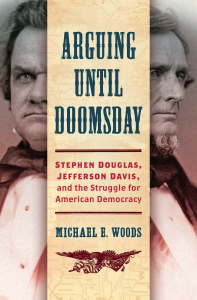
Lastly, and a departure from science, I’ve been reading Arguing Until Doomsday these last few weeks. This is a joint look at the lives of Jefferson Davis and Stephen E. Douglas, and through their political histories, an examination of how the Democratic party fractured through the 1850s and led the way for a purely sectional candidate — Abraham Lincoln — to win the election with only 39% of the popular vote. The book largely focuses on Douglas, which makes sense given how much more of a challenge he had. Jefferson Davis was essentially the heir of John Calhoun in representing southern (or at least, plantation) interests: his goal was to make the Democracy a reliable protector of those interests. While previous generations had been content if the government were not directly adversarial to them, the disruption caused by the Kansas-Nebraska act meant that offense could be the one and only defense. If the government did not actively protect slavery and “property”, the South would be corralled in and its ‘pecuilar institution’ actively attacked by a North increasingly assisted by western states. Douglas had a harder row to hoe, trying to be a candidate who could unite the Democracy against rival parties like the nativist Know-Nothings and the rising Republicans. He sought an answer in popular sovereignty, or majoritarianism, in which the people of a territory made the decision of whether or not their state would be slave or free. This led to not only things like Bleeding Kansas, but changed the way discussions on the transcontinental railroad developed. Jefferson Davis presented a far better argument for a southern route than his colleagues could for a northern route, but there were fears that a southern line would disrupt the advantage northerners had in populating the west coast, or at least make it easier for the ‘slave power’ to extend itself across the rails. Ultimately, the South — seeing abolitionist violence on the rise — would make the decision to break from the Democracy and ultimately, from the Union. This is an extremely detailed account of Davis and Douglas’ grapple for the future of the Democratic party; a little inside baseball at times, but considering my current obsession, it suited my tastes exactly. I am planning on reading Chorus of the Union, Douglas’ postelection attempts to keep the South from leaving the Union, sometime soon.

 Reading Freely