
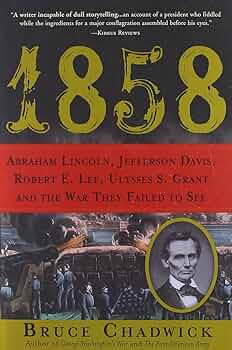
1858 is a history of the second year of James Buchanan’s administration, a year notable less for what Buchanan did than for what he refused to do while the slavery debate burned white-hot. He maintained that slavery was no longer a live issue, having been “settled” by the Dred Scott decision, which declared that neither territorial governments nor Congress could restrict slavery in the West. Married to that conviction, Buchanan turned his attention instead to pining after Cuba, chest-thumping in Paraguay, and quarreling with—and often actively undermining—his own party. Although this book sometimes felt scattered, it has some very strong sections and was wholly diverting even when it appeared off-topic.
Before reading this book, I had assumed Buchanan largely earned his terrible reputation through his paralysis after secession; Chadwick makes clear that this was only one entry in a much longer portfolio of failure. Despite his extensive legislative experience, Buchanan appears to have had little talent for managing people, and by the midterms he had alienated many of those around him. His astonishing December declaration that slavery was no longer a contentious issue only underscores how detached he was from political reality. Buchanan is not the book’s sole focus, however. The rise of Abraham Lincoln receives sustained attention, particularly through the Lincoln–Douglas debates, where Lincoln’s name and political philosophy were established on a national stage. Other pivotal figures appear as well—Lee, Jefferson Davis, William Sherman—but their role in the year’s story feels largely incidental, if often fun in themselves (who would expect the savage Sherman to be an enthusiastic sketcher of birds?).
Although Buchanan claimed to stand on Jeffersonian principles, using them to justify his passivity during the secession crisis, Chadwick argues persuasively that Buchanan was perfectly willing to intervene when it suited him. His response to Paraguay—dispatching a nineteen-ship fleet to demand compensation after an American vessel was fired upon for allegedly trespassing on the Paraná River—was anything but restrained. While Buchanan may have hoped to focus on foreign policy, particularly on acquiring Cuba, the book reveals just how close the country was drifting toward catastrophe and how foolish the president was to turn a blind eye. (Literally, in Buchanan’s case — he had terrible eye trouble.) Kansas was the key: after years of bloody fighting between pro-slavery and anti-slavery factions, the pro-slavery faction attempted to impose a state constitution so radically pro-slavery that even criticizing the institution was a crime. It was so extreme, in fact, that Buchanan’s own pro-slavery territorial governor resigned in protest—and despite Buchanan’s endorsement, the proposed constitution was ultimately rejected by both Congress and the people of Kansas.
This was an eye-opening reading. While the main goal for me was to learn more about Buchanan, I enjoyed meeting the other historical figures and seeing their human side — Sherman’s art, Lee’s desire to leave the Army to tend to his wife’s health, etc — and learning about the Lincoln-Douglas debates and the scope of Buchanan’s failures was tremendously educational. Buchanan’s effective sabotage of his own party was among the most striking revelations of the book. He was not merely ineffective, but actively corrosive, alienating allies, enforcing ideological loyalty, and expending political capital on foreign fixations while the country steamed toward crisis. What continues to baffle me is why a Pennsylvanian with no economic ties to slavery was, throughout his career, one of the vile institution’s most reliable defenders — but that may be the subject of another book. Buchnanan appears to be a man so obsessed with scoring foreign policy wins, especially expanding DC’s influence into Latin America, that he was willing to sweep the obvious domestic crisis under a rug and declare he’d made a clean sweep of it. Can you imagine a president ignoring fundamental domestic issues, alienating allies, and being obsessed with expanding American power in Latin America today?
Coming up next: um, more Buchanan. I’m nearly done with a formal biography of Buchanan (my WWW made me a liar, I assumed I’d be done when I scheduled it a few days ago), and I’m plowing through a joint biography of Buchanan and William Rufus King in a book that examines the role of Congressional “messes” — boardinghouse arrangments that had solons living together in the early days of Washington — had on legislation and alliances.

 Reading Freely
I am really enjoying these reviews! I doubt I’ll ever have the energy to get through this many presidential biographies myself, but I am learning a lot here.
EH Carr in his book What Is History? places an emphasis on the roles which individuals play in history, rather than individuals being unique heroes (or villains). I can see how this shows up in presidential history, with different archetypes coming back throughout the years. Some of these pre-Civil War presidents would fit in a bit *too* well in the 21st century—sweeping things under the rug hoping someone else will handle it later, being cluelessly out of touch with the public and everyday needs, or preoccupying themselves with celebrity lifestyle and “being all things to all people.”
I’m glad someone else is besides me! I’d feared that people are just eying the blog and patiently waiting for this mood to expire. XD Some of these men seem very much like they’d fit in today, and others…not so much. Van Buren was a political animal who would be right at home, but I’m not so sure about Buchanan — it’s as though he had this idealization of himself as the gentleman farmer/lawyer/statesman, but the only one of those he was GOOD at doing was being a lawyer, and he assumed being a statesman would come along with simply making the write speeches and right laws. My sense of Lincoln from 1858 and other books is that he was much more interested in getting to the minds of other people, figuring out what they wanted, and then trying to lead them towards what HE wanted insofar as their and his interests/goals were compatible. Even reading this “Bosom Friends” book is not helping my image of him as someone quite vain and pompous, though he must’ve been entertaining to SOME degree. No shortage of visitors…